Walk through the forests or abandoned villages near the 1,200-kilometer front line in Ukraine today and you will notice something bizarre glistening in the sunlight. It looks exactly like massive, silver spider webs draped over tree branches, tangled in wheat fields, and trailing across shattered rooftops. It isn't silk. It is ultra-thin fiber-optic cable, unspooled by the hundreds of thousands of kilometers by military drones.
Now, the local wildlife is dealing with this high-tech litter in the most practical way possible. Birds are using these glass threads to build their homes. You might also find this related story useful: The Bangkok Bar Fire Tragedies We Keep Failing To Prevent.
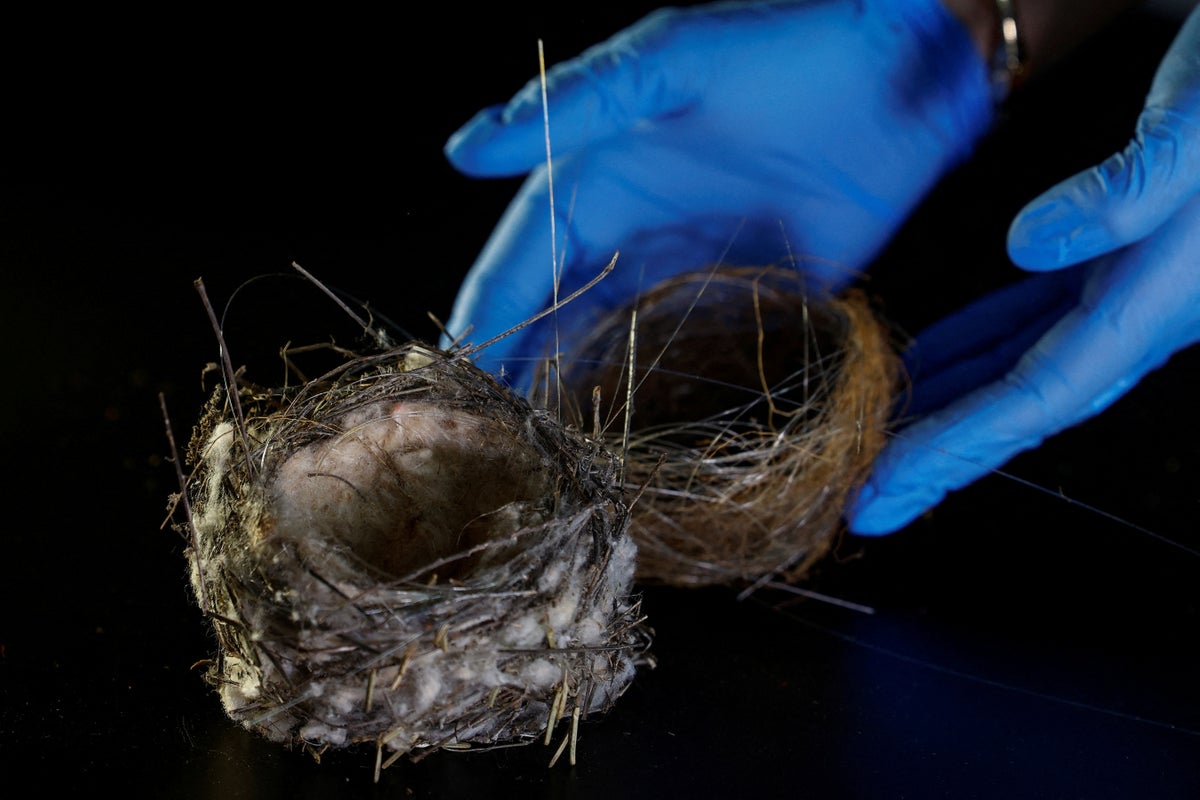
Soldiers fighting in heavily contested areas like Donetsk, Kharkiv, and Zaporizhzhia started finding these strange, synthetic creations and sharing videos online. Two of these nests recently made it to the National Museum of the History of Ukraine in the Second World War in Kyiv. One nest is staying there as a permanent record of how modern conflict alters nature, while the other is heading to the Netherlands so biologists can extract DNA and figure out exactly which species built it.
This development tells us something vital about how modern battlefields alter ecosystems. Warfare has shifted from heavy metal and chemical pollution to an era of autonomous tech that leaves an entirely new kind of trash behind. As extensively documented in latest articles by Wikipedia, the effects are notable.
The Reality of Fiber Optic Drone Warfare
To understand how these nests happened, you have to look at how the air war in Ukraine changed over the last year. Radio-frequency jamming became so intense on both sides that standard wireless signals stopped working reliably. If a pilot can't talk to their drone, the drone crashes uselessly.
To bypass this electronic jamming, engineers went backward to go forward. They turned to physical wires.
Modern first-person view attack drones now carry a spool of micro-thin fiber-optic cable. As the drone flies toward its target, the wire unspools behind it, sometimes stretching for up to 20 kilometers. Because the control signals travel through light pulses inside a physical wire rather than radio waves through the air, electronic warfare systems can't jam them. The pilot gets a crystal-clear video feed right up to the moment of impact.
But once that drone detonates or crashes, that 20-kilometer strand of wire doesn't vanish. It drops straight out of the sky. Multiply that by thousands of drone missions every single week, and you get an environment completely coated in synthetic fibers.
Plastic Glass and Twigs
Yana Hrynko, a senior researcher at the War Museum in Kyiv, spent time closely examining the recovered specimens. The construction is surprisingly tight. One of the nests consists almost entirely of dry grass tightly interwoven with long, glittering loops of the drone wire.
Birds are ultimate opportunists. They look for strength, flexibility, and insulation when gathering building materials. In a war zone where artillery has blasted trees to splinters and scorched local vegetation, traditional nesting materials are hard to come by. The long strands of military wire probably look like the jackpot to a nesting bird. They are incredibly strong, long enough to wrap around a structure multiple times, and light enough to carry through the air.
But this isn't just an interesting quirk of animal behavior. It comes with serious risks.
The Toxic Side of Synthetic Breeding
Biologists are worried. Auke-Florian Hiemstra, a researcher based at the Naturalis Biodiversity Center in the Dutch city of Leiden, specializes in studying how animals use artificial materials in their nests. He has seen birds use plastic wrappers, barbed wire, and cigarette butts, but fiber-optic military cables are entirely new territory.
The impact on avian populations will likely be a mixed bag. On one hand, the artificial threads create a physically stable nest that can withstand high winds or heavy rain far better than simple twigs and mud. It might even help a nest last through multiple winters.
On the other hand, the dangers are immediate. Fiber-optic cables are fundamentally made of glass coated in a thin protective layer of plastic. When these fibers snap or break, they create tiny, sharp splinters. Techs who work with commercial fiber optics wear thick gloves because those glass shards can easily pierce human skin. For a featherless, fragile bird chick sitting in a nest, those sharp edges can cause severe physical trauma.
There is also the constant threat of entanglement. If a chick gets its leg caught in a loop of high-tensile military wire, it cannot break free. As the bird grows, the wire cuts off circulation, leading to amputation or death. Parents can also get tangled while trying to feed their young, trapping them at the nest site.
Tracking the Hidden Builders
Right now, scientists don't actually know which species are building these techno-nests. The frontline environment is far too dangerous for regular field ornithology studies. You can't exactly sit with binoculars and a notebook in an active artillery zone to watch which bird flies into a bush.
That is where the Dutch research comes into play. Hiemstra and his team plan to use forensic extraction techniques on the nest sent to the Netherlands. When birds build a nest, they inevitably leave behind tiny biological clues. Feathers lose micro-fragments, skin sheds dander, and saliva stays behind on the twigs and wires they pull together with their beaks.
By running DNA analysis on these microscopic traces, the team can identify the specific species adapting to the drone trash. Ukraine boasts an incredibly diverse bird population, ranging from common house sparrows and storks to rare birds of prey. Finding out who built these nests will help scientists predict how different species will survive the long-term changes to their habitat.
Long Term Environmental Trashing
We usually measure the cost of war in human lives, destroyed cities, and economic wreckage. Those are the immediate, painful realities. But the ecological footprint of this specific conflict will linger for decades after the guns go silent.
These micro-thin wires represent a major microplastic and glass pollution event sprawling across hundreds of thousands of hectares of fertile farmland and protected forests. The plastic coatings on these cables will slowly degrade under the intense summer sun and winter frosts, breaking down into microplastics that enter the soil, water systems, and local food chains. Small mammals will eat them, larger predators will eat those mammals, and the material will bioaccumulate.
It shows that clean up efforts after a modern war can't just focus on unexploded landmines and artillery shells. Removing millions of kilometers of micro-thin plastic-coated glass thread tangled in the canopy of Ukrainian forests will be an almost impossible task.
Next Steps for Conservation and Tracking
If you are tracking the intersection of technology and wildlife conservation, there are a few concrete things you can do to follow this developing situation.
Keep an eye on the published research coming out of the Naturalis Biodiversity Center over the next few months. Once the DNA testing concludes, the team will release data showing which specific avian families are most at risk from drone debris.
Support organizations like the Ukrainian Nature Conservation Group. They are working under highly volatile conditions to document habitat destruction, forest fires caused by shelling, and the long-term chemical contamination of Ukraine's soil and water. Understanding the data they collect is the first step toward building a realistic environmental recovery plan when this conflict finally ends.