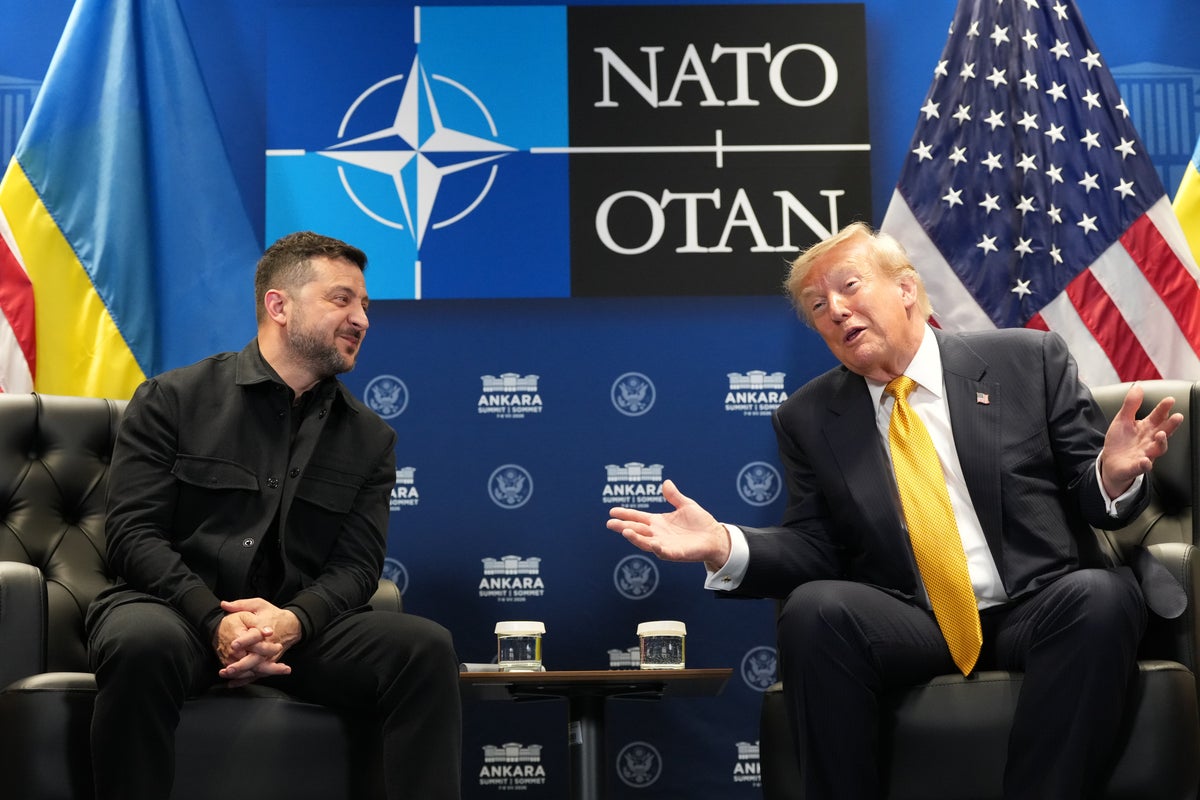
Donald Trump just tossed a massive wildcard into the Ukraine war. Standing next to Ukrainian President Volodymyr Zelensky at the NATO summit in Ankara, Turkey, Trump dropped a bombshell announcement. The United States will grant Kyiv a license to manufacture its own Patriot missile interceptors.
"We’re going to give a license to you to make Patriots," Trump said. "This way, you can't complain that we're not giving 'em enough."
On the surface, it sounds like a massive victory for Ukraine. Kyiv has been begging for more Patriot systems for years. They are the only weapons in Ukraine’s arsenal capable of swatting down Russia’s devastating ballistic missiles. But if you look past the headlines, this move is less about immediate battlefield relief and more about a calculated shift in American foreign policy. It is a classic Trump move, combining a massive headline with a heavy dose of "figure it out yourself."
The Reality Behind the Patriot Deal
Let's look at the numbers. The U.S. is facing its own critical supply crunch. Washington burned through more than half of its own Patriot stockpile during conflicts in the Middle East earlier this year, according to data from the Center for Strategic and International Studies (CSIS). Trump didn't hide this reality. He openly admitted that the U.S. simply does not have enough batteries to keep shipping them away.
"We have Patriots, but we don't have that many," Trump remarked. "We need them for ourselves, too."
By shifting the burden of production onto Ukraine, the White House gets to look supportive while capping direct American supply commitments. It stops the constant drainage of Pentagon stockpiles.
But building a Patriot missile is not like setting up a drone assembly line. These are among the most complex, tightly guarded pieces of military technology on earth. A single Patriot battery costs around $1 billion. Global production is notoriously slow, lagging at roughly 600 missiles per year worldwide.
Trump casually brushed off these logistical nightmares. He noted that defense giants Lockheed Martin and RTX Corporation hadn't even been informed of the decision before he announced it. "I'm sure they will be thrilled," he joked, asserting that the U.S. government holds great leverage over these companies.
What Most People Get Wrong About This Tech Transfer
The big question hanging over Ankara is where these missiles will actually be built. Trump suggested bringing American defense companies directly to Ukraine to explain the process.
Experts are deeply skeptical about setting up high-tech aerospace manufacturing inside a war zone. Russia has spent weeks pounding Ukrainian infrastructure. Just hours before the announcement, Moscow launched another ballistic missile wave at Kyiv. Ukraine's air defenses intercepted 139 drones but missed all five ballistic missiles due to an acute shortage of interceptors.
Setting up a factory for complex weapons under a rain of Russian missiles is incredibly risky. If American engineers land on the ground, they become instant targets. If the technology is captured, Moscow gets a look at the crown jewels of Western air defense.
Because of this, the actual manufacturing will likely have to take place in neighboring NATO countries like Poland or Romania, funded by Western capital but operated under a Ukrainian license.
Moscow Recalculates the Threat
The reaction from the Kremlin was swift and bitter. Russian Foreign Minister Sergey Lavrov warned that Washington is abandoning any pretense of acting as an honest broker in the conflict.
This policy pivot comes at a tense moment. Kremlin spokesperson Dmitry Peskov recently discarded the long-held phrase "special military operation," officially labeling the conflict a "real war" due to Western intervention.
The licensing deal disrupts Moscow’s long-term strategy. Russia knows it can't match Western industrial capacity over a ten-year horizon, but it was betting on political fatigue in Washington to cut off Ukraine's supply lines. By outsourcing the production rights, the U.S. is signaling that Ukraine's defensive capacity won't simply vanish after the next congressional budget debate.
The New Dynamic Between Trump and Zelensky
The optics in Ankara mark a sharp departure from the bitter public feuds that previously defined the relationship between Trump and Zelensky. The two leaders appeared strikingly aligned, with Trump praising Zelensky’s efficiency and stating they have developed a good relationship.
"We've settled a lot of wars, and this one is the one that I thought maybe would be the easiest, but Putin is a difficult character, and this guy's a difficult character."
— Donald Trump
Trump also hinted at a reverse trade, stating the U.S. is looking to buy Ukrainian-manufactured combat drones. Kyiv has excelled at mass-producing cheap, effective loitering munitions. A deal like that would turn a dependent relationship into a two-way defense partnership.
What Happens Next
If you are tracking the strategic trajectory of this conflict, look for these immediate operational developments:
- Watch the Defense Contractors: Keep a close eye on statements from Lockheed Martin and RTX Corporation. The real timeline for this deal depends on how fast these companies can iron out joint-venture legalities with Ukrainian state defense firms.
- Identify the Manufacturing Site: Watch for announcements regarding production facilities in Eastern Europe. Look at Poland or Slovakia as the likely physical hosts for any new production lines.
- Monitor the Immediate Supply Transfer: Trump promised that "some" interceptors would be sent immediately to bridge the gap while production plans are drawn up. Track whether these missiles come from U.S. active stockpiles or European allies.