If you send a harsh email to a government official, you might expect an automated response or complete silence. You don't expect two federal agents to show up at your house months later while you are traveling out of the country. That is exactly what happened to David Streever, a resident of Rochester, New York. His experience shows a scary shift in how federal law enforcement handles online dissent.
The line between a credible threat and angry political speech is shrinking fast. When the state uses its police power to track down citizens for writing angry letters, it isn't just investigating crimes. It is actively chilling the right to complain about the government. This trend goes way beyond one angry email. It signals a systematic effort by the Trump administration to monitor, flag, and confront regular people who voice opposition to immigration enforcement.
Understanding what happened to Streever requires looking at the specific events that triggered his email, the legal boundaries of the First Amendment, and the practical realities of dealing with federal overreach.
The Email That Brought Federal Agents to Rochester
In January 2026, an immigration officer named Jonathan Ross fatally shot a protester named Renee Good during an anti-ICE demonstration in Minneapolis. The shooting sparked widespread outrage and massive street protests across several cities. Like thousands of other Americans, Streever watched the videos of the incident online and felt deeply angry. He wanted to do something, even if it was just sending a piece of his mind to the person in charge.
Streever sent an email to Todd Lyons, who was serving as the acting director of U.S. Immigration and Customs Enforcement. The message did not mince words. Streever called Lyons a "monstrous human being" and wrote that he "will never know peace." He wrote that the way Lyons protected the officer in Minnesota would lead to his downfall, adding that even the president would turn on him before the end, leaving him a despised man eating himself alive with shame.
The email contained harsh, hyperbolic language, but it contained zero expressions of an intent to commit violence. It did not threaten physical harm, mention weapons, or suggest a plan to track Lyons down. It was a classic example of political vitriol directed at a public figure.
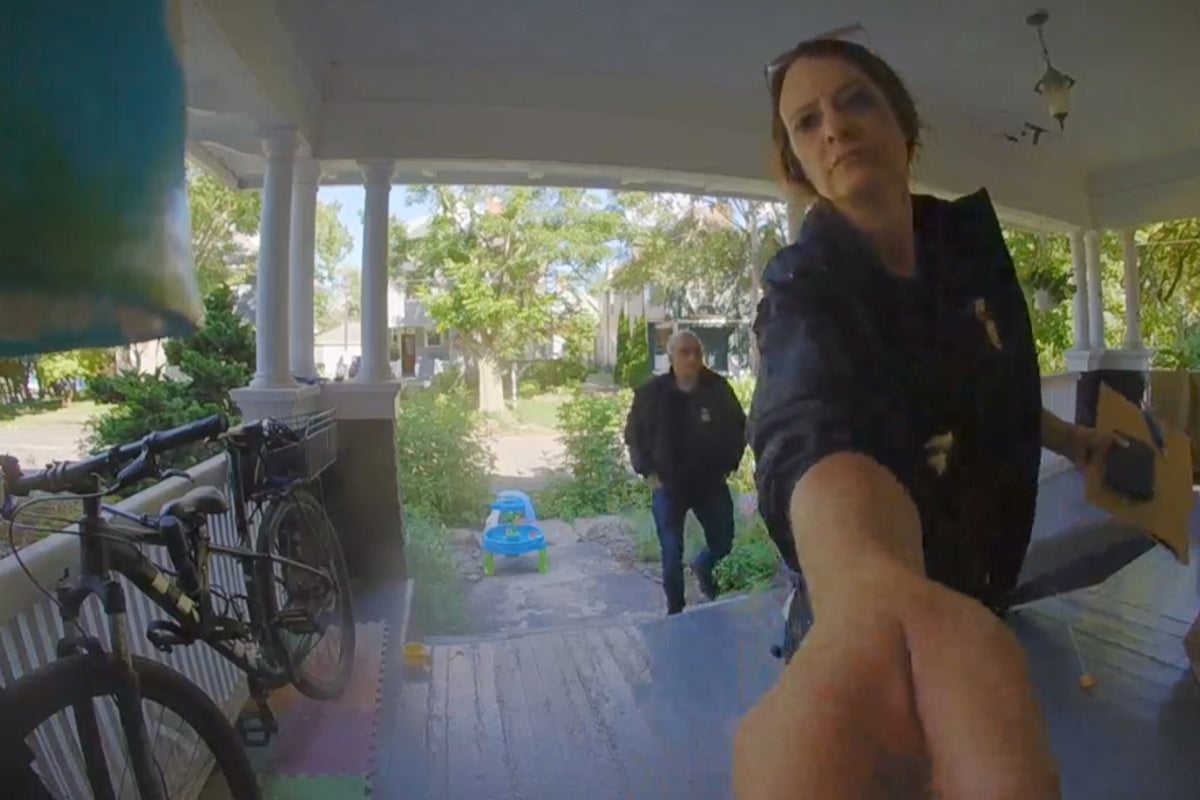
Five months passed. Streever went on a trip to Finland with his family. While he was away, two federal agents in blue jackets walked onto his porch in Rochester. They knocked on the door and handed his wife a formal paper labeled "WARNING NOTICE." The document stated that Streever might be in violation of federal law regarding threats against federal officials.
The tracking did not stop at his front door. When Streever flew back to the United States and checked into a hotel in New York City, federal agents showed up there too. They tried to get his room number to confront him in person. Hotel staff refused to cooperate and turned the agents away.
Think about the resources required for this operation. Multiple agents were deployed across different cities to track a man over a single email that had been sitting in an inbox for nearly half a year. That level of surveillance requires coordination and intent. It shows that federal agencies are actively keeping tabs on the movements of people who criticize their leadership.
A Pattern of Knocking on Doors in New York
Streever was not an isolated case. During the exact same week that agents left the warning at his home, another federal confrontation took place a few hours away in Syracuse.
Paigelynne Gonyea, a local poll worker, was working at a voting location during New York’s primary elections. Two federal officers walked directly into the polling site to confront her. Their issue was an Instagram post she had shared about Jonathan Ross, the officer involved in the Minneapolis shooting.
The government claimed Gonyea committed a federal crime by posting the officer's address online. A spokesperson for ICE stated that if people doxx officers, they will be investigated and brought to justice. Gonyea maintains she was merely speaking out against agency violence. The New York Attorney General’s Office has since opened a review into the interaction because federal agents entering an active polling place to interrogate a poll worker raises massive legal red flags.
When you look at these two cases together, a clear strategy emerges. The administration is using the justification of protecting its staff to run a aggressive campaign against online critics. They are treating internet anger as a law enforcement emergency.
Where Protected Speech Ends and True Threats Begin
The legal defense for these actions usually centers on officer safety. ICE has stated publicly that it investigates all credible threats against its employees and leadership. Nobody disputes that actual threats of violence should be checked out. If someone sends a message detailing a plan to harm a worker, law enforcement has a job to do.
The problem lies in how the Supreme Court defines a threat versus how federal agencies are defining it right now. Under long-standing First Amendment law, a "true threat" is a statement where the speaker means to communicate a serious expression of an intent to commit an act of unlawful violence to a particular individual or group.
Political hyperbole does not meet this standard. Saying a politician will "never know peace" or will "eat himself alive with shame" is protected expression. The Foundation for Individual Rights and Expression, the civil liberties group representing Streever, pointed out that his email was an act of petitioning the government for a redress of grievances, a right specifically protected by the Constitution.
When federal agencies redefine angry political rhetoric as a security threat, they bypass the courts entirely. They do not need to prove a crime in front of a judge to send agents to your house. They use the visit itself as the punishment. The goal is simple. They want people to think twice before typing an angry comment or sending a critical letter.
The Infrastructure of Digital Surveillance
This shift in tactics does not happen in a vacuum. It relies on a massive digital surveillance system built up over recent years. ICE and Homeland Security Investigations have signed major contracts with private data analytics firms to monitor public online spaces.
The agency uses platforms like Zignal Labs to scan billions of social media posts every day. They pay millions to companies like Penlink to gather data from the dark web, location databases, and mainstream social media sites. While the official reason for these tools is to track organized crime and human trafficking, recent privacy impact assessments show they are frequently used to flag general anti-ICE statements.
The agency recently claimed it faced an 8,000% increase in death threats. When civil rights groups looked at the evidence provided to back up that claim, they found a handful of vague examples. One post showed someone saying they would record and report officers, an action completely protected by law. Another was a voicemail wishing an officer's kids would get deported by mistake. By taking every angry internet comment and labeling it a threat, the agency builds a false narrative of danger to justify spying on domestic political opponents.
The surveillance has also targeted tech companies. The Electronic Frontier Foundation filed a lawsuit against the Department of Homeland Security over its use of administrative subpoenas to unmask anonymous online critics. The government has been using an obscure 1930 tariff law, meant for determining taxes on imported goods, to force platforms like Google, Meta, Reddit, and Discord to hand over the names, IP addresses, and email addresses of people who post negative things about immigration enforcement.
What to Do If Federal Agents Show Up for Your Speech
If you find yourself in a situation where federal officers are at your door or contacting you about something you said online, you need to understand your rights immediately. Do not panic, and do not let fear cause you to give up your legal protections.
- You do not have to let them inside. Unless agents have a search warrant signed by a judge, they have no right to enter your home. Asking to see a warrant through a window or screen door is your right. An administrative warning notice or an ICE administrative warrant is not a judicial search warrant.
- You have the right to remain silent. You do not have to answer questions about why you wrote a post, what you meant by an email, or what your political beliefs are. Anything you say can be used to build a case against you later, even if you think you are just clarifying a misunderstanding.
- Say clearly that you want a lawyer. The safest response to federal questioning is to state that you are uncomfortable talking without legal representation and that your attorney will contact them.
- Document everything. If agents leave a document, keep it. If you can safely record the interaction on your phone without interfering with their work, do so. Note the badges, names, and agencies of the officers involved.
- Contact civil liberties groups. Organizations like the ACLU and the Foundation for Individual Rights and Expression look for cases where the government is abusing its power to silence speech. They can provide resources and legal help.
The immigration debate is one of the most divisive issues in the country. It involves real human costs, street protests, and intense public anger. When the federal government uses its investigative machinery to hunt down people for writing angry letters, it threatens the basic mechanism of American democracy. Free speech matters most when it is uncomfortable, loud, and angry. If citizens let the state scare them into silence, the right to criticize power disappears entirely.