When a political protest turns fatal on an American street corner, the legal system faces an impossible task. It has to balance the raw emotion of a grieving community against the rigid definitions of criminal law. On June 30, 2026, Ventura County Superior Court tried to close the book on one of the most polarizing local tragedies in recent memory. The result satisfied almost nobody.
Loay Abdel Fattah Alnaji, a 53-year-old former computer science professor from Moorpark, stood in a Ventura County courtroom and received his sentence: one year in county jail and two years of felony probation. He had already pleaded guilty in May to felony involuntary manslaughter and felony battery causing serious bodily injury. He also admitted that he personally inflicted great bodily injury, used a weapon, and that his victim was particularly vulnerable.
That victim was Paul Kessler, a 69-year-old retired medical sales representative and amateur pilot who loved his family, walked his neighborhood, and cared deeply about Israel. In November 2023, Kessler died after Alnaji struck him in the head with a megaphone during dueling political rallies at an intersection in Thousand Oaks.
The sentence feels like a slap on the wrist to Kessler’s family and local advocacy groups. To the prosecution, it was a failure to secure true accountability. To understand how a man walked away with a single year in county jail for an action that ended a human life, you have to look past the headlines and examine the chaotic reality of that November afternoon, the legal limitations of manslaughter, and the compromise of a pre-trial plea deal.
The Fatal Interaction at a Thousand Oaks Street Corner
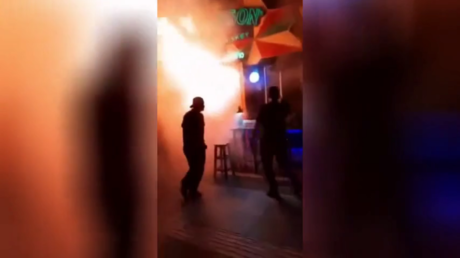
The intersection of Thousand Oaks Boulevard and Westlake Boulevard is usually a standard suburban crossroads. On November 5, 2023, it became a flashpoint. It was less than a month after the October 7 attacks, and emotions across the country were running exceptionally high. Two opposing groups had gathered at the location: "Freedom for Palestine" and "We are Pro-Israel".
Between 75 and 100 people were gathered on the sidewalks. For most of the afternoon, the demonstration followed a familiar pattern of shouting, sign-waving, and chanting. Police patrolling the area checked in about fifteen minutes before the fatal encounter and saw no signs of physical violence.
Then the situation fractured. Kessler, carrying an Israeli flag, ended up in close proximity to Alnaji, who was using a megaphone to lead pro-Palestinian chants. What happened in the next few seconds became the core of a multi-year legal battle.
According to prosecutors, Alnaji escalated a shouting match into a physical assault, swinging his heavy megaphone and hitting Kessler squarely in the head. The blow sent the 69-year-old backward. He fell hard, striking the back of his skull against the concrete pavement.
Alnaji didn't flee the scene. He stayed, dialed 911, and waited for emergency responders to arrive. When deputies got to the corner around 3:20 PM, they found Kessler on the ground, bleeding from his head and mouth but still conscious and capable of speaking. Paramedics rushed Kessler to a nearby hospital. He spoke with law enforcement officers from his hospital bed, but his condition deteriorated rapidly overnight. Early the next morning, November 6, Kessler died from his injuries.
The Ventura County Medical Examiner ruled the death a homicide, citing blunt-force head injuries. The autopsy revealed skull fractures, internal brain swelling, and bruising, along with separate, non-lethal injuries to his face that pointed to a direct blow.
Why the Charges Stopped Short of a Hate Crime
In the immediate aftermath of Kessler's death, public pressure on the Ventura County Sheriff’s Office and District Attorney Erik Nasarenko was immense. Activists demanded first-degree murder charges and hate crime enhancements. Yet, when charges were filed days later, Alnaji was booked for involuntary manslaughter and battery.
The decision infuriated many, but it reflected a cold legal reality. To prove a hate crime or murder in a courtroom, prosecutors need clear evidence of intent or specific bias motivating the act. The evidence from that chaotic street corner simply didn't support it.
Investigators reviewed more than 600 pieces of evidence. They interviewed more than 60 witnesses who were standing at or near the intersection. They analyzed cell phone videos, surveillance footage from nearby businesses, and traffic camera data. Despite that massive mountain of data, no single piece of media captured a clean, unobstructed view of the exact second the physical contact occurred.
Witness accounts were wildly contradictory. Some people swore they saw a deliberate, aggressive swing of the megaphone. Others claimed it was a defensive reflex. Alnaji’s defense attorney, Ron Bamieh, argued that Kessler had stepped directly into Alnaji's personal space and thrust a cell phone into his face to film him. The defense maintained that Alnaji swatted at the phone to get it away from his face, and the megaphone accidentally made contact with Kessler.
Because of these conflicting stories, prosecutors couldn't prove beyond a reasonable doubt that Alnaji intended to kill Kessler, nor could they prove that the act was driven by antisemitic hatred. Involuntary manslaughter is defined as an unlawful killing that occurs without intent to take a life. It happens when someone acts with criminal negligence or during the commission of a non-felony unlawful act. By charging involuntary manslaughter, the District Attorney focused on what they could actually prove in front of a jury: Alnaji used a weapon recklessly, and that recklessness caused a death.
The physical evidence eventually forced Alnaji’s hand. During a two-day judicial hearing in May 2024, prosecutors brought forward DNA analysis showing that blood and genetic material matching Paul Kessler was found directly on the rim of the megaphone Alnaji was holding. The "accidental fall without contact" narrative was dead. The judge ordered Alnaji to stand trial.
Inside the Controversial Plea Deal
A full jury trial was scheduled to begin in May 2026. If convicted on all counts by a jury, Alnaji faced a maximum of four years in state prison. Just a week before the trial was set to start, the case took a sharp turn.
Ventura County Superior Court Judge Derek Malan offered Alnaji a court-initiated plea deal. Under California law, a judge can indicate a sentence they feel is appropriate if a defendant agrees to plead guilty to all charges without a trial. Alnaji changed his plea from not guilty to guilty on both felony counts. He admitted to the involuntary manslaughter, the battery, and the aggravating factors regarding the weapon and the victim’s age and vulnerability.
The judge’s deal bypassed the maximum prison sentence, capping Alnaji's time behind bars at 365 days in a local county jail, followed by formal probation.
District Attorney Erik Nasarenko and his prosecuting team were furious. They formally objected to the deal in court and continued to fight for state prison time right up until the June 30 sentencing hearing. Nasarenko made his position clear, stating that Alnaji’s violent behavior warranted a real state prison commitment to show the severity of the crime and deter future political violence.
Why did the judge offer this? In cases where a defendant has no prior criminal record, stays at the scene, cooperates with emergency services, and where the death is legally deemed involuntary, local courts frequently lean away from state prison sentences. Defense attorney Ron Bamieh noted that short jail stays coupled with long probation are standard for fatal altercations where the defendant wasn't deemed the initial physical aggressor. With good behavior and standard jail credits, Alnaji will likely serve only about six months of that one-year sentence.
Public Outrage and a Family Left Grieving
The leniency of the sentence reopened the raw wounds of the local community. Jewish leaders and civil rights organizations expressed deep disappointment with the outcome. They worry about the message it sends during a period of intense national polarization.
Joshua Burt, the regional director of the Anti-Defamation League for the Santa Barbara and Tri-Counties region, labeled the plea deal entirely inadequate. He argued that a minor jail sentence fails to act as a real deterrent and leaves vulnerable communities feeling unprotected when political anger boils over into public spaces.
Rabbi Noah Farkas, the chief executive of the Jewish Federation of Greater Los Angeles, took a slightly different stance, acknowledging the pain of the light sentence but finding some solace in the formal admission of guilt. The guilty plea at least removed any doubt that Alnaji’s actions were directly responsible for Kessler's death, stripping away the defense's ability to claim it was a completely blameless accident.
Away from the political arguments and the legal maneuvers sits a family that has been permanently altered. Kessler had been married to his wife for 43 years. He was a fixture in his neighborhood, a man who spent his retirement flying planes and staying active.
In a victim impact statement submitted to the court, Kessler’s widow laid bare the quiet, crushing reality of her day-to-day life. She spoke of the relentless grief and the heavy silence that now fills their home. She noted that no legal outcome could ever replace his voice, his companionship, or the future they had mapped out together.
Next Steps for Public Safety and Community Protests
The Thousand Oaks case provides a stark lesson for anyone participating in public demonstrations or managing community safety. If you find yourself organizing, attending, or monitoring rallies in highly charged climates, specific practical adjustments are necessary to prevent escalation and preserve accountability.
- Enforce physical buffers: Organizers from opposing sides must actively coordinate with local law enforcement to maintain distinct physical separation. Dueling protests should never occupy the exact same sidewalk corner or mixing zone.
- Deploy designated de-escalators: Protest groups need trained, non-vocal peacekeepers whose sole job is to step between agitated individuals and pull them back before verbal spats turn physical.
- Use continuous bodycam logging: Relying on erratic, short cell phone clips leaves too many blind spots for investigators. If you're attending a high-stakes rally, utilize continuous-recording body cameras or chest mounts to establish an unbroken, objective record of your surroundings.
- Rethink megaphones as proximity tools: Heavy aluminum or plastic megaphones are easily categorized as weapons under the law if an altercation occurs. They should be kept back from the front lines of a crowd barrier to avoid accidental or reactive contact.
Loay Alnaji's transition from a college computer science professor to a convicted felon serving time in the Ventura County Jail is complete. He lost his career, faced intense public scrutiny, and received a criminal record that will follow him forever. Yet for the family of Paul Kessler, a one-year jail term will never feel like an equal trade for a life cut short on a suburban sidewalk. The legal case is closed, but the chill it leaves on public discourse remains.