Ninety-six hours under compressed concrete changes a person. Your body shuts down. Thirst becomes an active, burning weapon. The mind plays tricks, turning the shifting creaks of unstable ruins into the footsteps of rescuers who aren't there yet.
When international rescue teams pulled a father and his teenage son from the crushed remains of a building in Caraballeda, the crowd didn't just cheer. They wept. It was a rare moment of raw joy in a week that has otherwise broken Venezuela. Don't miss our recent post on this related article.
The twin earthquakes on June 24, 2026—clashing strike-slip movements registering at magnitudes of 7.2 and 7.5—tore open the ground near the San Sebastián fault system. Within ninety seconds, the disaster shattered cities, left at least 1,450 people dead, and triggered a humanitarian nightmare that is still unfolding.
Finding anyone alive after the critical 72-hour survival window isn't just rare. It's a logistical anomaly. Here is how this survival happened, why the rescue operation succeeded against staggering odds, and what the reality looks like on the ground right now. If you want more about the background here, USA.gov provides an in-depth summary.
The Science of Pulling Life From Concrete
Most people assume surviving an earthquake is purely about luck. It's not. It is about voids.
When a building pancakes—which is exactly what happened to nearly 200 structures in the coastal state of La Guaira—the floors collapse directly onto one another. If a building is made of poorly reinforced concrete, it pulverizes, leaving zero air pockets. But when structural columns break unevenly, they sometimes create a "lean-to" or a small triangular pocket of space.
That's where the father and son were trapped. They weren't crushed; they were entombed.
French and American search-and-rescue teams didn't just stumble upon them. They spent 12 agonizing hours using specialized technical search cameras and sensitive acoustic probes. These teams listen for micro-vibrations—a fingernail scratching against concrete, a faint rhythmic tapping, or a shallow breath.
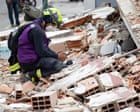
Once located, the extraction process is a masterclass in patience. You don't just pull someone out. The rubble is terrifyingly unstable. Moving one chunk of masonry can trigger a secondary collapse, crushing the victims instantly. Rescuers worked in shifts, meticulously securing the surrounding debris before digging a narrow extraction tunnel.
When they emerged, the son came out first on an improvised fabric stretcher. He was caked in grey dust, his knees bleeding, his right hand tightly bandaged. His father followed shortly after, immediately hooked up to life support equipment.
They were profoundly weak. When you're trapped for four days without water, your kidneys begin to fail as they struggle to process waste. Doctors immediately started a delicate rehydration protocol through IV lines right there in the debris-strewn streets of Caraballeda before the ambulance even shifted into gear.
A Country Broken Long Before the Ground Shook
To understand why the death toll is climbing so fast, you have to look at the structural reality of Venezuela before June 24.
This isn't a story about a natural disaster hitting a perfectly prepared nation. Years of economic hardship meant building codes weren't strictly enforced. Cheap materials, unauthorized floor additions, and lack of maintenance turned ordinary apartments into death traps when the San Sebastián fault ruptured.
The initial 7.2 shockwave hit at 6:04 PM local time. That was a massive warning shot. But the true catastrophe occurred just 39 seconds later, when a massive 7.5 mainshock ripped through the exact same area. Structures already compromised by the first tremor simply gave way under the violent force of the second.
Look at the sheer scale of the damage:
- Over 1,450 confirmed fatalities, a number that health officials openly admit only counts those recorded at hospitals.
- More than 3,150 people treated for severe injuries.
- An estimated 58,870 buildings damaged or destroyed according to Copernicus Sentinel-1 satellite data analyzed by Oregon State University.
- Up to 50,000 people currently unaccounted for on emergency tracking registries.
The economic blow is crushing. The United Nations estimates the immediate physical damage at between $4.7 billion and $8.7 billion. For context, that is roughly 4% to 8% of Venezuela's entire GDP.
The Tensions Boiling in the Rubble
While the rescue in Caraballeda brought brief hope, the atmosphere across the rest of the disaster zone is turning ugly.
In the port city of La Guaira, right by the main international airport, desperation has crossed over into anger. Outbreaks of looting have targeted surviving storefronts. People don't have water. They don't have food.
Worse, public fury is boiling over regarding the official response. In the Tanaguarena neighborhood, locals openly clashed with military personnel. Residents who have been digging through hot concrete with their bare hands for days are demanding that soldiers drop their weapons and pick up shovels.
The geopolitical reality complicates things further. Interim President Delcy Rodríguez has declared a state of emergency, and international aid is flowing. Twenty-four nations have sent over 521 tons of supplies, 2,700 search personnel, and specialized K9 units. Even the U.S. Treasury stepped in, temporarily lifting specific sanctions until October to ensure rescue funds and equipment can clear banking hurdles without delay.
But coordination is chaotic. The mortuary in Caracas is completely overwhelmed. Cold storage units are failing, and families are standing in long lines outside in the heat, desperate to identify bodies brought in from the coast.
What Needs to Happen Right Now
The miracle in Caraballeda proves that survivors can still be found, but the window is shut tight. Hope must now pivot to immediate, aggressive survival logistics for the living. The UN migration agency estimates that up to 6.76 million people are directly affected by this disaster.
If you want to support the relief efforts or understand what concrete actions are required on the ground today, focus on these critical needs:
Clean Water Infrastructure
The water grid in La Guaira is obliterated. Without immediate distribution of water purification tablets and portable desalination units for coastal communities, waterborne diseases will start killing people who survived the initial collapse.
Secure Temporary Shelter
With nearly 60,000 buildings compromised, tens of thousands of families are sleeping on asphalt or under plastic sheeting. Professional-grade, weather-resistant tents and structural assessments of standing buildings are desperately required to safely house the displaced.
Decentralized Medical Stations
The central hospitals are bottlenecks. Field clinics must be established directly in neighborhoods like Catia La Mar, Caraballeda, and San Bernardino to treat infected wounds, manage crush syndrome cases, and distribute basic pharmaceuticals.
Don't look at this as a closed news story about a lucky rescue. The survival of that father and son is a tiny, bright speck on a dark canvas. The real work of saving Venezuela from the aftermath of June 24 is only beginning.