History is full of stories that sound totally made up. If you heard about a trench-fighting, cigarette-lighting primate who took shrapnel on the front lines during World War I, you'd probably laugh. But Corporal Jackie the South African baboon was completely real. He didn't just hang around the camps as a cute distraction. He lived in the mud, stood sentry at night, and bled alongside human soldiers. His life was a wild mix of loyalty and raw survival that completely shatters standard military history.
Most people assume military mascots are just there for photos. Jackie proved everyone wrong. He became a legitimate comrade in arms to the men of the 3rd South African Infantry Regiment. Understanding his journey gives us a completely different look at the brutal realities of the Western Front.
The Farm Pet That Became a Private
It all started around 1913 on a small farm called Cheshire in Villieria, near Pretoria. A farmer named Albert Marr discovered an orphaned infant Chacma baboon wandering around his property. Marr adopted the animal, named him Jackie, and raised him like a member of the family. The two became completely inseparable.
Then 1914 changed everything. World War I broke out.
By August 1915, Marr volunteered for military service to join the South African Overseas Expeditionary Force. He refused to leave his pet behind. In a move that would never happen in today's military, Marr approached his commanding officer, Lieutenant Colonel Edward Francis Thackeray, and asked for permission to bring Jackie along. Surprisingly, Thackeray agreed.
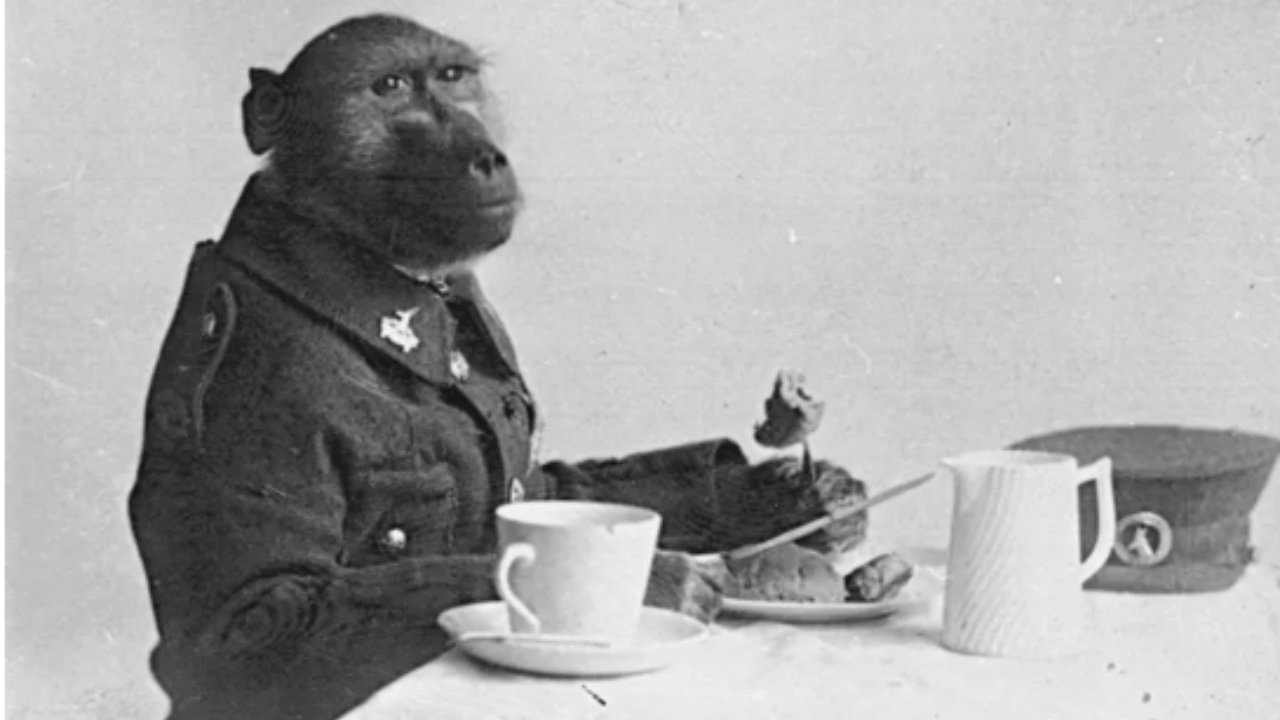
The military didn't just tolerate Jackie. They officially enlisted him. He was given the rank of private, a customized uniform with buttons and regimental badges, a proper cap, and even his own official army paybook.
He wasn't a circus act. He adjusted to the military routine immediately. Jackie marched in formation during drills, stood at ease with his hands behind his back, and sat at the mess table using a knife and fork. He even used his own small washing basin after meals. To the soldiers facing the terrifying unknown of deployment, this bizarrely disciplined baboon became an instant pillar of morale.
Life in the Trenches with a Chacma Baboon
The regiment deployed first to Egypt to fight Ottoman forces before heading straight into the meat grinder of the Western Front in Europe. This is where Jackie transitioned from a quirky mascot into a literal lifesaver.
Baboons have senses that leave humans far behind. Jackie's acute hearing and incredible night vision made him an asset during night sentry duties. He sat on guard with Marr in the pitch black. Long before a human soldier could hear the rustle of an enemy raiding party or the click of a rifle, Jackie knew. He gave early warnings by making sharp, quiet barks or aggressively tugging on Marr's wool tunic. He saved lives. It was that simple.
The bond between the farmer and the baboon grew deeper during the Battle of Agagia in February 1916. Marr took a bullet to the shoulder and dropped to the ground. Distraught and agitated, Jackie refused to leave his side. The baboon stood over Marr and continuously licked the open wound, keeping it clean from infection until the medical stretcher bearers arrived.
After that incident, the men ceased viewing Jackie as a pet. He was one of them. He endured the horror of Delville Wood, an infamous engagement where the South African brigade suffered a staggering 80 percent casualty rate. He survived the deep, freezing mud of Passchendaele. Through it all, he offered simple comforts to the traumatized men, even learning how to strike a match to light cigarettes for his trench mates.
The Explosive Night Near La Clytte
Every soldier's luck eventually runs out in heavy artillery warfare. Jackie's turn came in April 1918 during the fierce German Spring Offensive near La Clytte in Belgium.
The South African brigade came under heavy, unrelenting shellfire. Heavy explosions ripped the earth apart. Terrified but mimicking the soldiers around him, Jackie frantically tried to build a small protective wall of stones around his body. He worked desperately, piling rock after rock as shrapnel rained down.
A heavy shell exploded right next to him.
A jagged piece of shrapnel tore into his right arm. Another fragment slammed into his left leg, shattering the bone and leaving the limb hanging by mere shreds of muscle. Despite the excruciating pain, Jackie refused to let the screaming stretcher-bearers get near him. He hobbled around on his remaining good leg, trying to finish his stone wall. He only allowed Marr to carry him to the medical tent.
The regimental medical officer, Captain R.N. Woodsend, described the scene as heartbreaking. Marr was weeping openly, begging the medical staff to save his friend. Woodsend administered chloroform, completely unsure how a baboon's body would react to the heavy anesthetic. He used surgical scissors to quickly amputate the shattered leg and dressed the remaining wounds.
Against all medical expectations, Jackie woke up. Within days, he was sitting up in his hospital bed, reportedly offering a sharp paw salute to the officer in charge.
Honor and the Return to Civil Life
The war was effectively over for Jackie after the amputation. For his incredible bravery under fire, the military promoted him to the rank of Corporal. He received a gold wound stripe and three blue service chevrons to mark his years of frontline combat.
Before returning home, Jackie and Marr spent time in London. They became public sensations. The decorated baboon participated in the Lord Mayor's Day Procession, riding in a grand parade to a cheering crowd. The duo utilized their fame to raise massive amounts of money for the Widows and Orphans Fund. Members of the public eagerly paid half a crown just to shake Jackie's hand.
Corporal Jackie's Military Record:
- Enlistment: August 1915 (3rd South African Infantry)
- Campaigns: Senussi Campaign (Egypt), Western Front (France/Belgium)
- Key Battles: Agagia, Delville Wood, Passchendaele, La Clytte
- Injuries: Shrapnel wounds to arm, right leg amputated (1918)
- Decorations: Pretoria Citizen's Service Medal, Three Blue Chevrons
By 1919, Jackie received his official discharge papers at the Maitland Dispersal Camp in Cape Town, complete with a standard military pension. He returned to the Marr family farm to live out his days in peace.
Tragically, his civilian life was cut short. He died in May 1921. Historical records offer a couple of accounts regarding his end. Some sources state he perished in a sudden farmhouse fire. Other military history societies note that a severe, violent electrical storm hit Pretoria, and the loud thunderclaps triggered a fatal heart attack in the shell-shocked animal.
Albert Marr lived until 1973, passing away at the age of 84. He never forgot the loyal baboon who shared the trenches with him. Today, Jackie's Pretoria Citizen's Service Medal sits preserved in the South African National Museum of Military History, a tangible reminder of the strange, beautiful, and tragic ways bonds form in the darkest times.
Your Next Steps to Discover More War History
If you want to dig deeper into the incredible roles animals played in the First World War, don't stop here. Take these action steps to learn more.
- Visit the South African National Museum of Military History website to view archived photos of Jackie in his tailored uniform.
- Read about the Dickin Medal, which acts as the animal equivalent of the Victoria Cross, honoring wartime bravery.
- Research Sergeant Stubby, the most decorated war dog of World War I, who saved an entire American regiment from gas attacks.