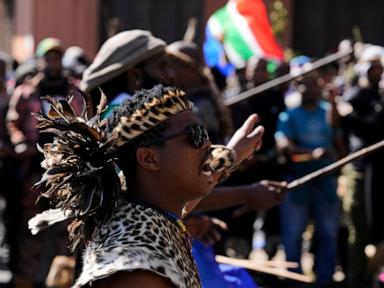
Thousands of people are filling the streets of Johannesburg, Durban, and Pretoria. Shop shutters are down. Heavily armed police units, backed by military hardware, are patrolling empty market squares in townships like Thokoza. Today is June 30, 2026, a date self-appointed vigilante groups declared as the final deadline for all undocumented immigrants to pack up and leave South Africa.
It's a powder keg moment. Local anti-migration groups like March and March, Operation Dudula, and the Progressive Forces have forced a standoff with the state. They blame foreign nationals for the country's brutal unemployment numbers, crumbling public infrastructure, and rampant crime.
The state didn't recognize this arbitrary deadline, but it isn't taking chances either. President Cyril Ramaphosa spent the night huddled in meetings with protest leaders, begging for peace. Meanwhile, the government is burning through 600 million rand ($37 million) just to keep the peace and prevent a re-run of the horrific 2008 xenophobic riots that left 62 people dead.
If you want to understand why South Africa has reached this breaking point, you have to look past the political grandstanding. This isn't just a local policing issue. It's a systemic failure of border control, economic stagnation, and political scapegoating that threatens to destabilize the regional economy.
The Mirage of the June 30 Deadline
Vigilante groups don't have the authority to deport people. Everyone knows this, yet the "March and March" movement successfully created enough panic to trigger a mass exodus before the sun even rose today.
Over the past few days, the Beitbridge border post into Zimbabwe has been choked with buses. Thousands of terrified Malawian and Zimbabwean nationals have been sleeping outside their embassies, begging for immediate repatriation. To date, over 25,000 foreign nationals have already been quietly shipped out via temporary repatriation centers.
The sheer terror driving these families out stems from real, recent trauma. Over the last month, mobs have gone door-to-door in the Western Cape and KwaZulu-Natal, forcing foreigners out of their homes. Two Mozambican nationals were killed in early June. In Durban, thousands of displaced migrants have been sleeping in public parks because their homes were looted.
The leaders of these anti-migrant movements claim they aren't calling for blood. Jacinta Ngobese-Zuma, the head of March and March, explicitly told reporters that no looting would happen in their name. But when you march through a township chanting "abahambe" (they must leave) while carrying sticks, the message received on the ground isn't one of peaceful activism. It's an ultimatum backed by the threat of violence.
Why the Deep Anger Isn't Going Away
It's incredibly easy for international human rights organizations to condemn the protests as simple xenophobia. Amnesty International point blank accused local groups of scapegoating refugees for problems rooted in the lingering legacies of apartheid. They aren't entirely wrong, but that analysis ignores the lived reality of everyday South Africans.
Let's look at the actual ground conditions driving a normal person to join a march:
- The Economic Squeeze: Local workers are routinely undercut by employers who hire undocumented workers for a fraction of the minimum wage, completely bypassing labor laws.
- Failing Public Services: Clinics and public hospitals are overwhelmed. Local residents in communities like Tembisa complain they wait in lines for hours while resources dry up.
- The Border Collapse: South Africa's border management has been notoriously porous for over a decade. It's an open secret that a small bribe at a border gate can buy entry, creating deep resentment among locals who feel the state has abandoned its sovereignty.
Even President Ramaphosa admitted in a letter to the nation this week that the concerns over illegal immigration and underregulated borders are completely valid. The immigration system needs a massive overhaul. The mistake isn't acknowledging the crisis; the mistake is letting vigilantes dictate the timeline for fixing it.
The Economic Cost of the Backlash
This chaos isn't happening in a vacuum. South Africa is the industrial hub of southern Africa, and its economy relies heavily on cross-border trade.
Justice Minister Mmamoloko Kubayi warned that these rolling protests are actively sabotaging the nation's image abroad. It's already hurting local businesses that operate across the continent. When South African mobs target Malawian, Zimbabwean, or Mozambican truck drivers and shop owners, there is an immediate, chill effect on regional trade.
Worse, it breeds deep diplomatic resentment. Six African governments have already had to step in to pull their citizens out of South Africa before the violence escalated today. You can't position yourself as the leader of the African continent while your neighbors are fleeing your borders in fear of their lives.
What Needs to Happen Next
The current police deployments are a temporary band-aid on a massive, infected wound. Sending 25,000 cops to stand in front of foreign-owned spaza shops every time a protest group prints a flyer isn't a sustainable national security strategy.
If the government wants to stop the vigilante deadlines, it has to take the wind out of their sails by enforcing its own laws.
First, the Department of Employment and Labour needs to aggressively fine businesses that exploit undocumented workers to avoid paying the minimum wage. If you eliminate the financial incentive for illegal hiring, you level the playing field for local workers.
Second, the newly deployed Border Management Authority needs real teeth, real funding, and zero-tolerance corruption policies at major checkpoints like Beitbridge.
The scenes unfolding across South Africa today show a country completely exhausted by its own governance failures. Until the state proves it can secure its borders and protect its own workforce through official channels, the streets will keep filling up with people determined to do it themselves.