Karma has a way of finding you on the high seas.
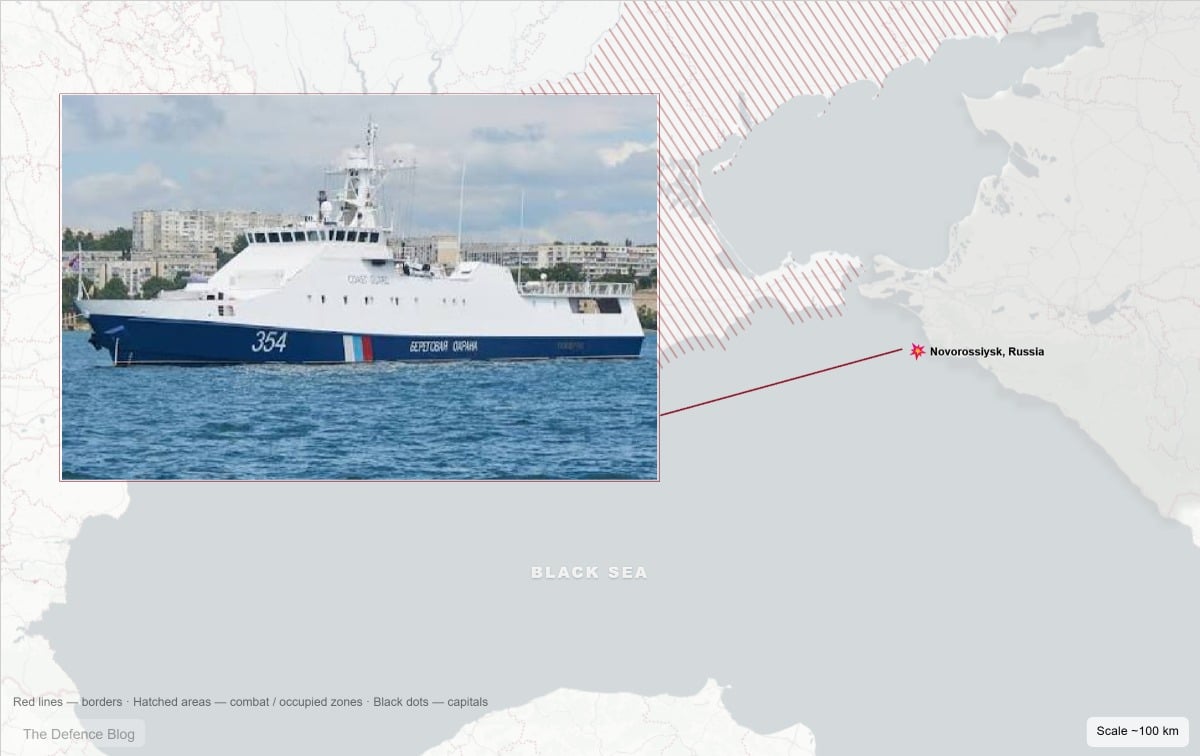
In the early morning hours, the Ukrainian Navy delivered a devastating blow right on Russia’s doorstep, sinking the Federal Security Service (FSB) border patrol vessel Izumrud near the major port of Novorossiysk. The strike didn't just take out another valuable piece of Russian naval hardware. It closed a bitter chapter of history that Ukrainian sailors have been waiting to settle for nearly eight years.
According to the Ukrainian Navy, the Izumrud, a second-rank Rubin-class patrol ship, was hunted down and sent to the bottom of the Black Sea using a brand-new weapon: the Sargan-3000 unmanned surface strike platform. The Ukrainian military confirmed there are dead and wounded among the Russian crew.
While Moscow has kept quiet about the disaster, the strategic and symbolic ripples of this attack are shaking the Russian naval command. This isn't just about another ship lost. It's about a highly specific, deeply personal act of maritime retribution.
Setting the Score of the 2018 Kerch Strait Incident
To understand why Ukrainian naval headquarters is celebrating this particular sinking, you have to look back to November 25, 2018.
Years before the full-scale invasion began, Russia was already trying to choke off Ukraine’s access to the Sea of Azov. That day, three small Ukrainian vessels—the artillery boats Berdyansk and Nikopol, and the tugboat Yany Kapu—attempted a routine, lawful transit from Odesa to Mariupol through the Kerch Strait.
What followed was the first time Russian forces openly fired on Ukrainian military units. Russian coast guard vessels, including the Izumrud and the Don, intercepted the tiny Ukrainian flotilla. The confrontation turned chaotic:
- The Russian ship Don rammed the Ukrainian tugboat.
- In the frantic maneuvering, the Izumrud actually collided with its sister ship, the Don, damaging both of their hulls.
- Eventually, the Izumrud opened direct fire on the Berdyansk, wounding Ukrainian sailors.
- Russian special forces boarded the vessels, capturing 24 Ukrainian servicemen and parading them through pre-trial detention facilities in Moscow.
The captured sailors spent nearly a year in Russian custody before being returned in a September 2019 prisoner swap. Ukraine never forgot the humiliation. When the Navy announced the sinking of the Izumrud, they attached a blunt, icy promise: "Retribution is inevitable. To be continued."
Inside the Weapon that Did It: The Sargan-3000
The tool chosen for this payback wasn't one of the well-known Magura V5 or Sea Baby drones that have terrorized Russia's Black Sea Fleet over the last few years. Instead, Ukraine deployed its latest domestically built unmanned surface vehicle (USV): the Sargan-3000.
Ukraine has quietly integrated the Sargan-3000 into its Unmanned Systems Forces. While exact technical schematics remain highly classified, military analysts point to several features that allowed it to slip past Russian defensive nets:
- Low-profile design: It rides incredibly low in the water, making radar detection near-impossible in choppy seas.
- Extended range: To strike near Novorossiysk—located deep in Russian territory on the eastern edge of the Black Sea—the drone had to travel hundreds of miles from Ukrainian-controlled coastlines.
- High-yield payload: Sinking a 750-ton, heavily armored patrol ship like the Rubin-class requires a massive warhead. The Sargan-3000 carried enough explosive force to tear through the Izumrud’s hull, causing rapid flooding that the crew couldn't contain.
What the Loss of a Rubin-Class Patrol Ship Means for Moscow
The Izumrud wasn't a cheap patrol boat. Launched in 2014 and commissioned into the FSB Coast Guard in occupied Crimea in 2015, the vessel was a sophisticated, modern asset.
Technical Profile of the Izumrud
- Length: 62.5 meters (approximately 205 feet)
- Displacement: 630 to 750 metric tons
- Top Speed: 27 knots (roughly 50 km/h)
- Key Feature: Equipped with an active helicopter landing deck, advanced radar tracking systems, and automatic rapid-fire naval guns.
Historically, ships like the Izumrud were used by the FSB to guard illegal sand extraction operations in Ukrainian waters and protect Russian infrastructure, including the highly vulnerable Kerch Strait Bridge. More recently, as Ukraine's drone campaign forced the primary Russian Black Sea Fleet to flee its historic base in Sevastopol, Crimea, Novorossiysk became Russia’s primary safe haven.
By sinking the Izumrud right outside Novorossiysk, Ukraine has proven that Russia’s "safe harbor" is anything but safe.
The Broader Sea of Azov Campaign
The destruction of the Izumrud isn't an isolated incident. It’s part of a massive, coordinated offensive. Ukraine's Unmanned Systems Forces, led by commander Robert “Madyar” Brovdi, have unleashed a relentless campaign targeting Russia’s maritime logistics.
Dubbed Operation MoLoChKa, this initiative has systematically hunted down Russian vessels. In a recent nine-day stretch alone, Ukrainian drones struck 116 Russian vessels.
The primary target of this campaign is Russia's "shadow fleet"—the network of smaller tankers and cargo vessels that carry fuel and oil through the Volga-Don Canal and the Sea of Azov. By disabling these support vessels and the patrol ships that guard them, Ukraine is choking off the logistics chain that keeps Russian troops in occupied Crimea fueled and armed.
What Happens Next
If you're keeping score, Russia's options in the Black Sea are rapidly shrinking. They've tried installing "cope cages" on submarines, building massive boom defenses, and barricading harbor mouths with sunken barges. None of it is working.
For commercial shippers and Russian military commanders alike, the message is clear: if Ukraine can build a drone that travels hundreds of miles to sink a heavily armed FSB patrol ship in Russia's most heavily guarded eastern port, no ship flying the Russian flag is safe.
Expect Russia to pull its remaining naval assets even further back, potentially abandoning active patrols in the eastern Black Sea altogether. For Ukraine, the hunt continues.