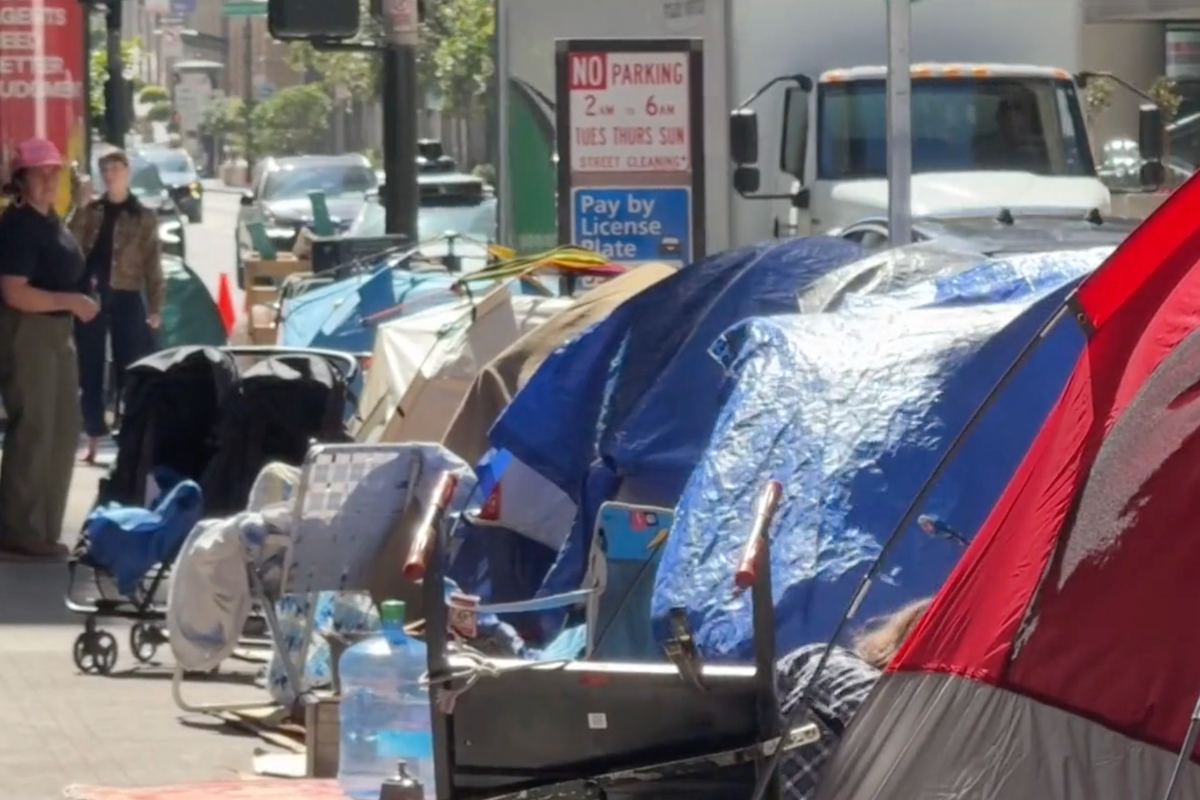
Imagine walking to your office in the heart of San Francisco's Financial District and suddenly finding the entire intersection blocked by a massive, sprawling tent city. That's exactly what happened on Friday morning at California and Battery streets. For locals accustomed to the complex realities of the city's housing crisis, it felt like a massive overnight escalation.
People panicked. They pulled out their phones. They flooded the city’s 311 non-emergency line with complaints.
But if you looked closer, things didn't quite add up. The tents were pristine. The scattered trash looked a little too curated. There was even a random sports trophy sitting on top of a pile of debris.
It wasn’t a sudden social crisis. It was Hollywood.
Netflix took over a half-block of downtown San Francisco to shoot an upcoming thriller. The production crew built a hyper-realistic replica of a homeless encampment, complete with burn barrels and actor extras milling around in costume. The incident sparked a massive wave of confusion, highlighting a bizarre intersection of local politics, movie magic, and the very real tensions defining life in the city today.
The Anatomy of a Perfect Hollywood Misunderstanding
Commuters coming off the BART or walking from nearby offices were caught completely off guard. The Financial District usually doesn't see encampments of this scale. The Tenderloin? Sure. But Battery Street? Not normally.
Passerby Bei Liu told local reporters that she initially assumed the city had simply forced unhoused residents out of other neighborhoods and into downtown. She noted that it looked exactly like the Tenderloin at first glance.
Then she noticed what was missing.
There was no smell. Real street encampments come with the harsh, unavoidable scents of urban neglect and human survival. This one smelled like fresh canvas and asphalt.
Another passerby, Bryan Talmage, noticed a Hollywood cliché right away. He spotted a classic cinematic burn barrel. Real encampments don't use Hollywood prop barrels. That was his immediate clue that a camera crew was hiding nearby.
By Friday afternoon, the truth was out. Security guards began holding back the crowds. Massive boom cameras swung over the intersection. Vans packed with high-end tech rolled down the street.
Who Is Behind the Cameras
This wasn't some indie student film. Netflix backed the project, which operates under the working title 2034.
Joseph Gordon-Levitt is directing the project. He co-wrote the script alongside Kieran Fitzgerald, who previously worked on Snowden. Even more interesting is that Natasha Lyonne helped craft the story. It is being produced by T-Street Productions, the powerhouse team behind the Knives Out franchise.
The cast list reads like an awards show roster. It features Rachel McAdams, Jeff Daniels, Joel Edgerton, Alfre Woodard, Toni Collette, Caleb McLaughlin, and former Oakland Raider Nnamdi Asomugha.
Gordon-Levitt was spotted right in the middle of the fake encampment, jumping out of a production van to direct scenes. Earlier in the week, eagle-eyed residents on Reddit saw him filming near City Hall. He wasn't alone there either. Mayor Daniel Lurie was standing right by his side.
The Real Irony of Filming an AI Thriller in San Francisco
The plot of 2034 remains largely under wraps, but the production team confirmed it's an AI-centered thriller. Gordon-Levitt has spent nearly a decade developing this concept. He famously waited for artificial intelligence to fully enter the public consciousness before pushing for a greenlight. He has frequently spoken publicly about the need for tech accountability and the dangers of unchecked silicon valley power.
Using a massive homeless encampment as the backdrop for a futuristic tech thriller is incredibly on the nose.
San Francisco lives this reality every single day. The extreme wealth generated by the tech sector sits in stark contrast to the thousands of people sleeping on the sidewalks. Seeing a Hollywood crew construct a pristine version of this suffering to serve as atmosphere for a movie about tech dystopia left a sour taste in some residents' mouths.
The production team stayed in town for three days of intense shooting. They used the city’s actual backdrop to ground their sci-fi story in a tangible, recognizable reality.
Why San Francisco is Begging Hollywood to Come Back
You might wonder why the city allowed a production crew to cause this kind of public confusion. The short answer is cash.
San Francisco wants its film industry back. For decades, the city was a premier filming destination. Classics like Vertigo, Dirty Harry, and The Matrix Resurrections used these hills to perfection. But soaring costs and complex bureaucracy pushed studios toward cheaper locations like Atlanta, Vancouver, or even Eastern Europe. In fact, 2034 did the bulk of its principal photography in Serbia and Montenegro before coming to California for exterior shots.
To reverse this trend, local leaders changed the rules. The Board of Supervisors passed an aggressive local incentive package.
The Million Dollar Rebate
The city introduced a massive $1 million cash rebate program designed specifically to lure major studios back to local streets. Manijeh Fata, the executive director of the San Francisco Film Commission, pointed out that the city faces intense global competition. There are over 120 distinct film incentives worldwide trying to steal production dollars.
San Francisco had to get competitive. The new cash rebate program aims to ensure that movies actually set in the city are filmed here, rather than on a soundstage in Atlanta.
The strategy is working. The presence of a massive Netflix production brings immediate economic benefits. Crews rent out local hotel rooms, buy food from downtown restaurants, and hire local tech and security staff. The publicity team for 2034 explicitly credited the expanded tax incentives as the primary reason they brought the production to town.
The Friction Between Public Policy and Hollywood Magic
Even with the economic boost, the fake tent city highlights the delicate nature of San Francisco's public image. The city has faced intense national scrutiny over open-air drug markets, property crime, and homelessness.
When residents see a massive camp pop up overnight, their immediate reaction is shaped by years of local political debates. Mayor Daniel Lurie won his election on promises to clean up the streets and tackle these exact issues. Seeing him smile next to a director creating a fictional version of the city's biggest problem felt conflicting for onlookers.
The 311 calls show that locals aren't indifferent. They are hyper-vigilant. They notice changes on their blocks instantly.
For a few hours, Hollywood exposed a strange truth about modern urban life. The line between reality and cinematic dystopia has become incredibly thin. When a movie prop looks identical to a neighborhood crisis, distinguishing art from reality gets complicated.
What You Should Do Next Time You See an Overnight Encampment
If you live or work in downtown San Francisco, don't immediately assume the worst when a block transforms overnight. Film production is ramping up across the city.
Check the SF Film Commission website for active filming permits in your neighborhood. Production companies must post physical notices on light poles and street signs at least 72 hours before taking over a public sidewalk. Look for bright pink or yellow signs detailing parking restrictions and filming times.
Keep an eye out for subtle giveaways before calling 311. Look for heavy-duty power cables running along the gutters, security guards wearing high-visibility vests with earpieces, or craft services tables loaded with snacks. If the tents look brand new and you spot a vintage burn barrel, save yourself the phone call. You are just walking through a scene in someone else's movie.
Watch local reporting on the downtown film set to see just how closely the production crew replicated the streets of San Francisco for this upcoming release.