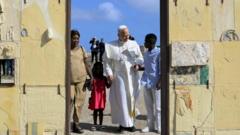
While the United States celebrated its 250th anniversary with fireworks, parades, and backyard barbecues, the first American-born pope chose a completely different backdrop. Pope Leo XIV spent the Fourth of July on Lampedusa. It's a tiny, sun-baked Italian island closer to North Africa than mainland Europe.
He didn't go there for a vacation. He went to send a blunt, unmistakable message to the West. For an alternative perspective, read: this related article.
Lampedusa serves as the premier frontline of Europe’s migration crisis. For over a decade, overcrowded dinghies and makeshift vessels have crossed the Mediterranean, attempting to reach this patch of land. Many don't make it. The sea is filled with unmarked graves. By standing on these docks on America's landmark birthday, Leo wasn't just visiting a geographic gateway. He was challenging the collective conscience of both Washington and Brussels.
The Defiant Symbolism of July 4
Politicians love to talk about borders. Pope Leo wants to talk about people. Related analysis regarding this has been provided by Associated Press.
Choosing the 250th anniversary of U.S. independence to visit Europe's most famous migrant landing point is a calculated chess move. It’s a direct response to rising nationalism and hardline immigration crackdowns across the globe.
In a letter sent directly to his home country while standing on the Italian island, Leo pulled no punches. He reminded Americans that the core Catholic value of defending life doesn't stop at a border wall. It demands welcoming, protecting, and assisting immigrants.
"To receive immigrants with compassion and generosity is not only an act of charity, but also a recognition of the dignity that belongs to every human person," Leo wrote.
This isn't the first time the pontiff has locked horns with political leaders. Last year, he drew heavy criticism from the White House after calling Donald Trump’s hardline anti-immigration policies "inhuman." By skipping the massive Washington celebrations to hang out with Coast Guard rescue teams and newly arrived African refugees, Leo made his stance clear. Human dignity matters more than political theater.
What the Media Misses About Lampedusa
Mainstream news outlets love to throw out raw numbers. They'll tell you that arrivals in Lampedusa have already topped 7,000 this year. They'll call it an "influx" or a "crisis."
What they fail to show you is the reality on the ground.
Lampedusa is an island of contradictions. It sits on one of the world's deadliest migration routes, yet it's populated by local fishermen, tireless aid workers, and a Coast Guard that spends sleepless nights pulling terrified children from freezing water.
When you look closely at the island, you see the real tragedy. In the local cemetery, simple crosses made from the splintered wood of shipwrecked migrant boats mark the graves of nameless children. That's the real cost of political gridlock.
Leo’s visit deliberately mirrors the historic 2013 trip made by his predecessor, Pope Francis. Back then, Francis blasted the "globalization of indifference" that allowed the Mediterranean to turn into a graveyard. Thirteen years later, Leo is looking out at the exact same waters, furious that the world is still looking away.
Why Europe’s Current Strategy is Failing
European leaders have spent years trying to outsource the problem. They fund foreign coast guards, build detention centers in transit countries, and bicker over quotas.
It’s not working.
During his day trip, Leo called out European leaders for treating migration like an emergency pop-up problem rather than a permanent reality. He argued that immediate relief efforts are useless without a long-term strategic plan to actually integrate people.
The strategy can't just be about building higher walls or paying other countries to act as prison guards. True safety requires a two-way street. Just weeks before his Lampedusa trip, during a visit to Spain’s Canary Islands, Leo pushed for "reciprocal integration." He argued that while host countries must uphold human rights and offer legal pathways, migrants also have a duty to learn local languages, respect laws, and actively join community life.
It’s a nuanced take that annoys extremists on both sides. Left-wing activists sometimes cringe at enforcing rules on refugees, while right-wing nationalists reject the idea of welcoming them at all. But hands-on experience shows this balanced approach is the only way forward.
Moving Beyond Indifference
If you want to see what actual solutions look like, look at Spain’s recent regularisation program. They recently launched an effort to legalise the status of roughly 500,000 undocumented migrants, pulling people out of the shadow economy and into formal society where they can pay taxes and work legally.
Vague promises and political speeches don't save lives at sea. If we want to fix the broken migration system, the international community has to take concrete steps.
- Create legal and safe pathways: Stop forcing desperate families into the hands of human traffickers. If people have a legal avenue to apply for asylum or work visas from their home countries, the black-market smuggling industry collapses.
- Target the human trafficking syndicates: Smugglers profit heavily off human despair. Leo recently warned these traffickers that they will "face God's wrath," but European intelligence agencies need to back that up with aggressive financial tracking and international arrests.
- Invest in countries of origin: People don't leave their homes, families, and cultures for fun. They flee because of war, total economic collapse, or extreme violence. True border security starts by stabilizing the regions people are running from.
The next time a politician tells you that immigration is a simple issue with an easy fix, don't believe them. It's complicated, messy, and deeply emotional. But as Pope Leo reminded the world from the shores of Lampedusa, our humanity is judged by how we treat the most vulnerable people knocking on our door.