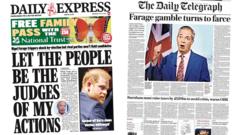
Nigel Farage just threw British politics into absolute chaos. Again. By resigning as the Member of Parliament for Clacton, the Reform UK leader didn't just step down; he triggered a high-stakes by-election designed to bypass a damning parliamentary standards investigation. It's a classic populist maneuver. Instead of letting a committee of Westminster bureaucrats rule on his undeclared multi-million-pound gifts, Farage wants the voters of a faded Essex seaside town to act as his jury.
He calls it a "people versus the establishment" showdown. His critics call it a desperate stunt to outrun a sleaze scandal. But whatever you want to call it, the move has completely rewritten the political playbook for 2026.
By pulling the trigger himself, Farage is betting everything on a single, aggressive throw of the dice. If he wins big, he sanitizes his record and returns to the House of Commons with a renewed democratic mandate that makes him practically untouchable. If the strategy misfires, or if the public sees through the spectacle, the entire Reform UK movement could stall out right when it was leading national polls.
The Millions in the Shadows
To understand why Farage did this, you have to look at the money. This isn't about minor administrative oversight or a missed lunch declaration. The Parliamentary Commissioner for Standards, Daniel Greenberg, has been circling Farage over massive financial inputs that came to light earlier this year.
At the center of the storm is a staggering £5 million gift from Christopher Harborne, a cryptocurrency billionaire based in Thailand. Farage received this massive sum just weeks before announcing he would stand in the 2024 general election. Under parliamentary rules, new lawmakers must declare any substantial gifts or donations received in the twelve months before their election if those funds could reasonably be seen as linked to their political activities.
Farage didn't declare it. His defense? He claims the cash was an "unconditional gift" meant strictly for his personal security. During a heated interview on LBC, he snapped that he could spend it on Ferraris or put it on horses if he wanted to.
"I can do what I want with it," Farage insisted.
But the standards watchdog didn't buy that defense. Then came the second blow. Fresh allegations surfaced involving undeclared funding for staffing, security, and a luxury London townhouse near Buckingham Palace provided by George Cottrell. Cottrell, a close friend and convicted fraudster, has been a frequent fixture at Reform UK events despite holding no official title.
With two separate watchdog probes gaining momentum, Farage faced a real threat of a formal suspension from the House of Commons. A suspension lasting ten days or more would automatically trigger a recall petition under UK law. If ten percent of Clacton voters signed that petition, Farage would have been forced into a by-election anyway—but on terms dictated by his enemies.
He chose to jump before he was pushed.
Why the Westminster Boycott Changes Everything
The immediate counter-strategy from the mainstream political parties surprised everyone. Instead of rushing to fight Farage on the beaches of Clacton, Labour, the Conservatives, the Liberal Democrats, and even the hard-right Restore Britain party announced a total boycott of the contest.
They refuse to run candidates.
It is an incredibly risky move. Prime Minister Keir Starmer labeled the election a "desperate stunt" by a man up to his neck in sleaze. Conservative leader Kemi Badenoch stated her party wouldn't participate in a "fake by-election" designed purely to distract the public from serious financial scrutiny. Rupert Lowe, who split from Reform to lead Restore Britain, openly refused to join what he termed a "media circus designed to puff up Farage's ego."
This coordinated retreat leaves Farage in a bizarre political vacuum. He wanted a dramatic, prime-time battle against the establishment elite. Instead, he might end up sharing a debate stage exclusively with satirical fringe figures like Count Binface.
The boycott aims to starve Farage of the oxygen he thrives on. Without a serious establishment opponent to rail against, his "people versus the elite" narrative loses its teeth. It turns a grand constitutional drama into a bizarre, one-sided vanity project.
However, the strategy could easily backfire on the mainstream parties. By vacating the field, they are giving Reform UK a free run to secure a massive, mathematically historic majority in Clacton. Farage's allies, like Reform chair Lee Anderson, are already predicting a victory of over 50 percent. When Farage walks back into Parliament with that kind of landslide, he will claim total vindication, regardless of who else was on the ballot.
The View from the Clacton Frontline
Clacton-on-Sea is the perfect backdrop for this kind of populist theater. It is a town that feels perpetually abandoned by Whitehall. Over 96 percent of the population is white, and the area voted overwhelmingly for Brexit in 2016. In 2024, Farage won the seat comfortably with 46.2 percent of the vote.
If you talk to the people living there, you find a deep, exhausting cynicism. Some locals view Farage as a genuine savior. They don't care about the £5 million from a crypto billionaire. In fact, some think he needs the money just to protect himself from a hostile media. To them, the financial probes are proof that the system is rigged against anyone who speaks for the working class.
But scratch beneath the surface, and a profound weariness is setting in. Many residents are tired of their home being used as a political playground. Younger locals, like the hospitality workers and retail staff who keep the seafront running, see Farage as an absentee landlord who spends more time flying to American political rallies than fixing the broken infrastructure of Essex.
The town has massive economic challenges. Jaywick, a neighborhood just down the road, is regularly ranked among the most deprived areas in the UK. The people there need investment, better healthcare, and real jobs. Instead, they are getting a £250,000 by-election over the summer months because their MP didn't want to answer questions about his bank account.
The Legal Loopholes in Play
Don't think for a second that this resignation makes Farage's legal troubles disappear. It merely pauses them.
When a Member of Parliament resigns, the Parliamentary Commissioner for Standards loses jurisdiction because the individual is no longer an active lawmaker. The current inquiries into the Harborne and Cottrell funding will go on ice the moment the writ for the by-election is dropped. Farage buys himself weeks of clear air to campaign without the threat of an imminent, damning report dropping mid-cycle.
But the House of Commons procedural rules are very clear on what happens next. If Farage wins the by-election and gets re-elected, the standards commissioner has the explicit power to reactivate the investigations immediately.
The exact same evidence will be waiting for him on his desk. The same rules will apply.
Farage could win this summer election, celebrate a massive victory, walk back into the House of Commons, and still face a suspension a few months later if the watchdog finds him guilty of serious disclosure breaches. If that suspension hits the ten-day threshold, Clacton could face a second, mandatory recall by-election before the year is out.
It is a dizzying, circular game of political survival.
The Looming Threat to the Reform Movement
This gamble isn't just about Farage's personal seat. It comes at a fragile moment for Reform UK. While the party has consistently run high in national opinion polls, it recently suffered three consecutive special election losses across the country. The momentum has shown signs of softening.
By forcing a local vote focused entirely on his personal integrity, Farage has tied the entire brand of his party to his own financial transparency. If his margin of victory shrinks because angry or bored voters stay home, it will signal to the entire country that the populist wave is finally breaking.
Mainstream political analysts are watching the turnout numbers far more than the final vote share. If turnout plummets because the other parties aren't running, Farage’s big victory will look hollow. It becomes a manufactured mandate.
What Happens Next
The political machinery is already moving. If you want to understand how this plays out over the coming weeks, look for these specific developments.
- The Writ is Dropped: Watch for the formal announcement of the by-election date. Reform UK has offered to cover the £250,000 administration cost to neutralize accusations of wasting taxpayer money, but the local council still has to manage the logistics during peak tourist season.
- The Fringe Candidates Arrive: With major parties out, expect an influx of independent, satirical, and single-issue candidates trying to hijack the national media spotlight.
- The Media War Escalates: Farage will continue to bar mainstream journalists from his events, relying on direct-to-camera streaming and friendly alternative outlets to frame the narrative.
- The Watchdog Prepares: Keep an eye on the office of the Parliamentary Standards Commissioner. Their public statements will reveal exactly how quickly they plan to resume the files the moment the election concludes.
This isn't a normal election. It is an end-run around accountability, executed by a master communicator who knows exactly how to weaponize public distrust. Farage has built his career by daring the political establishment to stop him. By refusing to play his game, his rivals have left him running a race against his own shadow.