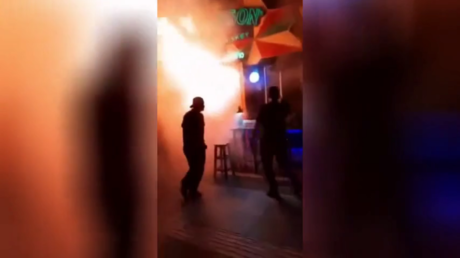
A quiet Wednesday morning on Rambla Ferran turned into total chaos when an intercity coach slammed directly into the stone facade of the Diputació de Lleida building. The clock read roughly 7:15 AM on July 1, 2026, when the vehicle veered wildly across a straight stretch of road. It carried 55 passengers. Within minutes, 12 ambulances, 11 firefighter units, and a medical helicopter swarmed the city center. The final count stands at 46 people injured. Four are fighting for their lives in critical condition. Nine have serious injuries. The rest suffered minor cuts and bruises.
This was not a random highway pile-up. It happened right after the bus pulled out of the central station. It reveals an uncomfortable truth about how we transport seasonal agricultural workers in Catalonia.
The immediate aftermath on Rambla Ferran
Emergency medical teams from the Servei d'Emergències Mèdiques arrived to find a scene of sheer panic. The bus smashed hard into the building facade and an adjacent bus stop. Debris covered the asphalt. Rescuers immediately set up a makeshift triage zone on the sidewalk to sort the walking wounded from those trapped inside the metal frame.
Thirteen victims required instant evacuation to the Arnau de Vilanova Hospital and the local CUAP Prat de la Riba. Surgeons went to work immediately on the most critical cases. The physical damage to the historic building is obvious, but the human toll is what local officials are focusing on. Lleida Mayor Fèlix Larrosa called it the most serious traffic accident the city has seen in recent memory.
Novice drivers and the co-driver system
Investigators are looking closely at who was behind the wheel. The driver was a novice. Because of their lack of experience, a veteran co-driver sat next to them to supervise the route. That system failed spectacularly on Rambla Ferran.
For reasons still unknown, the young driver lost control on a straight section of the avenue. The bus veered sharply to the right. The impact crushed the front passenger side where the experienced supervisor sat. That senior driver suffered a partial leg amputation from the crushing force of the building facade. The novice driver survived the impact but remains in a severe state of emotional shock, unable to give a clear statement to the Guàrdia Urbana.
Placing a rookie driver on a high-density commuter route during peak hours raises massive questions about training timelines. Transport companies often face severe driver shortages during the summer months. This leads to fast-tracked training and heavy reliance on the co-driver safety net. When that safety net results in a severe injury to the supervisor, the entire system needs a rewrite.
Seasonal workers bear the brunt of transit risks
Most of the passengers on that coach were seasonal agricultural laborers. They were heading out toward La Granja d'Escarp to work in the fruit orchards that drive the economy of the Segrià region. Every summer, thousands of workers arrive in Lleida. They depend entirely on regional intercity buses to get to the fields.
These worker transport routes operate under intense time pressure. Buses must hit multiple rural destinations early in the morning before temperatures skyrocket past 40 degrees Celsius. The packed nature of these commuter lines means that any mechanical or human error immediately results in mass casualties. We talk a lot about labor conditions in agriculture, but we rarely look at the hazardous daily commute these workers endure just to reach the fields.
Urban infrastructure saved lives by an hour
Mayor Larrosa noted a chilling detail during his midday press briefing. If this crash had happened just one hour later, the death toll would have been catastrophic. Rambla Ferran is a major pedestrian artery in Lleida. At 8:15 AM, the sidewalks are full of commuters, shoppers, and office workers heading into government buildings.
The bus narrowly missed pedestrians on the sidewalk before striking the facade of number 11 Rambla Ferran. The stone structure of the Diputació building absorbed the kinetic energy of the 15-ton vehicle. While the impact caused massive injuries inside the bus, the solid building prevented the vehicle from plowing deeper into a crowded urban space.
Regional leadership promises action
The political fallout started before the emergency crews even cleared the glass from the street. Salvador Illa, the President of the Generalitat, paused a government session to call Mayor Larrosa and express his solidarity. Alongside Parliament President Josep Rull, Illa promised a full investigation into the safety protocols of regional transit providers.
Words of support do not fix broken bones or replace severed limbs. Local labor advocates are already demanding strict audits of the private bus companies contracted for intercity routes. They want to see driving logs, maintenance records, and clear data on how many hours these novice drivers log before they are handed the keys to a 55-passenger vehicle.
What transit operators must do right now
This disaster cannot fade from the headlines without forcing real operational changes. Private transport lines and municipal authorities need to overhaul their approach to safety.
First, novice drivers should not manage maximum-capacity commuter routes during the peak morning rush. They need to log their initial hours during off-peak times or on lower-density rural tracks.
Second, the physical protection of co-drivers needs addressing. If the supervisor sits in the direct impact zone without structural reinforcement, the co-driver system places veterans in extreme danger.
Third, the Segrià region needs dedicated, staggered transport schedules for agricultural workers to reduce the frantic rush hour push. Spreading the passenger load across a wider time window minimizes the risk of mass-casualty events.
The investigation will eventually pinpoint whether a medical emergency, a mechanical failure, or simple human error caused the vehicle to veer right. The underlying lesson is already clear. Our current system of moving hundreds of workers through tight urban corridors relies far too much on luck. On July 1, that luck ran out on Rambla Ferran.