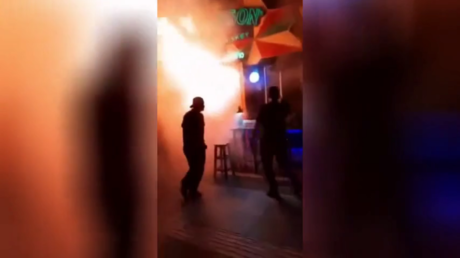
The sirens didn't just wail over Kyiv early Thursday morning. They screamed for eleven straight hours as the skies rained fire. It was the biggest aerial assault the city has seen since the invasion began.
When the sun finally broke through the heavy smoke, the reality settled in. Kyiv residents reel after largest Russian attack on city kills at least 13 and leaves scores more bleeding in the debris of shattered apartment complexes. This wasn't a standard strike. This was a brutal test of endurance that changed how we look at the air war over Europe.
If you think this is just another tragic headline, you are missing the bigger tactical picture. The math behind the attack is terrifying. Moscow deployed a staggering 496 drones alongside 74 missiles, including advanced ballistic projectiles that ignore traditional interceptors. Ukrainian air defense teams worked miracles. They knocked down the vast majority of the incoming threats. Still, twenty-five ballistic missiles and a dozen drones penetrated the shield, blasting 33 separate locations across the capital.
The wreckage on Shevchenko Boulevard is a grim reminder of what happens when air defenses get overwhelmed. It reveals a massive strategic gap that Western allies are failing to address quickly enough.
The morning Kyiv woke up to rubble
People spent the night huddled on concrete floors in underground metro stations, holding their children and pets while the ground shook above them. By dawn, the central districts looked like a war zone from a different century. Emergency crews dug through smoldering brick and twisted metal to pull out survivors.
Kyiv Mayor Vitali Klitschko confirmed the mounting toll, noting that the casualties included small children and ambulance workers who were targeted while trying to save lives.
The Kremlin says these strikes hit military and energy targets. That's an outright lie. The reality on the ground shows apartment blocks ripped wide open, destroyed civilian vehicles, and shattered windows for blocks. This was an intentional effort to terrorize the civilian population and break their spirit. It failed to break their spirit, but it did expose a critical vulnerability.
Why Russia launched nearly five hundred drones in one night
To understand why this happened now, look at the Russian oil sector. Ukraine has been running a relentless drone campaign against Russian refineries, hitting facilities like the major NORSI plant in the Nizhny Novgorod region. These strikes have caused serious domestic fuel shortages inside Russia, driving up prices and putting immense political pressure on Vladimir Putin.
The Kremlin called this massive raid a act of retaliation. But there's a deeper military utility here.
Russia uses cheap, Iranian-designed Shahed drones to saturate the air space. They don't expect most of them to hit anything. The goal is to force Ukraine to expend its limited supply of expensive Western air defense missiles on cheap plastic targets. When the defense network is busy tracking and shooting down hundreds of slow drones, Russia fires its fast ballistic missiles right behind them.
It's a cruel game of attrition. A single Patriot missile can cost millions of dollars. A Shahed drone costs a fraction of that. You don't need a math degree to see who wins that economic calculation over time.
The structural problem with Ukrainian air defense right now
President Volodymyr Zelenskyy didn't just ask for more air defense systems after the smoke cleared; he asked the United States for something far more important. He wants the licenses to manufacture Patriot interceptor missiles domestically inside Ukraine.
This request highlights the absolute core of the problem. Shipping completed batteries from Western warehouses is no longer enough. The supply chains are too slow. Shipping lanes are too vulnerable. The bureaucratic red tape takes months when Ukraine has only hours.
If Ukraine can build its own ammunition for the Patriot system, it fundamentally alters the logistics of the war. It removes the dependence on Western political debates and shifting congressional budgets.
Military experts know that setting up domestic production for highly sophisticated missile interceptors takes years under normal conditions. Ukraine doesn't have years. They need emergency fast-tracking of tech transfers to build localized assembly lines in reinforced, underground facilities.
What the West gets wrong about the drone war
Many Western analysts look at the high shoot-down percentages and think Ukraine is winning the air battle. They see a 90% interception rate and celebrate it as a triumph of Western technology.
That view is incredibly dangerous. In a city of millions, the 10% that get through cause catastrophic damage.
When 25 ballistic missiles get through the defensive net, hospitals get destroyed, power grids collapse, and innocent people die in their sleep. High interception rates don't mean the shield is working perfectly. They mean the enemy is scaling up the volume of their attacks until the shield inevitably cracks under the sheer weight of numbers.
The international community must stop treating air defense as a defensive luxury. It's the literal foundation of survival for the Ukrainian state. Without a completely secure sky, economic recovery is impossible, schools can't stay open, and foreign investment won't return.
Immediate steps for supporting Ukrainian security
We can't just look at the tragedy and offer thoughts and prayers. Real action is required to prevent the next eleven-hour nightmare.
First, the United States must grant the manufacturing licenses for Patriot components immediately. Bypassing standard export restrictions during an active conflict is a political choice, not a legal impossibility.
Second, European allies need to increase the supply of mobile, gun-based air defense systems like the German Gepard. These systems use conventional ammunition to shred low-flying drones, preserving the high-end missiles for ballistic threats.
Finally, global sanctions must tighten around the electronics supply chains that feed Russian missile factories. Despite thousands of restrictions, Western microchips are still finding their way into Russian weapons through third-party distributors in Asia and the Middle East. Stopping that flow is the only way to physically slow down the assembly lines in Moscow.
Kyiv survived Thursday morning, but the city is exhausted. The residents will sweep up the glass, bury their dead, and keep going because they have no other choice. The rest of the world needs to match that resolve before the next barrage comes.