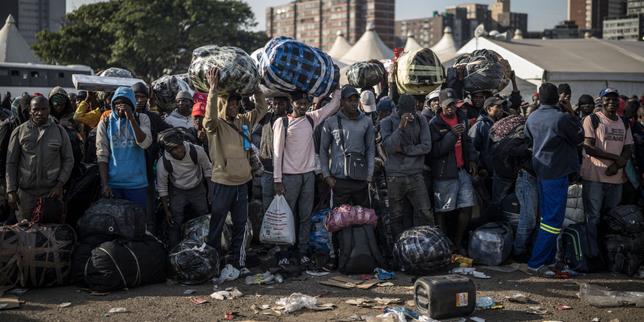
Thousands of people are currently packing their lives into overcrowded buses in Durban and Johannesburg, trying to escape a country before a terrifying ticking clock runs out. They aren't leaving because they want to. They're fleeing for their lives.
An informal, completely unauthorized deadline of June 30, 2026, has been circulating across South African social media and informal settlements. Set by aggressive anti-immigrant groups like the March and March movement, this date was issued as an ultimatum for undocumented foreign nationals to "self-deport". The threat behind it is clear. Leave, or face the consequences.
The situation on the ground is critical. Over 25,000 foreign nationals have already fled the country in panic. Many are heading back to neighboring states like Malawi, leaving everything they built behind. Meanwhile, the South African government is scramblying to maintain order, deploying a massive 600 million Rand security operation to prevent a total security collapse.
The Reality Behind the Unofficial June 30 Deadline
To understand why this is happening right now, you have to look at the groups driving the panic. The ultimatum wasn't declared by the state. It came from civic groups led by figures like Jacinta Ngobese-Zuma, the founder of March and March. They claim they're just pushing for legal compliance and border control. But their methods tell a completely different story.
Flyers mimicking official government notices have flooded communities. They falsely claim that mass state deportations and sweeps will begin immediately after the deadline. Videos of vigilante groups cornering migrants, demanding identity documents, and vandalizing foreign-owned businesses have gone viral on social media. It's a coordinated psychological campaign designed to spark terror.
The strategy is working. The fear is real. For thousands of African migrants sleeping outside consulates or waiting for emergency transport, the linguistic nuances of whether this is "citizens' activism" or "xenophobic violence" don't matter at all. They hear their neighbors telling them that blood will flow if they stay past the deadline. So they leave.
Why Scapegoating Immigrants Won't Fix the Economy
South Africa is trapped in a brutal, multi-layered economic crisis. That's the real fuel for this fire. The expanded unemployment rate has climbed past 40%. Most local municipalities are completely broke or on the verge of total institutional collapse. Basic public services like electricity, water, and healthcare are failing daily.
People are angry. They feel abandoned by the ruling African National Congress government. But instead of holding corrupt politicians and failed state structures accountable, that anger is being redirected toward the easiest target available. Foreign shop owners, laborers, and refugees.
It's a textbook distraction tactic. When prominent public figures and social media influencers blame migrants for clogging public hospitals or stealing jobs, they hide the truth. The reality is that foreign-born workers make up only a tiny fraction of the economy. For instance, in the higher education workforce, foreign staff account for just under 8%. In the local retail sector, foreign nationals make up only a minority of formal spaza shop registrations. Removing them won't magically create millions of jobs. It will just destroy local trade networks.
A Massive State Response to Prevent Chaos
The government knows it's sitting on a powder keg. Acting Police Minister Firoz Cachalia finalized an emergency operational plan, putting the South African Police Service on high alert. No police officers are allowed to take leave right now.
Law enforcement agencies, operating under the National Joint Operational and Intelligence Structure, have set up roadblocks, escorted repatriation buses, and arrested hundreds of people for incitement and public violence. The state is desperate to avoid a repeat of the July 2021 unrest, which saw widespread looting and over 300 deaths.
Minister of Justice and Constitutional Development Mmamaloko Kubayi has repeatedly declared that June 30 is a normal working day, not a national shutdown. She warned that vigilantism will be met with the full force of the law. The state maintains that only official government bodies have the right to enforce immigration laws.
But the state is playing a double game here. While President Cyril Ramaphosa gave a speech defending human rights and condemning vigilantism, his administration has simultaneously tightened refugee regulations and reduced documentation access. By framing migration as a key driver of economic hardship, the government inadvertently feeds the exact same anti-foreigner narrative it claims to fight.
The Human and Public Health Cost of the Crisis
This isn't just a political debate. It's a massive humanitarian issue that is actively breaking South African society apart. Public health professionals across the country are sounding the alarm. Xenophobia is a severe public health crisis.
When mobs block access to clinics and hospitals to check people's accents or skin color, everyone loses. Migrants stop seeking essential medical care, which undermines national programs for infectious disease prevention. It creates an environment of total distrust. Health workers are currently being urged by professional bodies to ignore the arbitrary deadline and treat every patient who walks through the door, regardless of their nationality or paperwork.
The psychological trauma is immense. Families are being ripped apart. Children are missing school because their parents are too terrified to let them walk outside. South Africans who happen to look "too foreign" or don't speak a local language fluently are also being caught in the crosshairs of vigilante checkpoints.
How to Protect Vulnerable Communities Right Now
If you are an activist, a community leader, or an ordinary resident who wants to prevent violence in your neighborhood, waiting for the police isn't enough. You have to take direct action to counter the panic.
First, dismantle the misinformation immediately. Share official government statements confirming that the June 30 deadline is completely illegal and has no legal backing. Make it clear to your peers that amateur citizen's arrests are unlawful and will result in criminal prosecution.
Second, support local grassroots solidarity structures. Groups like the Tembelihle Crisis Committee in southern Johannesburg are holding community meetings to actively discourage attacks and protect their foreign neighbors. Replicate these meetings in your local area. Build physical networks of safety.
Finally, document and report any signs of intimidation or irregular profiling to the South African Human Rights Commission or local law enforcement. Don't let vigilante groups operate with impunity in your streets. The only way to stop this cycle of violence is to refuse to let fear dictate how we treat our fellow human beings.