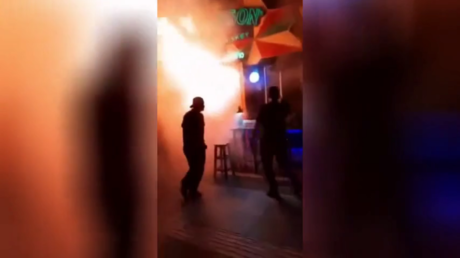
Smoke is choking the air just an hour south of Paris. The historic Fontainebleau forest is burning. It is not just a small brush fire that firefighters can put out in an afternoon. This is an exceptional disaster that has already chewed through 800 hectares of ancient woodland in less than twenty-four hours. That is roughly 5% of the entire forest gone.
If you have ever walked through these woods or climbed its famous sandstone boulders, this news hits hard. Fontainebleau is not just a collection of trees. It is a national treasure. It is a place where French kings hunted, where painters found inspiration, and where millions of weekend travelers escape the concrete grid of Paris. Now, it is a scorched zone.
The true shock lies in how fast it happened and how close it is to the capital. Wildfires are something people usually associate with the dry, baked hills of southern France or Spain. Not here. Not in the Île-de-France region. This disaster tells us that the rules of summer have officially changed.
A Massive Disaster Right on Paris Doorstep
The fire started on Sunday afternoon near Noisy-sur-École. It spread with terrifying speed. Fueled by a relentless heatwave and hot winds, the flames tore through dry brush and climbed straight into the pine canopies. By Sunday night, the local fire department described the situation as very virulent and of an exceptional scale.
The physical impact was immediate. Authorities had to partially shut down the A6 highway, which is the main artery connecting Paris to Lyon and the south of France. Imagine the chaos. It was the first major weekend for summer holiday departures, right before the July 14 national holiday. Families packed into cars found themselves trapped or diverted as thick black smoke blanketed the asphalt.
The rail lines took a massive hit too. High-speed trains running out of Paris Gare de Lyon faced delays of up to six hours. Passengers sat stranded in sweltering train cars while crews scrambled to manage the danger.
For the people living in the quiet villages dotted throughout the forest, it turned into a nightmare. In Le Vaudoue, the local fire service evacuated around fifteen homes as flames crept closer. Residents gathered near the village war memorial, watching emergency vehicles scream past. They had to pack up their pets, grab their papers, and leave. Valerie, a local resident who fled with her husband Daniel, described seeing ash falling like snow while the fire closed in on both sides of their road. It is the kind of terror locals here never expected to face.
Why the Fontainebleau Fire Is Unprecedented
We need to understand why this specific event is shaking French officials to the core. It comes down to geography and resource management. Historically, northern France does not get fires like this. The ecosystem is different, the climate is typically milder, and the regional emergency services are set up for structural fires, not raging forest blazes.
For the first time ever, authorities had to scramble water-bombing planes from the south of France to the Paris region. Think about that for a second. Firefighting aircraft had to fly hundreds of miles north because the local infrastructure simply does not have those tools on hand. Two planes, two helicopters, and an observation aircraft spent hours dropping water onto the canopy before nightfall forced them to pause.
Valérie Pécresse, the president of the Île-de-France region, did not hold back. She called it the worst fire the region has ever known.
The sheer scale of the destruction makes normal forest fires look tiny. According to the Office National des Forêts, Fontainebleau typically averages about 20 hectares of fire damage per year. This single blaze wiped out dozens of times that amount in a blink. It is an absolute anomaly that shows how vulnerable northern ecosystems have become.
The Dark Side of the Smoke
There is an even more sinister element to this disaster. It looks like someone did this on purpose.
Interior Minister Laurent Nuñez visited the operations room in Fontainebleau and dropped a bombshell. Investigators found roughly ten different ignition points within a one-kilometer radius. They also found two distinct ignition points on opposite sides of the A6 motorway. Fires do not just naturally start in ten places at once.
The National Gendarmerie is running a full criminal investigation. If this is arson, it is an act of environmental terrorism. So far this year, authorities across France have arrested 44 people on suspicion of starting forest fires. The anger among locals and officials is palpable. People are demanding exemplary punishment for whoever caused this destruction.
Setting a fire in these conditions is flat-out malicious. The forest was already a tinderbox. France is currently sweating through its third red-alert heatwave of the summer. Temperatures in the region have blown past 40 degrees Celsius. The soil is dry. The leaves are crisp. It takes nothing more than a single match or a discarded cigarette to start a catastrophe, let alone ten deliberate sparks.
How Firefighters Are Battling the Beast
Right now, around 500 firefighters are on the ground. They are facing a monster.
Fighting a forest fire in Fontainebleau is uniquely difficult because of the terrain. The forest is famous for its chaotic mazes of sandstone boulders and sandy paths. It is a paradise for hikers, but it is hell for heavy fire trucks. Emergency vehicles cannot easily navigate the narrow, rocky tracks. Firefighters have to drag heavy hoses through rough terrain on foot, risking their lives while the wind changes direction without warning.
Pierre Ory, the prefect for the Seine-et-Marne department, noted that the fire was still progressing moderately on Monday. Containing it is a slow, grueling process. Fire officials estimate that while they might stop the active spread soon, fully extinguishing the underground embers could take several weeks. Forest fires can smolder deep in the root systems and the peat, waiting for a gust of wind to flare back up.
The immediate goal is protecting human life and saving homes. So far, the massive deployment has worked to prevent injuries and structural losses, but the pressure is immense. Resources are stretched thin across the country as smaller fires pop up elsewhere, all while France tries to celebrate its national holidays.
The Impact on Nature and Tourism
The damage to the local environment is going to leave scars for decades. Fontainebleau is a delicate biosphere. It houses rare insects, birds, and specific plant life that thrive in its unique sandy soil.
The fire tore straight through popular areas, including sections near the famous 25 Bosses hiking trail. This area is legendary among the global bouldering community. Climbers travel from all over the world to test their skills on these specific rocks. Now, the surrounding trees are charcoal, and the area is completely closed off.
Some commentators online have tried to downplay the damage, arguing that forest ecosystems recover within a few years. That is a dangerous misunderstanding. While small ground brush can grow back quickly, the massive oaks and pines that form the heart of Fontainebleau take centuries to mature. You cannot just replace a 200-year-old tree. When 5% of a forest like this burns to the ground, the local microclimate alters, shade disappears, and soil erosion accelerates.
The economic hit to the region will also be severe. Fontainebleau relies heavily on outdoor tourism. Hotels, guesthouses, and local cafes depend on the steady stream of hikers, climbers, and cyclists. With large swathes of the forest closed for safety and restoration, local businesses face a grim summer season.
What We Need to Do Next
This fire is a symptom of a much larger crisis. The planet is getting hotter, and areas that used to be safe are now on the front lines. We cannot treat this as an isolated accident or just a bad stroke of luck with arson.
If you visit forested areas during the summer, you have to change your behavior immediately. The old habits do not work anymore.
- Respect all forest closures. Do not try to sneak into closed sectors for a quick hike or a climb. You risk getting trapped, and you pull emergency resources away from active fire zones.
- Report suspicious behavior instantly. With arson on the rise, if you see someone messing around with fire Starters or acting strange in a dry wooded area, call the authorities immediately.
- Forget campfires and outdoor grills completely. Even if you think you are being safe, a single flying ember can catch a dry branch twenty feet away. It is not worth the risk.
- Keep roads clear. If you see emergency vehicles or smoke, clear the area. Do not stop to take photos or gawk. Highway closures happen for a reason, and traffic jams block life-saving equipment.
The tragedy in Fontainebleau shows that climate change is not a far-off problem for the next generation. It is happening right now, right outside Paris. The loss of 5% of this historic forest is a permanent scar on the land, and a stark reminder that we are running out of time to protect what is left.