Military aviation is a high-stakes environment where a single component failure turns a routine flight into a crisis. On July 9, 2026, a Greek pilot faced exactly that scenario over the Ionian Sea. A standard training flight in a Hellenic Air Force F-16C Fighting Falcon went wrong fast, forcing an emergency belly landing at Zakynthos International Airport.
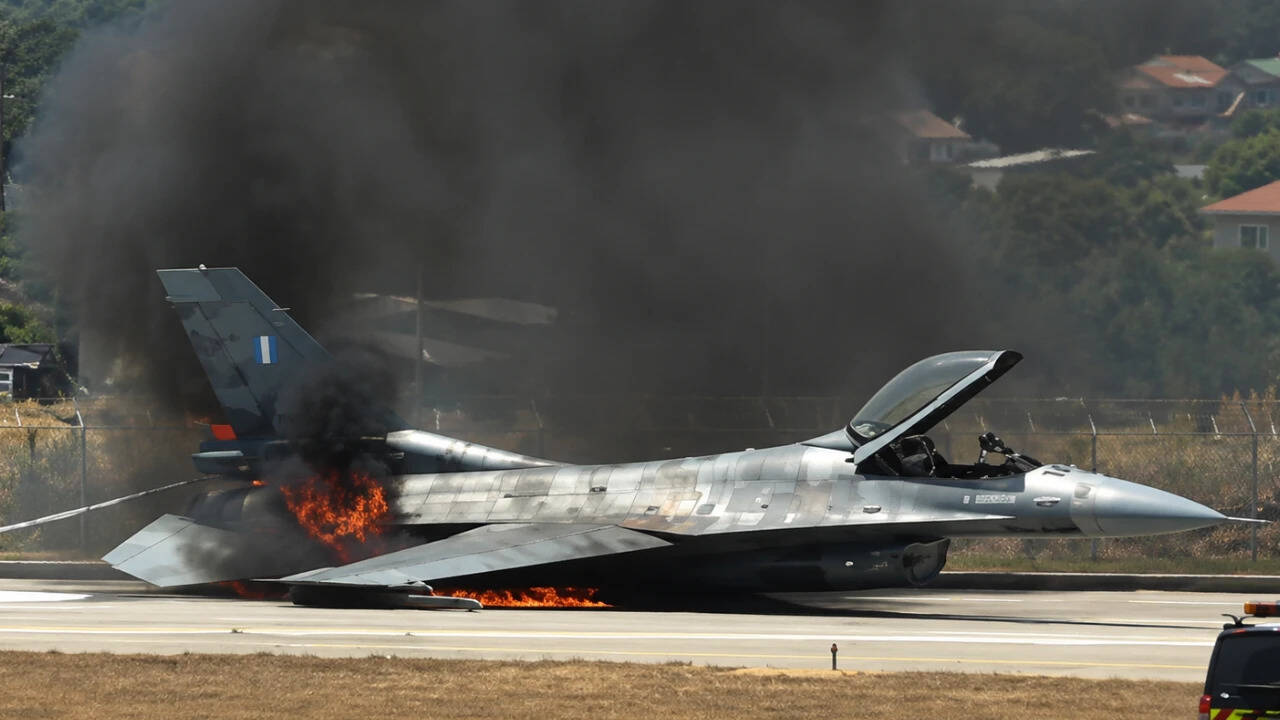
The aircraft skidded down the runway, friction tore at the metal, and flames erupted from beneath the fuselage. Yet the pilot walked away without a single scratch.
This incident offers a rare look into high-stress military decision-making, mechanical failure modes, and the sudden intersection of tactical fighter operations with civilian holiday travel. It was not just a dramatic accident. It was an example of perfect emergency execution under extreme pressure.
Anatomy of a Mid-Air Mechanical Crisis
The flight started routinely from Araxos Air Base, located on the northwestern Peloponnese peninsula. The jet belonged to the renowned 116th Combat Wing, a cornerstone of Greece's air defense strategy. At around 1:45 p.m. local time, the pilot noticed a severe malfunction shortly after takeoff. Reports indicate the core problem involved a catastrophic landing gear failure, compounded by indications of an initial engine fire threat.
When a fighter pilot encounters a landing gear malfunction, options shrink by the second. Flying back to Araxos was out of the question due to the nature of the technical issue. The pilot immediately notified the National Air Operations Center, the Tactical Air Force Command, and the home base. Command gave the instruction to divert immediately to the nearest viable strip, which happened to be Dionysios Solomos Airport on the tourist-heavy island of Zakynthos, commonly known as Zante.
Choosing a civilian airport for a military emergency is never ideal, but it's often the only choice to save a life. Zakynthos possesses a single runway, which handles millions of European vacationers every summer. Diverting a multi-million dollar weapon system with an active emergency toward a commercial hub requires rapid, calculated coordination. Air traffic control scrambled to clear the airspace, putting all inbound and outbound civilian flights on immediate hold.
The Dangerous Physics of a Gear-Up Landing
Landing a modern jet fighter without the undercarriage deployed is an aerodynamic nightmare. The F-16 is designed to withstand intense landing impacts on its heavy-duty tires and struts. When those struts stay locked inside the belly, the pilot must slide the aircraft directly onto its aluminum and composite skin, external fuel tanks, or structural hardpoints.
Footage captured by onlookers showed the F-16 approaching the Zakynthos runway with its belly completely bare. No wheels down. As the metal hull met the concrete tarmac, the friction created intense heat instantly. The jet slid for hundreds of meters along the runway, throwing a massive trail of sparks and immediate fire.
The intense friction fire combined with any residual fuel vapor is what typically destroys an aircraft in this situation. The F-16 features a single engine, meaning its fuel lines run tight against the central fuselage. If the structural skin wears through during the slide, the fuel tanks rupture, turning the entire jet into a massive fireball.
The airport emergency response crews saved the day here. Because they received early warnings from military command, firefighting vehicles were already positioned along the runway before the jet even touched down. As the sliding jet ground to a halt, emergency crews swarmed the burning airframe, dousing the flames with highly specialized suppression foam and water within seconds. They prevented the fire from breaching the main fuel cells, protecting the integrity of the cockpit module.
Why Egress Beat Ejection in This Crisis
A common question in military aviation accidents is why the pilot chose not to eject. The F-16 is equipped with an advanced ACES II ejection seat, capable of safely launching a pilot even from zero altitude and zero speed. Ejection, however, is a violent event. It subjects the human body to massive G-forces, often resulting in spinal compression, broken bones, or permanent career-ending injuries.
Ejection also leaves the unpiloted aircraft to crash wherever its momentum takes it. Over a highly populated tourist island like Zakynthos, ejecting early could have sent a driverless, fuel-heavy fighter jet crashing into a resort, a terminal, or a residential neighborhood.
The pilot chose the much braver, more controlled path. By sticking with the airframe through the belly landing, the pilot maintained control over where the jet traveled on the ground. Once the plane stopped, the pilot opted for a ground egress.
Images from the scene confirm the canopy remained fully intact and the ejection seat was unfired. The pilot popped the canopy manually, unbuckled from the survival kit, climbed out of the burning airframe, and ran to safety. Lieutenant Colonel Konstantinos Gravalos, a spokesperson for the Hellenic Air Force, later confirmed to international media outlets that the pilot walked away completely unharmed and in excellent health.
[Image diagram showing the component layout of an F-16 fighter jet fuselage]
Logistical Fallout Across European Tourism Hubs
The survival of the pilot was a triumph, but the physical location of the crash triggered immediate chaos for commercial travel. Zakynthos is a major summer destination for northern Europeans, particularly British vacationers. The airport handles over two million passengers annually, mostly concentrated in the hot summer months.
Because the disabled, fire-damaged F-16 was sitting right on the single runway, the entire airport ground to an absolute halt. Authorities issued an emergency Notice to Airmen (NOTAM) around 12:10 UTC, officially closing the runway to all traffic except for authorized medical, military, or government helicopters.
The closure sent shockwaves through regional air traffic control networks. Inbound flights operated by major airlines like British Airways, TUI, Ryanair, Jet2, and easyJet had to abandon their approaches. Dozens of flights were diverted mid-flight to alternative Greek airports, including Athens, Corfu, and Thessaloniki.
Thousands of passengers found themselves stranded. Some were stuck inside diverted planes on hot tarmacs elsewhere in Greece, while others sat inside the packed Zakynthos terminal waiting for updates on canceled flights. The physical removal of a military jet with potential structural damage, remaining volatile fuel, and unexploded emergency systems is a slow process. Crane crews and military investigators had to carefully secure the airframe before clearing the runway for commercial operations.
The Reality of Shared Military and Civilian Infrastructure
This accident highlights a broader reality of modern European defense logistics. Military wings and commercial airlines frequently share regional airspaces and emergency infrastructure. The Hellenic Air Force operates extensively over the Aegean and Ionian seas, balancing defense readiness with Greece's massive commercial tourism economy.
The 116th Combat Wing at Araxos, which operated the crashed F-16, is a highly decorated unit. It consists of the 335th and 336th squadrons. These units are known historically for being the very last in the world to fly the venerable A-7 Corsair II before its retirement in 2014. Today, they fly block-upgraded F-16s, maintaining tight readiness parameters due to regional geopolitical tensions.
When training exercises occur near major tourist tracks, risks are mitigated by strict protocols. The quick thinking of the pilot and the immediate response of the civilian airport's fire crews prove that these emergency coordination frameworks actually work under pressure. The financial cost of the damaged F-16 is significant, but avoiding civilian casualties and preserving the life of a trained fighter pilot makes the outcome a definitive success for emergency operations.
Immediate Action Steps for Impacted Travelers
If you are currently traveling through or scheduled to fly into the Ionian region, don't rely on generic flight boards. Take these specific steps to manage the disruption.
- Check Live Airframe Status: Use tools like Flightradar24 to look up your actual incoming aircraft's tail number rather than relying solely on the airport terminal screen. This tells you exactly where your plane is diverted.
- Contact Your Tour Operator Directly: If you booked a package holiday through TUI or Jet2, they are legally obligated to manage your accommodation and ground transfers if your flight is shifted to mainland hubs like Athens.
- Document Everything for Insurance: Keep receipts for meals, water, and alternative transit. Standard European passenger rights regulations (EU261) handle military-induced airport closures under extraordinary circumstances, meaning cash compensation for delays is unlikely, but duty of care expenses like hotels must still be covered by the operating carrier.