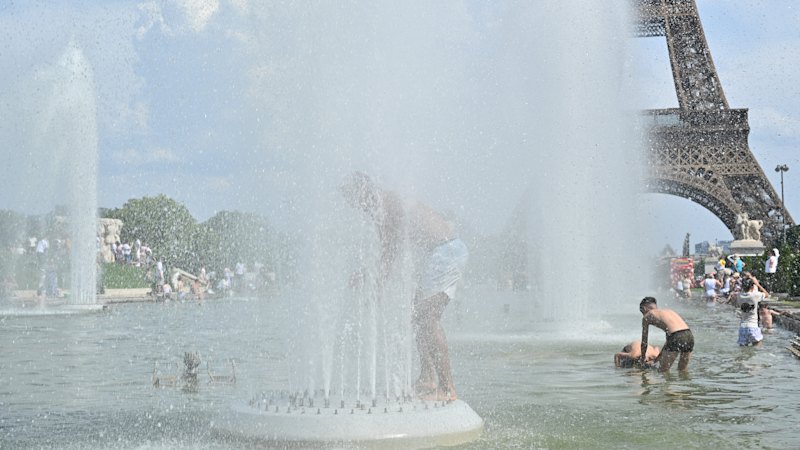
The ground is baking, the air feels like a furnace, and it's barely the start of summer. Right now, a massive high-pressure weather system is trapping sizzling air from the Sahara desert over large swathes of western and central Europe. Meteorologists call this phenomenon a heat dome. In reality, it feels more like living inside an unventilated brick oven.
If you're tracking the weather maps this week, the numbers are brutal. Temperatures are charging straight toward 40 degrees Celsius in countries that historically built their cities for cold winters, not oppressive tropical heat. Red alerts are flashing across major Italian hubs like Milan, Florence, and Turin. One-third of France is under extreme weather advisories, and Spain is seeing the mercury explode past normal seasonal limits. Discover more on a similar issue: this related article.
This isn't just a tough week to be a tourist in Rome. It's a systemic infrastructure crisis hiding behind a sunny forecast.
The Mechanics Behind the Suffocating Air
You can't blame this entirely on standard summer patterns. The current crisis is fueled by a severe atmospheric setup called the African anticyclone. Think of it as a heavy, invisible lid clamped down over the continent. Additional journalism by Reuters delves into comparable views on this issue.
When hot air travels north from the Saharan desert, this high-pressure system forces the air downward. As the air sinks, it compresses. Basic physics tells us that compressing gas drives the temperature straight up. The lid traps the heat, preventing clouds from forming and allowing the intense mid-June sun to bake the earth for up to 16 hours a day.
Day after day, the ground stores that energy. The heat accumulates, and the nights offer no relief. When dark falls, concrete and asphalt radiate that stored heat back into the air, creating what scientists call tropical nights where temperatures never drop low enough for the human body to recover.
Why European Cities are Crumbling Under 40 Degrees
If you're from a perennially hot climate like Texas or Australia, 40 degrees Celsius sounds manageable. You simply crank up the central air conditioning and go about your day. But Europe wasn't built for this.
Less than 5% of European homes have built-in air conditioning. Apartments are designed to trap heat to keep residents warm during freezing winters. Thick masonry walls and insulated windows turn into thermal traps when summer anomalies hit. People are literally melting inside their own living rooms.
The infrastructure failure runs deeper than personal discomfort.
- Rail networks are stalling. In France, the national rail operator SNCF had to cancel dozens of intercity trains. Steel tracks expand under the blazing sun, risking derailment, while ancient overhead power lines sag and snap under thermal stress.
- Schools are shutting down. Hundreds of French schools ordered immediate closures because classrooms became dangerously hot.
- The energy grid is sweating. In Germany, power prices spiked sharply because wind generation dropped at the exact moment everyone plugged in portable fans, forcing utilities to rely on expensive backup energy sources.
Wildlife is paying a terrible price too. Rescue centers in Belgium report an influx of hundreds of heat-stressed animals. Young birds are throwing themselves out of nests under roof tiles because they are quite literally cooking alive in the shade.
Immediate Steps to Stay Safe
If you are currently living through this heat dome or traveling through western Europe, you need a survival strategy. Sitting near an open window won't save you when the outside air is hotter than your body temperature.
Seal the Fortress Early
Don't leave your windows open during the day. The moment the outside temperature creeps past 25 degrees, shut every window and draw every blind or curtain. You want to block the solar radiation from hitting your floors and walls. Open everything up only late at night when the outside air finally drops below the inside temperature.
Hydrate Before You Feel Thirsty
If you wait until you're thirsty, you're already dehydrated. Drink water constantly. Skip the heavy beers, iced coffees, and sugary sodas. Alcohol and caffeine act as diuretics, forcing your body to lose water faster when it desperately needs fluid to produce sweat and cool your core.
Master the Evaporative Cool Down
If you lack air conditioning, fans alone can be dangerous when indoor air exceeds 35 degrees. They end up blowing hot air over you like a convection oven, speeding up dehydration. Instead, drape a wet, cool towel over your shoulders or feet while sitting in front of the fan. The evaporating water mimics natural sweating and drops your skin temperature instantly.
The Reality Shift for European Travel
The old playbook of wandering through European cities in mid-summer is dead. Over 200,000 heat-related deaths have occurred across Europe over the last four years. This is a severe public health reality.
If you have trips planned for July or August, adapt immediately. Move your outdoor sightseeing to early morning hours before 11 am. Avoid the late afternoon altogether, which is when the ground finishes cooking and ambient temperatures hit their dangerous peak. Carry a small electric fan, wear light colors, and know exactly where air-conditioned public spaces, like museums or modern shopping malls, are located along your route.
The climate has shifted, and our summer habits have to shift with it. Stay indoors, look out for vulnerable neighbors, and don't underestimate the power of a compressed air mass.
This Europe Heatwave report provides deep visual insight into how these early summer heat systems are shattering historical records across the continent.