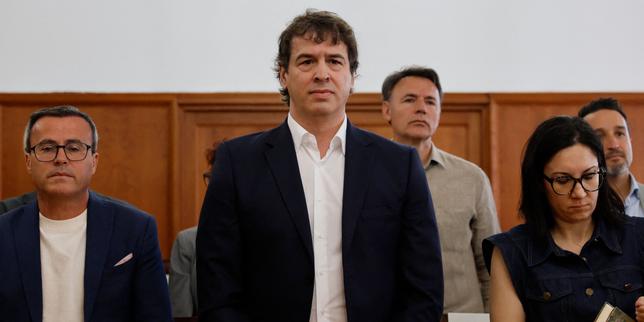
Spanish politics just took another massive hit. On July 14, 2026, a court in the south-western region of Extremadura handed down a ruling that sent shockwaves all the way to Madrid. David Sanchez, a classic composer, orchestra conductor, and the younger brother of Spain's Prime Minister Pedro Sanchez, was convicted of administrative misconduct.
The court banned him from holding any public office or exercising voting rights for the next nine years.
If you've been following the ongoing political theater in Madrid, you know this is a brutal blow. This isn't just an isolated case of local corruption in a sleepy province. It's a direct hit to the political survival of Pedro Sanchez and his fragile left-wing coalition government. Let's break down what actually happened in Badajoz, why this ruling matters so much, and what it means for Spain's immediate future.
A Tailor-Made Job for a Premier's Brother
To understand how we got here, we have to go back to July 2017. At the time, Pedro Sanchez was the national leader of the Spanish Socialist Workers' Party (PSOE) but hadn't yet grabbed the keys to the prime minister's office, which he did in 2018.
Down in the Badajoz province, the local council was firmly run by the PSOE. The council decided to create a brand-new position: coordinator of public music schools and conservatories. It sounds like a normal public job.
Except the court found it was anything but normal.
According to the Badajoz court's ruling, this position was "neither necessary nor urgent." Before David Sanchez walked into the office, those specific administrative coordination duties were handled by regular conservatory professors as part of their standard workload, without costing taxpayers a single extra euro. The court ruled that the job was engineered entirely "to serve the private interest of its recipient and not the public interest."
The judges didn't mince words. They called the creation of this role a completely useless administrative exercise. It was designed to fit David Sanchez's specific resume and musical background—he had trained in Toulouse, Saint Petersburg, Tokyo, and Madrid—and to give him a steady public salary.
Along with David Sanchez, ten other co-defendants went on trial in May 2026. The most prominent among them was Miguel Angel Gallardo, the former president of the Badajoz provincial council and a powerful regional PSOE figure. The court was far harsher on Gallardo, banning him from public office for a staggering 18 years for his central role in setting up the position.
What Actually Happened in Badajoz
This trial was about how local governments use public funds to reward friends and family of political heavyweights. The prosecution argued that David Sanchez's job was later transformed into the head of the province's performing arts office, which kept him on the public payroll until at least early 2025.
The court convicted David Sanchez of being an accomplice in prevaricación administrativa (administrative misconduct or abuse of office). In Spanish law, this charge applies when a public official makes an arbitrary and illegal decision knowing that it violates the law.
But David Sanchez managed to dodge a bullet.
He was acquitted of the more serious charge of influence peddling. The prosecution failed to prove that David Sanchez or anyone else in his circle exerted direct pressure on Badajoz officials to get him hired. If he had been convicted of influence peddling, he would likely be facing real prison time today. Instead, he walked away with a nine-year ban from public service and no jail sentence. He can still appeal this decision to higher courts.
The defense argued all along that the job was perfectly legal, that David Sanchez was fully qualified as an international conductor, and that the prosecution was a politically motivated witch-hunt. But the Badajoz judges disagreed. They pointed out that public resources are not a private sandbox for the families of politicians.
The Shift to Portugal and the Ghost Job Accusation
The financial and physical details of David Sanchez's employment made this case a media sensation in Spain. Beyond the initial hiring scandal, there was the highly embarrassing issue of where he actually lived while drawing his public salary.
In late 2021, David Sanchez officially moved his residence to Portugal.
Portugal has a highly favorable tax regime for foreign residents, meaning his tax bills plummeted. Yet, he was still employed as a full-time coordinator for the Badajoz provincial council in Spain.
How do you manage a local music coordination role in southwestern Spain while living across the border in Portugal?
The short answer is, you don't. Evidence presented during the investigation showed that David Sanchez was rarely seen at his actual workplace. He didn't have a designated physical office for a long time, and his physical attendance was sporadic at best. Opponents quickly labeled the position an empleo fictivo—a ghost job. He was getting paid by Spanish taxpayers while enjoying a low-tax lifestyle in Portugal. This detail turned public opinion heavily against him, even among moderate left-wing voters who usually back his brother.
Why This Hits Pedro Sanchez Where It Hurts Most
You can't separate David Sanchez's legal troubles from the political situation of his brother, Prime Minister Pedro Sanchez.
Pedro Sanchez has built his entire political brand on being the clean alternative to the conservative People's Party (PP), which was kicked out of power in 2018 following a massive kickback scandal known as the Gürtel case. For years, the PSOE claimed the moral high ground on corruption.
That moral high ground has dissolved.
The Prime Minister's political opponents on the right and far-right are having a field day. The legal complaint against David Sanchez was initiated by Manos Limpias (Clean Hands), a self-styled trade union with well-documented links to Spain's far-right. While the PSOE has repeatedly dismissed Manos Limpias' legal actions as politically motivated "lawfare" designed to destabilize the government, the Badajoz court's ruling proves that, in this case, the allegations had real legal merit.
The timing is awful for the government. Pedro Sanchez leads a highly unstable, minority coalition government that relies on the votes of Basque and Catalan nationalist parties to pass any legislation. Every single corruption scandal chips away at the government's credibility and makes those crucial coalition partners nervous.
A Perfect Storm of Legal Troubles for the PSOE
If David Sanchez's conviction were the only scandal, the government might be able to spin it as a minor local issue in Extremadura. But it isn't. The Prime Minister is surrounded by a ring of legal fire.
Look at the timeline of just the last few months of 2026.
In June 2026, Jose Luis Abalos, Pedro Sanchez's former right-hand man and transport minister, was sentenced to 24 years in prison by the Supreme Court for his role in a massive corruption and bribery scandal. Abalos was once the organizational muscle of the PSOE.
At the same time, Begona Gomez, the Prime Minister's wife, is under active judicial investigation for alleged influence peddling and corruption related to her private business activities and university connections.
Even Jose Luis Rodriguez Zapatero, the former Socialist Prime Minister and a close mentor to Pedro Sanchez, has found himself under investigation by the country's top criminal court over alleged international influence peddling and money laundering schemes.
When you add David Sanchez's nine-year ban to this list, the narrative of "isolated incidents" becomes impossible for the PSOE to maintain. The opposition is loudly demanding a snap general election, claiming that the Prime Minister is running a government completely compromised by familial and institutional corruption.
The Next Steps for Spain and the Sanchez Administration
The government's immediate strategy is damage control and deflection.
Government spokeswoman Elma Saiz told reporters that the administration maintains full confidence in the justice system and believes higher courts will eventually vindicate David Sanchez on appeal. Transport Minister Oscar Puente went further, accusing the opposition of using the courts to bring down a democratically elected government because they can't win at the ballot box.
But spinning this ruling won't be easy. The Badajoz court's decision is factual, detailed, and written by local judges who analyzed years of employment and tax records.
If you want to keep an eye on how this plays out, watch these three indicators.
- The Appeal Process: David Sanchez's legal team will undoubtedly appeal to the regional high court. If that court upholds the nine-year ban, his public career in Spain is permanently over, and the political damage to his brother will be locked in.
- Coalition Stability: Watch the reaction of the Catalan and Basque nationalist parties. If they decide that supporting Pedro Sanchez is becoming too politically costly ahead of future regional elections, they could pull their support, triggering an early general election.
- The Begona Gomez Investigation: The Prime Minister's wife remains the ultimate political prize for the opposition. If her investigation leads to an actual trial, Pedro Sanchez's position may become completely untenable.
The era of Pedro Sanchez pretending his family's legal troubles are just right-wing fantasies is over. A Spanish court has ruled, and the verdict is clear: his brother's job was an illegal, taxpayer-funded favor. How the Prime Minister navigates this reality will define the rest of his political life.