Elon Musk proved that landing rocket boosters on their own legs is possible. For a decade, the entire aerospace industry tried to copy SpaceX's homework. Everyone assumed heavy, deployable landing legs were the only way to build a reusable space program.
China just proved everyone wrong.
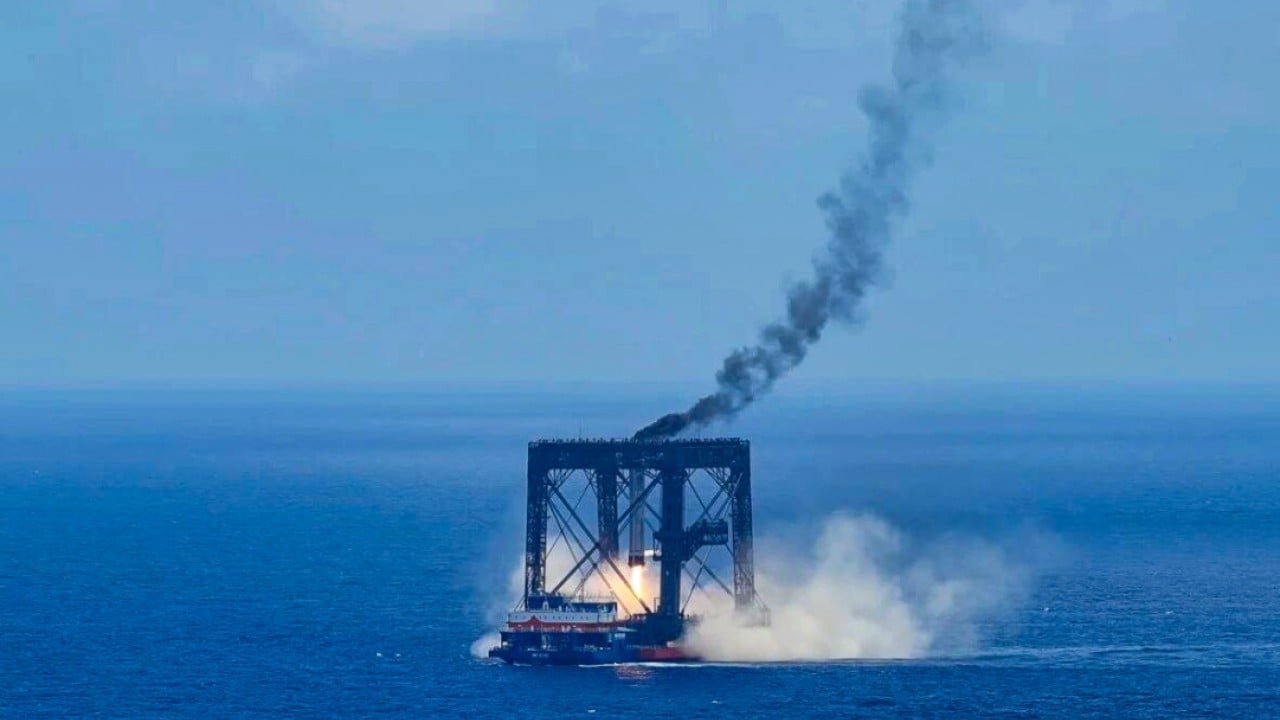
On July 10, 2026, the state-owned China Academy of Launch Vehicle Technology (CALT) launched its brand-new Long March 10B rocket from Hainan Island. It deployed a satellite, flipped around, and roared back down toward earth. But instead of extending massive metal legs to touch down on a drone ship, the 63-meter-tall booster dropped straight into a massive net suspended above a modified vessel named the Linghangzhe.
Four hooks near the top of the rocket snagged tensioned steel cables. The net absorbed the kinetic energy, and the rocket hung there, safely suspended above the ocean waves.
It worked perfectly on its very first try.
If you think this sounds like a circus act or a desperate engineering gimmick, you are missing the point entirely. This net-capture method solves the single biggest problem with reusable rockets: the tyranny of dead weight.
The Brutal Math Behind Rocket Legs
Every ounce of weight added to a rocket booster degrades its performance. If you want a rocket to land on legs, those legs have to be incredibly strong, heavily insulated against reentry heat, and packed with complex hydraulic systems.
Worse yet, those legs are dead weight for 99% of the mission. They ride all the way to the edge of space and back, eating up fuel and stealing precious payload capacity that could otherwise carry revenue-generating satellites.
By ditching the landing legs, Chinese engineers pulled off a brilliant engineering trade-off. They shifted the mechanical complexity away from the flight vehicle and onto the ground infrastructure.
The Long March 10B needs only a set of grid fins to steer and four lightweight hooks near the top of the tank structure. The heavy, complicated machinery remains on the ship.
This design choice maximizes efficiency. In its reusable configuration, the Long March 10B can still carry roughly 16 metric tonnes of cargo to low-Earth orbit. That places it squarely in the same weight class as a SpaceX Falcon 9, but without the structural penalty of carrying heavy landing gear through orbit.
Inside the Linghangzhe Recovery System
The ship at the center of this milestone is the Linghangzhe, which translates to Navigator. It is a 144-meter-long vessel packed with specialized marine technology.
To catch a falling skyscraper, the ship cannot just sit there blindly. It utilizes a high-precision dynamic positioning system to maintain its exact orientation despite ocean currents and wind gusts.
As the Long March 10B plummeted through the atmosphere, it lit three of its kerosene-liquid oxygen engines to slow its descent. Grid fins sliced through the air, refining its trajectory toward the ship.
When the booster reached the platform, it did not try to balance on a small surface. It aimed for a wide, cable-supported net structure. The four hooks on the booster engaged the tensioned steel cables, allowing the platform's braking system to absorb the final impact smoothly.
This system handles landing errors much better than a traditional pad. If a leg-based rocket misses its target by a few meters, it tips over, explodes, and destroys the drone ship. If a net-caught rocket wanders slightly off-center, the flexible cable network can flex and accommodate the variance.
The Three Paths to Rocket Recovery
We now have three distinct, proven philosophies for recovering an orbital-class rocket booster.
First, there is the Falcon 9 approach. The rocket carries its own legs and lands vertically on a flat surface. It is highly reliable, but it requires the rocket to carry significant structural dead weight on every single journey.
Second, there is the Starship approach. SpaceX's massive Mechazilla launch tower uses giant mechanical arms to catch the Super Heavy booster mid-air. This keeps the booster lightweight, but it requires an enormous, expensive tower on land. You cannot easily mount a Mechazilla tower on a moving ocean vessel to catch rockets far downrange.
Third, we now have China's net-capture system. It offers the weight-saving benefits of a tower catch but packages the system onto a mobile ocean platform. This allows the rocket to execute downrange landings, saving a massive amount of fuel that would otherwise be wasted flying all the way back to the launch site.
Beijing's Real Goal Behind the Tech
This development is not just about showing off cool technology. China faces a massive orbital bottleneck.
The Chinese government has made it clear that building out massive satellite constellations is a matter of strategic importance. Projects like the Qianfan mega-constellation aim to place thousands of communications satellites into low-Earth orbit to compete directly with Starlink.
Up until now, China's launch rate simply could not keep pace with its ambitions. Throwing away expensive rocket stages after a single flight is too slow and far too expensive.
The state-led aerospace sector needed a workhorse that could fly, land, and fly again within weeks. CALT engineers claim they intend to refurbish and re-fly this exact Long March 10B booster before the end of 2026. If they pull that off, the speed of Chinese satellite deployment will skyrocket within the next twenty-four months.
Unlike the American model, which relies heavily on private capital and independent giants like SpaceX, China operates through heavily coordinated state-owned enterprises. The development of the Long March 10 family is directly tied to the country's broader geopolitical goals, including its planned crewed lunar missions before 2030.
What to Watch Next
The successful catch on July 10 changed the game for rocket reusability. Here is how you can verify if this approach truly has long-term viability:
- Watch the turnaround time. Follow state media updates to see if CALT meets its goal of re-flying this booster before 2026 ends. A fast turnaround proves the net does not cause hidden structural damage to the airframe.
- Monitor structural wear. Look for engineering reports detailing how the hook attachment points handle the immense stress of deceleration.
- Track private competitors. Watch private Chinese firms like LandSpace, CAS Space, and Deep Blue Aerospace to see if they abandon their leg-based designs to adopt the state's net-capture infrastructure.