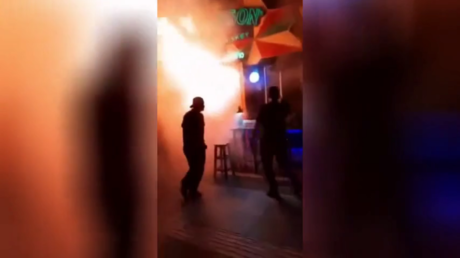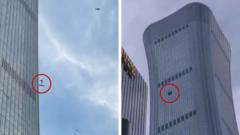
A light aircraft slammed directly into the side of Beijing's tallest building on Friday afternoon. It happened right in the middle of the crowded central business district during rush hour, showering the streets below with shattered glass and metal shards. If you went looking for the news on Chinese social media shortly after, you found a blank wall. Videos vanished. Hashtags disappeared. Search results for China Zun, the nickname of the 1,760-foot CITIC Tower, suddenly rolled back to the previous day as if time itself had stopped.
The event is a logistical and political nightmare for authorities in the capital. It bypassed some of the tightest air defense protocols on earth. It happened just a few miles from the leadership compound of the Communist Party. Most importantly, it completely shredded the strict low-altitude bans recently put in place to turn Beijing into an absolute no-fly zone.
The Chaos in the Guomao District
Around 5:40 PM, workers in the Chaoyang District heard a sound that didn't fit the usual city drone. Courriers and office workers reported a blast louder than any celebratory firework. A two-seat Sunward SA60L Aurora light sport aircraft, roughly the physical size of a small car, collided with the upper floors of the 109-story skyscraper.
The impact shattered heavy double-paned glass panels high up on the tower facade. Pieces of the plane, including a mangled wing section, ripped away and plunged toward the pavement. On the ground, panic sent pedestrians scattering into nearby subway entrances and underground shopping malls. A falling piece of debris smashed through the window of a passing taxi.
[Crash Timeline - June 26, 2026]
5:10 PM - Sunward SA60L Aurora takes off from Shifosi Airport in eastern Beijing.
5:30 PM - Plane drastically deviates from its approved flight path.
5:40 PM - Transponder signal cuts out near the East Fifth Ring Road.
5:42 PM - Aircraft impacts upper tier of the 528-meter CITIC Tower.
6:00 PM - Police seal off Guomao district, ordering witnesses to scrub phone video.
Emergency crews responded quickly. Fire trucks, heavily armed police units, and ambulances lined the surrounding avenues within minutes. Building security initiated a mass evacuation, spilling thousands of white-collar workers onto the sidewalks. By 6:45 PM, witnesses looking out from neighboring skyscrapers spotted a large blue tarp hastily rolled out across a section of the asphalt, hiding a vehicle-sized mass of wreckage from view.
Anatomy of the Sunward SA60L Aurora
The plane involved in the crash wasn't a massive commercial airliner, which explains why the structural damage to the tower was largely superficial rather than catastrophic. The Sunward SA60L Aurora is a domestically manufactured light sport aircraft. It is highly popular among private flight schools and hobbyists across mainland China.
It runs on a single engine, weighs about 600 kilograms at maximum takeoff capacity, and tops out at a cruising speed of roughly 220 kilometers per hour. It features a carbon fiber shell, meaning it is incredibly lightweight. When it struck the reinforced steel and thick glazing of China Zun, the building won the physical exchange. The plane essentially crumpled on impact, leaving a visible gash along the outer panels but leaving the structural integrity of the skyscraper fully intact.
The plane carried the registration B-12PP. Records indicate it belonged to a general aviation outfit operating out of Shifosi Airport, a small airfield located on the eastern rural fringes of the municipality. The solo pilot on board lost contact with air traffic controllers shortly before the collision, right around the time the plane made an unannounced, sharp turn directly toward the heart of the capital city.
Breaking Through the Fortified Airspace
To understand why this crash caused an immediate panic within the security apparatus, you have to understand just how heavily fortified the sky above Beijing actually is. The central government operates a multi-layered airspace management system that treats the urban core like a military base.
Civilians don't just buy a light plane and go for a weekend cruise. To get an aircraft into the sky anywhere near the municipality, an operator must secure explicit, multi-agency clearance from both the Civil Aviation Administration of China and the People's Liberation Army Air Force. This process requires submitting exact flight paths days in advance.
The restrictions became even more severe earlier this year. On May 1, Beijing enacted a sweeping low-altitude ban that effectively turned the capital into a drone-free and light-aircraft-free zone. Under those rules, casual recreational flying is entirely illegal. Even commercial drone operators have to jump through massive regulatory hoops for basic mapping tasks.
A former commercial pilot familiar with Beijing flight operations noted that entering the airspace inside the second ring road triggers an immediate military response. The CITIC Tower sits just outside the third ring road, putting it a matter of seconds away from the ultimate red line. The fact that a rogue sport plane managed to fly deep into the Central Business District without being intercepted points to a massive gap in low-altitude monitoring networks. Radars tuned to watch for fast-moving military threats or high-altitude commercial flights often struggle to track a tiny, carbon-fiber aircraft flying low among the hills and outskirts before it darts into the skyline.
The Information Blackout
The physical cleanup of the wreckage was remarkably fast, but the digital cleanup was even faster. Within half an hour of the impact, the machinery of online censorship swung into action across the Chinese internet.
Videos captured by bystanders showing the plane's tail section falling through the air were wiped from Weibo. Search queries for the terms plane crash Beijing or China Zun airplane yielded zero new results on apps like Xiaohongshu. The state-run evening news broadcasts completely ignored the event, focusing instead on standard economic reports and diplomatic meetings.
When foreign reporters arrived at the base of the tower to document the heavy police presence and the blocked roads, officers systematically turned them away. Passersby who were caught holding up their smartphones were told to delete their videos on the spot. One local courier openly admitted to international journalists that he deleted a clear clip of the plane embedded in the side of the skyscraper out of pure fear of police retaliation.
When an officer was pressed by a reporter on why everyone was being forced to leave the public sidewalk, the answer was short and telling. We all know why, the officer said.
This reaction isn't surprising. A visible security failure in the middle of the capital city undermines the narrative of absolute control and safety. By scrubbing the digital footprints of the crash, authorities bought themselves time to investigate the pilot's motives and fix the radar blind spots without facing a wave of public scrutiny or speculation.
Security Fallout for High Rise Structures
If you manage corporate real estate, run urban security, or consult on municipal risk, an event like this changes the entire calculus for high-rise safety in restricted areas. You cannot assume that government airspace bans will perfectly protect a facade.
When a low-altitude perimeter fails, the responsibility drops squarely on the building's own structural defense and emergency readiness plans.
- Glazing standards require reassessment. The double-paned tempered glass of the CITIC Tower successfully prevented the light aircraft from penetrating deep into the floor plates. High-value buildings need to invest in impact-resistant architectural glass that can absorb localized kinetic energy without triggering a systemic failure of the curtain wall.
- Evacuation protocols must account for falling hazards. During the Beijing incident, thousands of occupants were sent straight out of the main doors while heavy metal debris was still tumbling down the side of the tower. Safe room staging or directional evacuation through underground links is significantly safer than pushing a crowd out onto an exposed plaza.
- Independent communications systems are vital. When a regional cell network or localized internet access gets throttled during a major security event, standard mobile apps fail. Large corporate tenants must maintain independent, encrypted radio frequencies or hardwired emergency lines to coordinate with internal teams when public infrastructure goes dark.
The true story of flight B-12PP will likely remain buried behind official silence for months to come. We don't know if it was a catastrophic mechanical failure, a medical emergency that incapacitated the pilot, or a deliberate act of protest. What we do know is that a simple 600-kilogram sport plane managed to turn a symbol of corporate pride into a vulnerability in less than thirty minutes.
Audit your high-rise evacuation routes today. Check where your emergency exits discharge. Ensure your teams know how to handle an unexpected external impact without relying on immediate updates from public emergency channels.