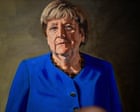
Angela Merkel spent 16 years running Europe’s largest economy with an ironclad sense of understatement. When she finally stepped down as German chancellor, she didn't chase corporate boards or flashy international speaking tours. True to form, her official portrait—unveiled this week at Berlin’s Bode-Museum—subverts exactly what people expected.
Instead of choosing a legendary, high-priced painter or a fellow former East German artist, Merkel handed the massive responsibility to Jérémie Queyras, a relatively unknown 28-year-old multidisciplinary artist who got her attention by writing a handwritten letter.
The painting, which remains on display to the public until October 4, 2026, before moving permanently to the Federal Chancellery, breaks decades of political art traditions in Berlin. It tells a much deeper story about power, vulnerability, and the current state of German politics than a simple press release suggests.
The Subversion of the Merkel Diamond
If you looked at any photo of Merkel during her four terms in office, her hands were almost always arranged in a neat, symmetrical diamond shape. The Merkel-Raute (Merkel Rhombus) became one of the most famous pieces of political body language in modern history.
Everyone expected it to be the centerpiece of her official portrait.
But both Merkel and Queyras decided that doing so would be a cheap cliché. Look at how the artist handled her body language instead. Her left hand rests casually on the arm of a chair with three fingers visible, while her right hand simply hangs down. She doesn't look relaxed; she looks slightly uncomfortable, showing that signature unease and impatience that characterized her press conferences. It looks like she is ready to stand up and walk out of the frame if the conversation drags on too long.
Her face looks slightly frayed, and the framing feels cramped. Queyras didn't try to smooth over the toll that leading a country through a financial meltdown, a historic migration crisis, and a global pandemic takes on a person. The 71-year-old former chancellor looks human, carrying the actual weight of her 16-year legacy.
Hidden Details in the Background
A great political portrait relies on the subtle clues left on the canvas. Queyras loaded the background with items taken straight from Merkel’s actual desk in the chancellery, giving us a clear view of her notoriously pragmatic mindset.
- The Yellow Folder: A simple, analogue cardboard file folder sits on the table behind her. It’s a quiet nod to her famously unflashy, bureaucratic style of governing and a reminder of a pre-digital political landscape where decisions were written on paper.
- The Silver Cube: Engraved on each side of this small desk ornament is a single word, forming her ultimate political motto: "In der Ruhe liegt die Kraft" (In serenity strength lies).
- The Blue Blazer: She is wearing a blue version of her signature uniform—the boxy, big-buttoned blazer that she used to eliminate any media obsession with her wardrobe choices.
The Legal Loophole Against the Far Right
The portrait will eventually hang on the first floor of the Federal Chancellery alongside Germany's post-WWII leaders, right next to her long-time political rival Gerhard Schröder. Schröder’s portrait, painted by Jörg Immendorff, features a massive, self-mocking gold head resembling a Roman emperor. Merkel's understated realism couldn't contrast more sharply.
But there’s a fascinating, strategic twist to how this painting is being handled.
Merkz's incoming administration will display the art, but it is officially entering the chancellery strictly as a loan. According to reports surrounding the unveiling, Merkel is retaining formal ownership of the artwork. The reason? If the far-right Alternative for Germany (AfD) party ever gains control of the government, Merkel retains the legal right to pull her portrait out of the building entirely. It's a highly calculated move from a leader who watched the political landscape shift dramatically since she left office in 2021.
How to See the Portrait Yourself
If you are in Berlin, don't wait until the painting disappears into the government quarter where access is limited. You can view the piece in a dedicated exhibition on the first floor of the historic Bode-Museum, surrounded by old master sculptures that make the modern, blue-blazer portrait pop.
- Location: Bode-Museum, Am Kupfergraben, 10117 Berlin.
- Exhibition Dates: Open now through October 4, 2026.
- Museum Hours: Closed on Mondays. Open Tuesday through Friday from 10:00 AM to 5:00 PM, and Saturdays and Sundays from 10:00 AM to 6:00 PM.
- Action Item: Book your museum tickets online in advance via the official visitBerlin portal to secure a time slot, as the summer tourist crowds and local political junkies are filling the galleries quickly.