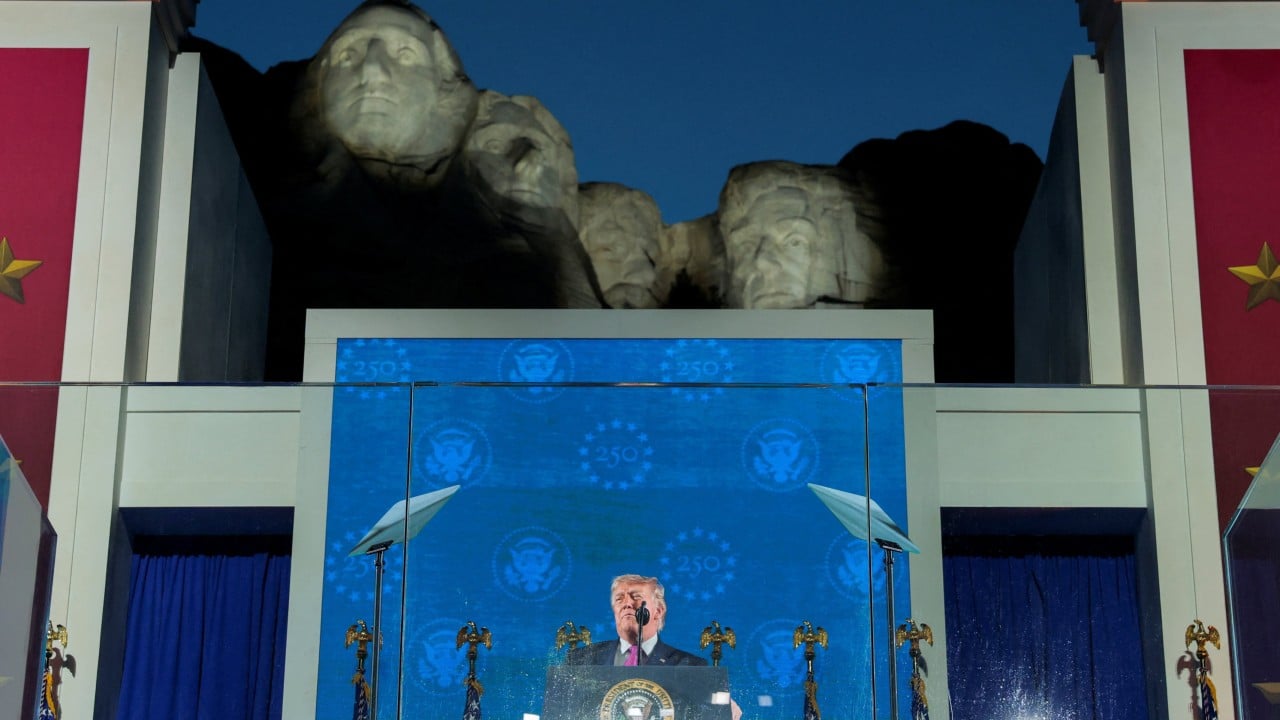
America just hit the quarter-millennium mark, but nobody is blowing out the candles with a unified smile. On the eve of the US 250th anniversary, the celebration morphed from a historical milestone into a fierce ideological slugfest. Standing under the stone faces of Mount Rushmore, President Donald Trump declared that American identity faces a renewed attack from within, framing the country's semiquincentennial not just as a birthday party, but as a fight for survival.
If you thought the country would pause its endless political bickering for a single day of national unity, you guessed wrong. The anniversary arrives at a time when the nation feels intensely fractured, torn between competing versions of its own history.
The Mount Rushmore Warning and the New Ideological Front
Trump used his speech at the South Dakota monument to draw a sharp line in the sand. He pointed to what he called a resurgence of a communist menace inside the United States. He wasn't talking about foreign adversaries. He targeted domestic radicals and extremists who he claims want to uproot the foundational principles of 1776.
This isn't just a standard policy dispute about taxes or government spending. It's an existential argument over what it actually means to be American.
The choice of Mount Rushmore wasn't accidental. The monument itself represents the grand, traditional narrative of American greatness. By speaking there, Trump tied his political movement directly to the legacies of Washington, Jefferson, Lincoln, and Roosevelt. His supporters have gone so far as to suggest carving Trump's own face into the granite. Critics see this framing as an attempt to weaponize history, turning a civic jubilee into a partisan rallying cry.
A Divided Nation Marks 250 Years
The reality on the ground shows a country wrestling with deep self-doubt. Inflation, economic strain, and foreign policy tensions have kept national morale low. Instead of a shared moment of pride, the semiquincentennial has exposed the country's deep polarization.
There are two starkly different views of America competing for dominance right now.
- The Exceptionalist Narrative: This view holds that America was founded on perfect, timeless ideals of liberty and individual rights. The goal is to protect these traditions from radical changes.
- The Critical Narrative: This view emphasizes the historical contradictions of the founding, focusing on systemic inequalities and the long struggle to expand those original promises to everyone.
Trump argued that the critical view amounts to an attack on the country's soul, suggesting that excessive focus on historical flaws threatens to dismantle national pride entirely.
The Politics of the Spectacle
The celebration moves immediately from the South Dakota mountains to the National Mall in Washington DC. Trump has promised the massive crowd a show of military flyovers and the largest fireworks display in world history.
For a leader who thrives in the spotlight, the 250th anniversary offers the ultimate stage. Yet, historians note a massive contrast between this year's rhetoric and past milestones. When Calvin Coolidge spoke at the 150th anniversary in 1926, or when Gerald Ford marked the Bicentennial in 1976, their speeches leaned heavily on universal ideals and democratic continuity. Today, the message is defensive, urgent, and deeply combative.
The American experiment has always been a loud, messy debate about freedom. As the country enters its next 250 years, that debate isn't slowing down. It's getting louder.
Where America Goes From Here
Celebrating a national milestone during an era of extreme division requires moving past the political theater. If you want to engage with the true spirit of the anniversary without getting caught in the culture war crossfire, focus on these steps.
Read the foundational texts for yourself. Revisit the Declaration of Independence and the Constitution to understand the core framework separate from modern political commentary.
Acknowledge the complexity. A nation can celebrate its massive achievements in human liberty while remaining honest about the areas where it still falls short.
Support local civic institutions. True national health doesn't come from massive rallies on the National Mall. It's built in local communities, libraries, and schools where people actually interact face-to-face.