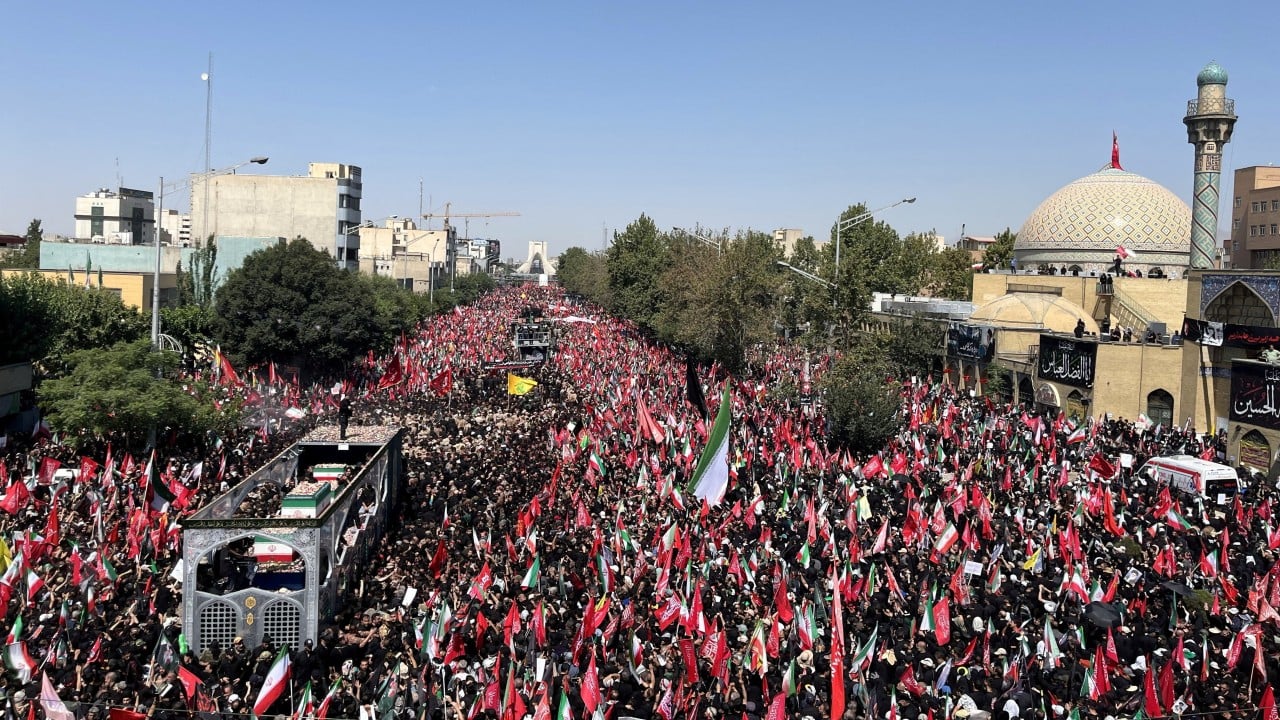
Millions of people are packing the streets of Iran’s capital today. The massive Tehran funeral procession for Ali Khamenei is officially moving, marking a delayed, emotionally charged farewell to the man who ruled the country for more than 35 years. If you look at the mainstream television feeds, you see a sea of black shirts, red banners demanding vengeance, and standard state-organized mourning. But that coverage misses the real story playing out on the ground right now.
This event isn't just a standard state funeral. It's a calculated projection of survival after months of direct military conflict with the United States and Israel. Khamenei was killed back on February 28, 2026. His body didn't get buried within 24 hours as Islamic tradition strictly demands. Instead, it sat in a refrigerated storage facility for over four months while bombs fell across the region.
Understanding what this funeral signifies means looking past the crowds. It requires looking at who showed up, who stayed in hiding, and how the regime managed to preserve a corpse without violating its own religious laws.
The Secret Logistics of a Four Month Delay
Islamic law is explicit about death. You bury the deceased immediately. Yet, Khamenei’s casket only just arrived at the Grand Mosalla religious complex this week.
Why the 125-day wait? The war made a massive public gathering impossible. Iranian leadership knew that putting millions of citizens and top officials in an open plaza during active hostilities would create a perfect target. Israel had already demonstrated a willingness to hit high-value targets during public appearances. Security teams refused to clear the event until a fragile ceasefire took hold.
This created a major theological and logistical problem. How do you keep a body intact for months without breaking religious taboos?
Christian or secular state traditions often rely on chemical embalming to preserve leaders like Vladimir Lenin or Mao Zedong. Islamic jurisprudence explicitly bans chemical embalming. It views the practice as a desecration of the human form.
To bypass this, the regime quietly formed the Special Headquarters for the Funeral and Burial of Ali Khamenei. Insiders confirm the body was kept in high-tech refrigerated cold storage. The temperature stayed fixed just above freezing to arrest decomposition without freezing the tissue solid. Spokesperson Iman Attarzadeh took to state media to assure the public that the remains were preserved with total legal and religious respect, avoiding any chemical intervention.
Beside Khamenei's casket rest smaller coffins. The February air strikes also killed his daughter, his son-in-law, his daughter-in-law, and his toddler granddaughter. The sight of these family coffins has amplified the public grief, transforming a political ceremony into an deeply personal family tragedy played out on a national stage.
The Invisible Supreme Leader
The biggest story in Tehran right now is an empty chair. Mojtaba Khamenei, the late leader's second son, was named the new Supreme Leader just ten days after the assassination. Yet, he is totally absent from his own father’s funeral procession.
Think about that. The absolute ruler of Iran has not been seen in public for over three months. He didn't even attend the funeral of his own wife last week.
Hardliners whisper about security precautions. Critics whisper about something worse.
Intelligence reports suggest Mojtaba suffered severe injuries during the initial February 28 strike on the family compound. The official line from the Revolutionary Guards is that the new leader remains in an undisclosed location for his own safety. They claim Israel still has an active hit list. This fear isn't unfounded.
To counter the optics of a completely hidden leadership, Mojtaba’s brothers—Masoud, Meysam, and Mostafa—made a highly publicized appearance at the Grand Mosalla prayers. Led by 97-year-old Shiite cleric Ayatollah Jafar Sobhani, the prayer line was a calculated display. It aimed to prove the Khamenei bloodline remains defiant and unbroken, even if its current head is ruling from a bunker.
Power Dynamics in the New Regime
The Tehran funeral procession for Ali Khamenei is serving as an official debut for Iran’s reshuffled elite. With so many top-tier commanders wiped out in the opening hours of the war, a new crop of officials is taking the reins.
Iranian President Masoud Pezeshkian has been front and center, trying to project stability to foreign dignitaries. Beside him stands Ahmad Vahidi, the newly minted chief of the Islamic Revolutionary Guard Corps. Vahidi’s predecessor died in the exact same strikes that killed Khamenei. Vahidi himself vanished from public view for weeks, leading to rumors of his own death. His reappearance at the funeral signals that the security apparatus has successfully consolidated power behind closed doors.
The foreign delegation list reveals exactly where Iran’s diplomatic leverage sits right now.
- Pakistani Prime Minister Shehbaz Sharif attended, representing a crucial diplomatic bridge as Islamabad continues to mediate back-channel talks between Tehran and Washington.
- Russian ex-president Dmitry Medvedev arrived on behalf of Vladimir Putin, demonstrating Moscow’s continued commitment to its primary Middle Eastern weapons supplier.
- Dignitaries from over 100 countries filled the VIP sections, showing that despite months of devastating warfare, the Islamic Republic is far from isolated.
How the Funeral Shapes the Ceasefire Negotiations
Do not mistake this procession for a simple moment of mourning. It is a live geopolitical negotiation tactic.
Right now, Iranian and American diplomats are engaging in tense, indirect talks to turn the current temporary ceasefire into a permanent peace treaty. The United States is demanding massive rollbacks in Iran’s regional influence and drone production capability.
By filling the streets of Tehran with millions of citizens, the regime is sending a direct message to Washington. They are showing they still retain the mandate of a highly mobilized, fiercely loyal population. When speakers at the Mosalla complex led chants of "revenge" and openly called for the death of Donald Trump, it wasn't just rhetoric. It was a warning that the hardline base will revolt if the current government compromises too much at the negotiating table.
Real World Risk Assessment for Observers
If you are tracking Middle Eastern security, supply chains, or energy markets, the next 72 hours are critical. The funeral procession will travel from Tehran to the clerical hub of Qom on Tuesday. On Wednesday, it makes an unprecedented cross-border journey to Shiite holy sites in Iraq, before returning to Mashhad for final burial on Thursday.
Watch the security protocols during the transit to Iraq. Any logistical breakdown or security breach during this multi-city journey will instantly collapse the fragile ceasefire. Keep an eye on state media broadcasts for any surprise audio or video messages from Mojtaba Khamenei. If he remains silent through the final burial on Thursday, assume the internal power struggle or his physical injuries are far more severe than the regime admits.
The crowds in Tehran are mourning a leader, but they are also watching the birth of a vastly different Iran. The old era is buried. What comes next depends entirely on the leaders who managed to survive the bunkers.

:max_bytes(150000):strip_icc()/TAL-nassau-bahamas-BEAUTCARIB0323-4fbfce903e5a4418b895e03717e3de0d.jpg)