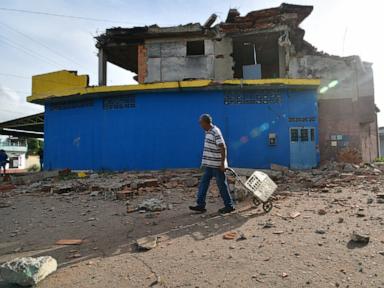
Venezuela is currently facing a catastrophic humanitarian crisis after two massive earthquakes struck back-to-back. The ground shook violently on Wednesday evening, June 24, 2026, catching millions of families by surprise during a national holiday. Many people were relaxing at home when the first tremor hit at 6:04 p.m. local time. Within sixty seconds, a second and even more powerful shock followed, compounding the destruction before anyone could escape.
Initial reports from acting President Delcy Rodríguez confirmed dozens of deaths and hundreds of injuries, but scientists are warning that the true toll will be drastically worse. The US Geological Survey (USGS) immediately flagged a terrifying reality. There is a high probability that casualties could eventually climb into the thousands, or even tens of thousands, due to the high population density near the epicenters and the fragile state of local infrastructure. Recently making headlines lately: Why The Uk Banned Iran's Irgc Today After Years Of Foot Dragging.
Understanding the mechanics of these specific tremors shows why they caused such extreme devastation. This wasn't just a routine tectonic shift. It was a worst-case scenario for a country already struggling with economic and structural vulnerabilities.
The Brutal Double Punch Near Morón
Most earthquakes involve a single major shock followed by smaller aftershocks. Venezuela experienced something far more rare and destructive. The first quake registered as a massive magnitude 7.1 or 7.2, striking near the coastal community of Morón, roughly 160 kilometers west of Caracas. Before the dust could even begin to settle, a second, stronger magnitude 7.5 earthquake ruptured just a minute later. Further details into this topic are detailed by Al Jazeera.
This rapid succession meant that structures weakened by the first shock were completely leveled by the second. The epicenters were shallow, occurring at depths between 10 and 22 kilometers. Shallow earthquakes always cause significantly more surface shaking than deep ones because the seismic energy has less earth to travel through before hitting the foundations of buildings.
The physical impact stretched far beyond the coast. Tremors rattled the capital city of Caracas, turning high-rise apartments into swaying hazards and causing several older concrete buildings to collapse entirely. People felt the shaking as far away as Bogotá, Colombia, hundreds of miles to the west.
A Broken Infrastructure Multiplies the Danger
Earthquakes are natural events, but disasters are entirely man-made. The extreme danger facing Venezuela right now stems directly from decades of economic hardship, which left the nation's building codes and emergency response systems in tatters.
Caracas and its surrounding urban centers are packed with informal settlements known as barrios. These neighborhoods feature thousands of homes built stacked on top of each other on steep hillsides. They use cheap materials like unreinforced brick and corrugated iron. They lack proper foundations. When a magnitude 7.5 quake hits, these hillsides turn into massive landslides, burying entire blocks under tons of debris.
Even the formal concrete buildings in the city centers are highly vulnerable. Venezuela hasn't seen rigorous enforcement of modern, earthquake-resistant engineering standards for years. Maintenance on older structures has been neglected. The result is a urban environment where even a moderate tremor can cause catastrophic structural failure.
The Tectonic Trap Under Northern Venezuela
Geologists have long warned about the danger lurking beneath the Venezuelan coastline. The country sits right on the chaotic boundary where the Caribbean tectonic plate grinds past the South American plate. This boundary is not a single clean line. It is a messy network of strike-slip faults, primarily the Boconó fault system and the San Sebastián fault system.
Historically, this zone has produced devastating events. The infamous 1967 Caracas earthquake, which was a much smaller magnitude 6.6, killed over 200 people and destroyed numerous modern buildings. The June 24 twin quakes released exponentially more energy than the 1967 event. The Caribbean plate moves eastward relative to South America at a rate of about twenty millimeters per year. This constant friction builds up immense stress over decades until the rock finally snaps. That snapping action is exactly what happened near Morón.
Immediate Realities on the Ground
Right now, the priority is search and rescue, but the logistical hurdles are staggering. The country's electrical grid failed almost instantly across multiple states following the tremors. The Caracas metro system, a vital lifeline for moving people through the crowded capital, shut down completely.
Hospitals are overwhelmed. Many medical facilities were already suffering from chronic shortages of basic supplies, medicine, and reliable backup power before this disaster. Now, doctors are forced to treat hundreds of severe crush injuries and fractures using flashlights and dwindling resources.
A temporary tsunami warning was issued for nearby Caribbean regions, including Puerto Rico, creating widespread panic along the coastlines. While the immediate wave threat has subsided, the fear of major aftershocks keeps millions of residents sleeping on the streets, terrified to return to any building that remains standing.
What Needs to Happen Next
If you want to understand how a country recovers from a twin strike of this magnitude, look at the immediate logistical demands. The next forty-eight hours are entirely about the golden window for saving lives trapped under concrete rubble.
First, international aid must be coordinated without political delays. Specialized search-and-rescue teams equipped with heavy lifting gear and acoustic listening devices are required immediately.
Second, temporary water purification and field hospitals must be established in the hard-hit areas near San Felipe and Morón. With plumbing systems shattered, the risk of waterborne disease outbreaks will spike rapidly over the next week.
Third, structural engineers must conduct immediate triage on standing infrastructure. Thousands of buildings might look intact but possess fatal structural cracks that could fail during a minor aftershock. Do not enter compromised concrete buildings under any circumstances until they are formally cleared by emergency personnel. Stay in open spaces and keep emergency pathways clear for rescue vehicles.