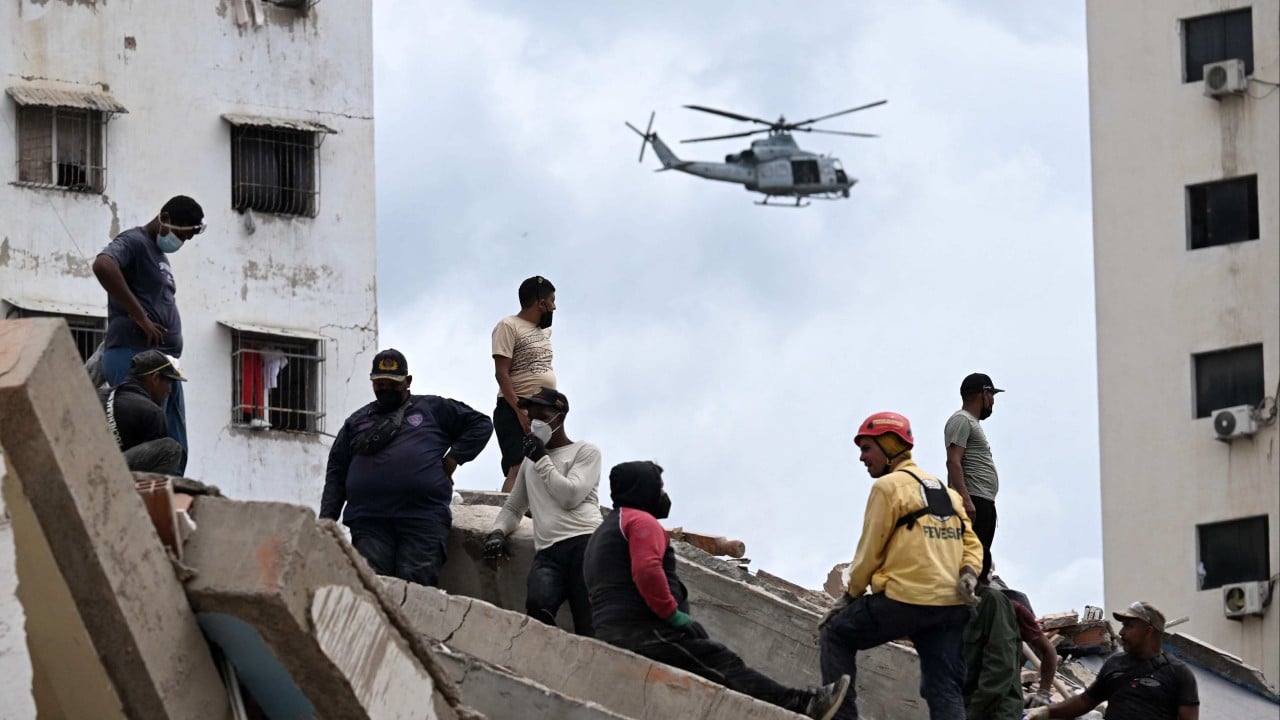
Six months ago, American troops were executing an armed operation to unseat a regime. Today, they're digging through twisted rebar and concrete in La Guaira to pull infants from collapsed buildings.
The geopolitical whiplash is dizzying. Following the catastrophic 7.2 and 7.5-magnitude twin earthquakes that ripped through north-central Venezuela on June 24, 2026, the US military launched a massive, logistics-heavy disaster intervention. Under the leadership of US Southern Command (SOUTHCOM), more than 900 American personnel have deployed directly into Venezuelan territory, backed by an additional 800 troops positioned at Caribbean staging hubs in Puerto Rico and Curacao.
If you're tracking the region, you know this isn't just a standard humanitarian mission. It's a high-stakes operational shift that rewrites the security dynamics of the Western Hemisphere. Washington isn't just sending checks; it's flying heavy transport assets, running airfield operations, and flying surveillance drones over a country that was, until recently, a closed fortress.
The Logistics of a Rapid Surge
When the ground stopped shaking, the new interim government led by Acting President Delcy Rodriguez faced an immediate crisis. Entire blocks in cities near Caracas pancaked. The death toll rapidly cleared 900, and initial estimates suggested thousands remained missing or trapped. Rodriguez quickly declared a state of emergency and requested direct American assistance.
The response from Washington was immediate. SOUTHCOM moved to execute what commanders call a force surge, treating the disaster with the same logistical velocity as a combat deployment.
- Airfield Takeover: Damage to the Simón Bolívar International Airport in Caracas threatened to choke incoming global relief. The US military deployed a 100-airman Contingency Response Element to repair, manage, and expand airfield operations, effectively taking the reins of the international air bridge.
- Heavy Airlift: Six C-17 Globemaster cargo aircraft and multiple C-130 Hercules transports have been running continuous sorties. They recently delivered a Marine Combat Logistics Company from Marine Corps Air Station Cherry Point, complete with heavy engineering machinery, structural tools, and water purification units.
- Aviation Assets: High-capacity rotary aircraft, including Army CH-47 Chinooks from Joint Task Force-Bravo in Honduras and Marine Corps MV-22 Ospreys out of Curacao, are bypassing ruined roads to move search teams directly to the frontlines.
- Naval Operations: The amphibious transport dock USS Fort Lauderdale has docked at the newly reopened Port of La Guaira alongside the littoral combat ship USS Billings, establishing a direct maritime supply pipeline.
Drones and Satellites in Humanitarian Warfare
The operational mechanics on display go far beyond boots and shovels. SOUTHCOM is using the exact same surveillance architecture designed to hunt drug cartels and state adversaries to manage the rubble.
General Francis Donovan, commander of SOUTHCOM, confirmed that the military has deployed four to five MQ-9 Reaper drones over Venezuela. These unmanned systems, feeding data back to a specialized fusion cell in Miami, map structural damage and track blocked transit corridors.
Simultaneously, Space Forces Southern is feeding commercial and military satellite imagery directly to disaster planners on the ground. When local authorities can't see past the wreckage on their street corner, overhead assets are telling them which bridges are structurally sound enough to support a 30-ton excavator. It's an overwhelming display of technical capability, and it serves as a blunt reminder of who holds the logistical keys to the region.
The Fragile Politics of Pre-Positioned Power
Let's be completely honest about what's happening here. This level of access would have been unthinkable last year. The deployment is only possible because a US-led intervention in January unseated the previous regime, opening the door for close cooperation with the current interim administration.
While the State Department has mobilized over $300 million in aid—funneled through partners like Samaritan's Purse, the Red Cross, and the UN—the sheer scale of the military footprint is bound to raise eyebrows across Latin America. Don't buy into the narrative that this is purely an altruistic exercise. Every flight hour, every drone feed, and every engineering assessment allows the US military to map Venezuelan topography, evaluate local infrastructure, and build deep institutional ties with the new political class.
Other global players are moving fast too. India mobilized its 60 Parachute Field Ambulance unit under Operation Amistad, flying in modular, AI-driven medical units. China pledged millions in extra relief and deployed its own satellite assets to support local merchant networks. Washington knows that leaving a logistical vacuum in Caracas means letting geopolitical rivals fill it.
What Happens Next
The immediate priority remains the recovery phase, but the window for finding survivors has slammed shut. The mission is rapidly transitioning from tactical search-and-rescue to long-term stabilization, civil engineering, and disease prevention.
If you are tracking this deployment or analyzing regional security, watch these specific indicators over the next few weeks:
- The Exit Timeline: General Donovan stated there's no intent to stay permanently, claiming "we leave when we're done." Watch whether the 900 personnel inside the country begin drawing down or if their mission morphs into permanent infrastructure rehabilitation.
- Airfield Control: Monitor when the Contingency Response Element hands airfield operations back to local Venezuelan civil aviation authorities. Continued US control of Simón Bolívar International signifies a deeper, long-term security footprint.
- Regional Pushback: Keep tabs on diplomatic signaling from neighboring states. Large-scale US military operations in South America traditionally spark pushback regarding sovereignty, regardless of the humanitarian justification.