You have fifteen years of experience under your belt. You know how to build systems, manage complex projects, and lead engineers through messy architectural overhauls. You assume your resume speaks for itself. In the current market, that assumption is a liability.
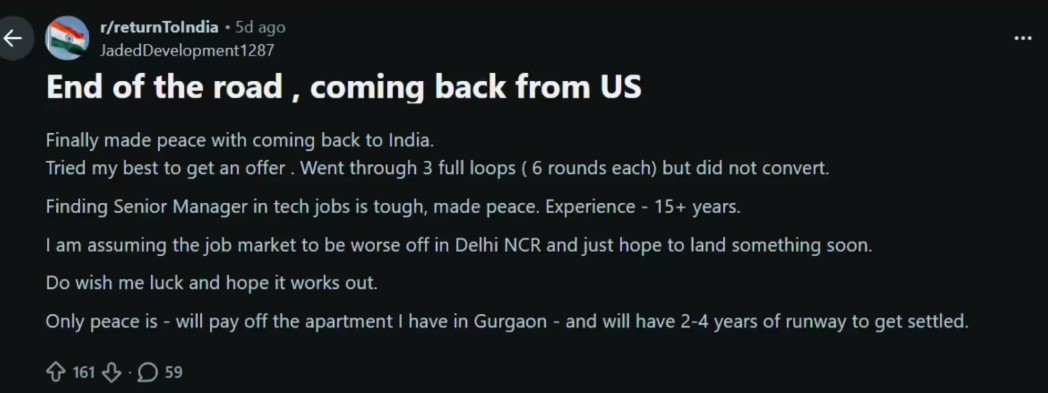
A viral story recently shook the tech community on Reddit, highlighting a senior technology manager who threw in the towel. After grinding through three full interview loops, each consisting of six grueling rounds, they ended up with zero offers. Despite a pristine fifteen-year track record, they made peace with packing up their life in the United States and moving back to India.
This isn't an isolated incident. It's a snapshot of a fundamental shift in how tech hiring operates. The traditional playbook for landing a senior US job offer is broken. Veteran engineers and managers are finding that decades of experience no longer guarantee safety, status, or a quick job transition. If you're counting on your tenure to save you in a job search, you need a reality check.
The Redefined Reality of Tech Experience
Years on a resume used to act as an automatic golden ticket. If you hit the ten or fifteen-year mark, recruiters assumed you possessed the wisdom to solve any problem. That era is dead. Today, tech companies treat extensive experience with intense skepticism.
Hiring managers worry about several things when they see a veteran applicant. They worry you're too expensive. They worry you're too set in your ways. They worry you won't get your hands dirty writing code or doing deep technical work because you've spent the last five years sitting in high-level strategy meetings.
The market is flooded with exceptional talent. The waves of tech layoffs that began a few years ago poured thousands of highly competent, desperate senior engineers into the applicant pool. When a single job opening receives five hundred applications in two hours, companies can afford to be absurdly picky. They aren't looking for someone who can do the job. They're looking for an exact, flawless match who fits a hyper-specific budget.
We're seeing a massive structural mismatch. Mid-level engineers are fighting to step up, while senior leaders are willing to take pay cuts just to stay employed. This creates a bottleneck at the top. Your fifteen years of leadership experience might actually work against you if a company is secretly looking for a cheap, hungry mid-level developer who will work eighty hours a week without questioning the leadership.
Why 18 Rounds of Interviews Can Yield Zero Offers
Let's talk about the sheer exhaustion of the modern interview loop. Going through three separate company loops, with six rounds each, means facing eighteen individual interviews. That requires hours of grueling preparation, coding challenges, system design grilling, and behavioral cross-examinations.
How does someone survive eighteen rounds of intense scrutiny and come away with nothing?
The answer lies in the rise of consensus-based hiring and administrative hesitation. In a booming market, companies hire for growth. If two out of six interviewers say "maybe," the company still pulls the trigger. They need bodies in seats.
In a tightening market, companies hire to mitigate risk. Hiring processes are designed to say no. If five interviewers give a glowing recommendation but the sixth person expresses a minor doubt about your cultural fit or your specific architectural approach, your application goes into the trash. One single "no" kills the deal.
The nature of the technical interview itself has become completely detached from day-to-day work. A senior manager with fifteen years of experience spends their days managing budgets, resolving team conflicts, and aligning product roadmaps. Yet, during an interview loop, they are forced to jump through the exact same hoops as a fresh computer science graduate.
You're asked to invert a binary tree on a whiteboard under a time limit. You're asked to solve complex algorithmic puzzles on platforms like LeetCode that you haven't touched since college. If your syntax trips up or you take five minutes too long to find an optimal solution, you're rejected. Your fifteen years of real-world leadership are completely neutralized by an arbitrary coding puzzle. It's frustrating, it's exhausting, and it's happening to the best minds in the industry.
The Hidden Math Behind the Senior Engineering Glut
The tech ecosystem is feeling the weight of a severe structural contraction. High interest rates changed the calculus for venture capital and corporate spending. Companies are no longer funded based on pure user growth. They're judged on profitability and efficiency.
This environment has triggered a massive re-evaluation of management layers. Middle management is getting squeezed out. Companies are flattening their organizations, demanding that managers become working contributors who write code alongside their teams.
Look at the math governing foreign workers in the United States, particularly those on H-1B visas. The pressure is immense. If a visa holder loses their job, a relentless sixty-day countdown clock begins. They have exactly sixty days to find another employer willing to sponsor their visa, or they must legally exit the country.
Finding a senior role in sixty days is nearly impossible in a normal environment. In a frozen market, it's a miracle. The sheer stress of that ticking clock forces many professionals to make a difficult choice before their time runs out. Rather than enduring endless rejection while watching their savings evaporate, an increasing number of senior tech workers are choosing to regain control of their destiny by planning an organized exit.
Moving Back to India with Real Financial Runway
Returning to your home country after a decade or more abroad is a massive emotional and logistical challenge. It feels like a step backward to some, but savvy tech professionals are reframing the move as a strategic reset.
The Reddit user who inspired this conversation highlighted a crucial survival tactic: financial cushion. They mentioned moving back to the Delhi NCR region with a paid-off apartment in Gurgaon and a two-to-four-year financial runway. That is how you handle a forced relocation without destroying your mental health.
When you have years of living expenses saved up, your relationship with the job market changes completely. You don't have to accept a toxic job out of desperation. You don't have to tolerate a massive salary downgrade from an employer who knows you're trapped. You can afford to wait, look for the right fit, or even explore building something of your own.
The Indian tech scene isn't a soft landing spot either. It's incredibly competitive. Cities like Bengaluru, Gurgaon, and Hyderabad are filled with elite talent. The local job market is facing its own slowing demand, meaning returnees from the US face fierce competition from local engineers who understand the current cultural and corporate environment much better.
Returning tech workers often face a rude awakening regarding compensation packages and corporate culture. While Global Capability Centers and rising tech startups offer lucrative roles, the work culture can be intense, hierarchical, and demanding. Having a long financial runway isn't a luxury. It's a defensive necessity that keeps you from rushing into a bad situation.
Practical Next Steps for Navigating a Brutal Hiring Freeze
If you find yourself stuck in a dead-end job search, dealing with endless interview loops that lead nowhere, you need to alter your strategy. Continuing to send out identical resumes and hoping for a different result is a waste of your energy.
First, fix your positioning. If you have fifteen years of experience, stop applying to generic senior engineer or standard manager roles where you'll be filtered out as overqualified or too expensive. Tailor your resume to emphasize recent, hands-on execution. Prove that you still build things. If you're aiming for leadership roles, target companies that explicitly need someone to scale a chaotic department, not companies that are merely looking for a placeholder manager.
Second, treat interview preparation like a separate, distinct skill. Accept that the interview process is flawed. You can complain about LeetCode and whiteboard testing all you want, but your complaints won't change company policy. Allocate dedicated time every single day to practice core algorithmic problems and system design fundamentals. If you haven't done an intense technical interview in a decade, you're going to fail your first few loops simply because your interview muscles have atrophied. Practice under pressure before you step into a real loop.
Third, look beyond traditional tech giants. Everyone wants to work for big tech or high-flying startups. Look at legacy industries, manufacturing companies, healthcare networks, and financial institutions that are quietly modernizing their infrastructure. These sectors often value stability, leadership, and deep institutional knowledge far more than a trendy startup does. They might not offer the same equity packages, but they provide stability and a smoother hiring process.
Finally, build an absolute financial safety net. If you're living on a visa in a foreign country, you need to operate under the assumption that your job could vanish tomorrow. Keep your fixed living costs low. Build a massive emergency fund that can cover your family for six months to a year. If things go wrong, a deep cash reserve prevents panic and gives you the freedom to make logical, calculated choices about your career and your life.
The tech world has changed, and the old assumptions no longer hold up. Experience is valuable only if you can translate it into immediate, actionable solutions for a skeptical hiring manager. Strip away the ego of your title, prepare ruthlessly for the flawed interview systems of today, and build a financial fortress that allows you to walk away on your own terms.