You don't expect a major breakthrough to look like a lumpy piece of grey rock. You certainly don't expect it to sit in a standard storage cabinet in Cambridge for four decades before anyone figures out what it actually is.
But that's exactly what happened with a ten-centimeter piece of prehistoric tail bone.
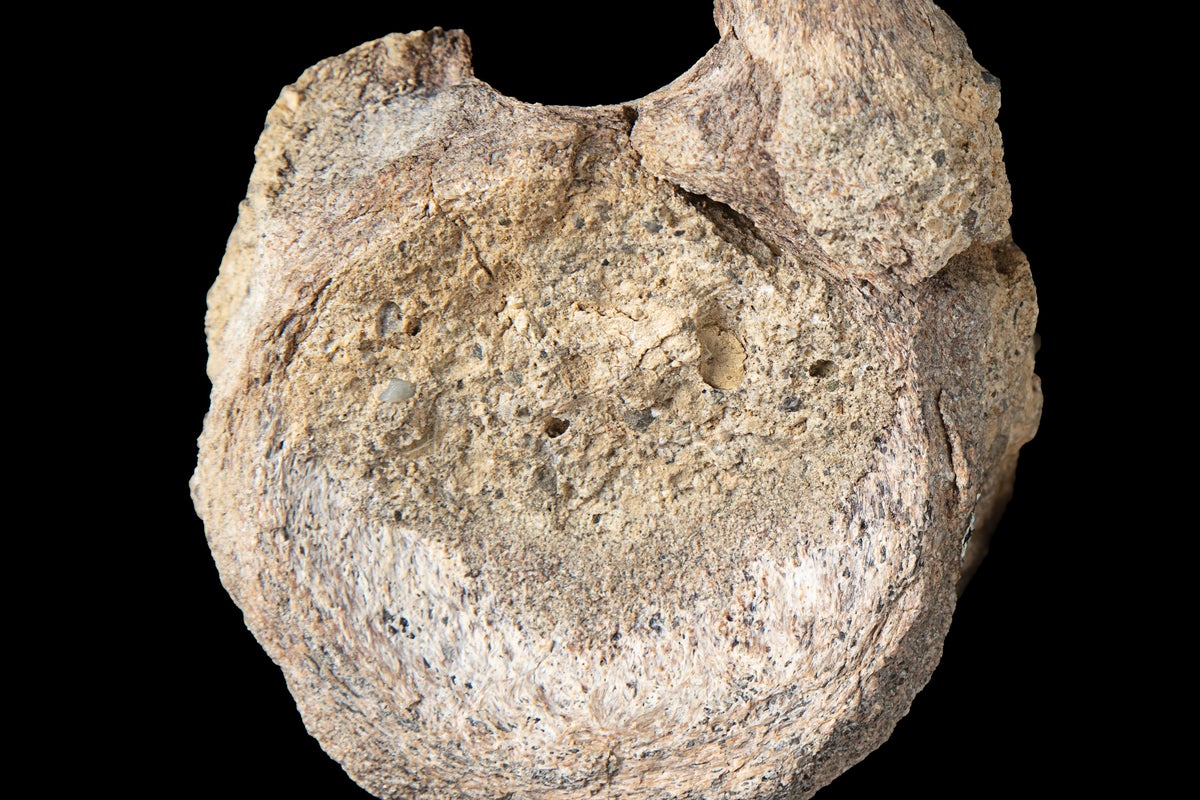
Collected back in 1985 on an icy island off the Antarctic Peninsula, this unassuming specimen was recently identified as a vertebra from a titanosaur. This group includes the absolute largest animals to ever walk the Earth. More importantly, its formal identification means it is officially the first dinosaur fossil ever collected on the Antarctic continent.
Museum drawers are notorious for holding secrets, but this one changes our understanding of how giant herbivores traversed the ancient world.
The 1985 Mistake That Took 40 Years to Fix
In December 1985, geologist Mike Thomson was trudging across the wind-scoured terrain of James Ross Island. Working for the British Antarctic Survey (BAS), Thomson wasn't looking for dinosaurs. His mission was mapping rock strata to help future scientists date the region's fossils.
When he spotted the grey bone, he didn't call the papers. He pulled out his field notebook, made a neat little sketch, and labeled it a "vertebra of large reptile."
Because the Santa Marta Formation where he found it consists of marine rock, Thomson and his team assumed the bone belonged to a prehistoric marine reptile. Think plesiosaur or mosasaur. They packed it up, shipped it back to the UK, and tucked it away in a geology collection drawer.
Thomson passed away in 2020, never knowing he had actually made history.
The breakthrough came when Dr. Mark Evans, the collections manager at BAS, began combing through the archives. He noticed the bone didn't fit the typical profile of a marine reptile. It had a strange combination of features: a deep hollow on one end and a distinct round bump on the other. It was a ball-and-socket joint setup.
Evans looped in Paul Barrett from the Natural History Museum in London. Together, they realized they were looking at a titanosaur caudal vertebra. The findings, published in the journal Acta Palaeontologica Polonica, confirm that the bone sat misclassified for nearly 40 years.
The Dinosaur That Shrank or Died Young
When we think of titanosaurs, we think of multi-ton monsters like Argentinosaurus or Patagotitan. Those beasts stretched over 30 meters long and weighed more than 15 tonnes.
This Antarctic resident was different. Based on the size of the 10-centimeter vertebra, scientists estimate this specific dinosaur was only about 6 to 7 meters (23 feet) long.
There are two main theories for why it was so small. It might have been a juvenile that died before it could reach its terrifying potential. Or it could belong to a dwarf species that adapted to the unique constraints of living at the bottom of the world.
We also know how it ended up in marine rock. The dinosaur didn't drown during a swim. It likely died near the coast of the ancient continent. Its bloated carcass floated out to sea, sank to the seabed, and got buried alongside ammonites and ancient shellfish.
What Antarctica Looked Like 82 Million Years Ago
It is hard to picture Antarctica as anything other than a brutal, frozen desert. But during the Late Cretaceous period, the region was unrecognizable.
Heavy volcanic activity pumped massive amounts of carbon dioxide into the atmosphere. This created an intense global greenhouse effect. Antarctica didn't have ice sheets. Instead, it was covered in lush, temperate forests full of conifers, ferns, and palms. It was a green land bridge connecting South America to other southern landmasses.
Ancient South America <----> Antarctic Peninsula <----> New Zealand / Australia
This newly identified fossil fills a massive gap in how these giants moved across the globe. Titanosaur fossils are incredibly common in South America, but they are virtually nonexistent in Australia and highly limited in New Zealand.
The presence of this titanosaur on James Ross Island proves that these long-necked herbivores were using Antarctica as a migration highway to spread across the fragmenting supercontinent of Gondwana.
Why More Discoveries Are Siting in Plain Sight
If you think this is a one-off event, think again. Museum collections worldwide are packed with unidentified specimens. Field researchers move quickly, budgets shift, and experts in highly specific dinosaur families aren't always available when a box of rocks arrives from the field.
Furthermore, searching for new bones in Antarctica is an absolute logistical nightmare. Deep ice sheets cover roughly 98% of the continent, leaving tiny fractions of exposed rock for paleontologists to explore.
Ironically, the biggest barrier to finding more Antarctic dinosaurs isn't just the cold—it is finding the time to audit the thousands of boxes we already brought back. As technology improves and more researchers peer inside these forgotten drawers, the prehistoric map of our world will keep changing.
If you want to keep up with how our understanding of the prehistoric world changes, don't just look at active dig sites in Patagonia or the American West. Keep an eye on the backrooms of your local research institutions. The next big dinosaur discovery might already be sitting in a drawer down the hall.