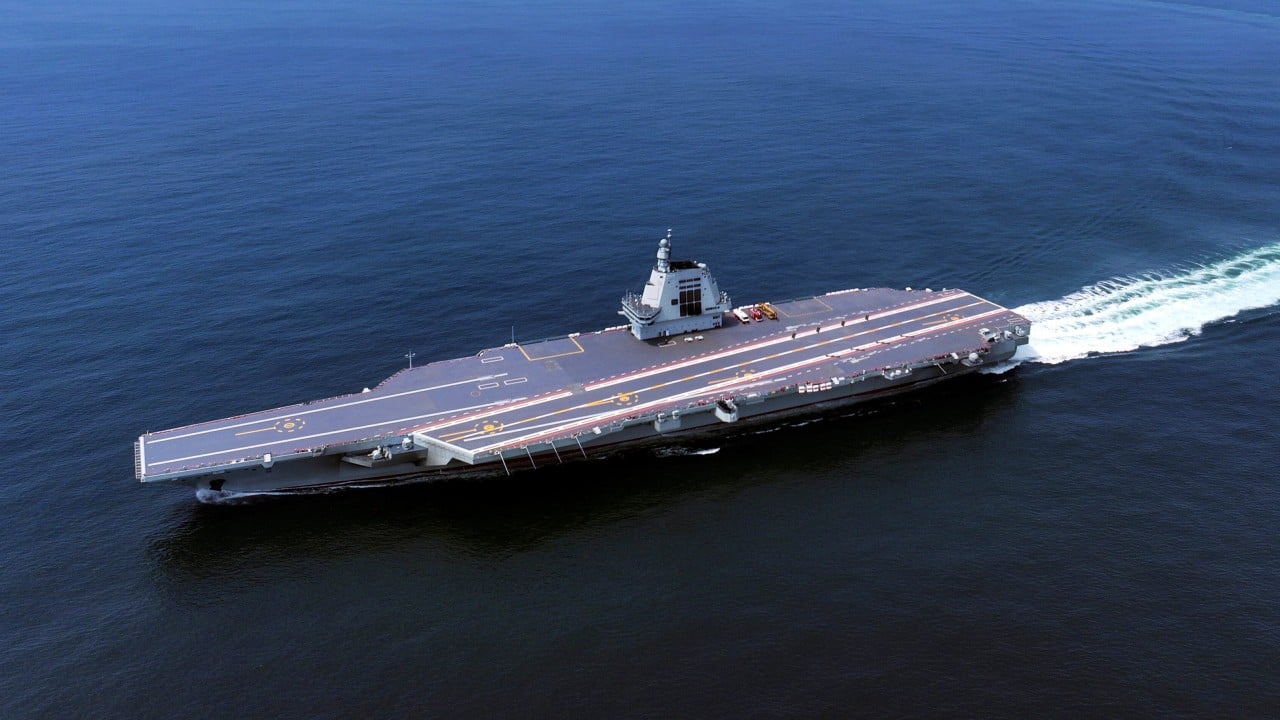
Aircraft carriers are often called floating cities, but they are also giant targets. When China commissioned its third and most advanced aircraft carrier, the Fujian, late last year, global attention focused almost entirely on its flight deck. Analysts obsessed over the electromagnetic catapults, a technological leap that skipped decades of steam-powered development. They tracked the stealthy J-35 fighters and the KJ-600 early warning planes designed to give Beijing a massive eye in the sky.
But the real battle for the survival of this 80,000-ton warship will not happen in the air. It will happen hundreds of feet below the surface. For a more detailed analysis into this area, we recommend: this related article.
Western military planners have long argued that in a high-intensity conflict, China's carriers would be sitting ducks for American and allied fast-attack submarines. The US Navy relies on its massive underwater advantage to neutralize surface threats. Knowing this, Chinese engineers did something unusual. Close inspection of the Fujian's hull structures reveals specialized multi-tube launchers mounted on the sponsons. This is the China Fujian anti-torpedo system, a defensive layer designed to tackle the apex predators of the deep.
Understanding how this system alters the tactical math in the Western Pacific requires looking past the propaganda. It means examining a brutal, fast-moving environment where a single weapon can sink a multi-billion-dollar flagship. To get more background on this development, in-depth reporting can also be found at CNET.
The Invisible Threat to Chinas Naval Ambitions
Surface ships have an inherent vulnerability. No matter how thick their steel or how advanced their radar, water transmits energy with devastating efficiency. A modern heavyweight torpedo does not actually need to hit a ship to destroy it. Weapons like the American Mark 48 ADCAP (Advanced Capability) are programmed to dive deep, swim directly under a ship's keel, and detonate.
The resulting explosion creates a massive gas bubble that lifts the ship out of the water. When the bubble collapses, the ship drops back down, snapping its spine under its own immense weight. A single well-placed torpedo can break a massive vessel in half.
For decades, the standard response to this threat was evasion and deception. Ships would drop acoustic decoys to trick the torpedo's sonar or rely on escorting destroyers to hunt down the hostile submarine before it could fire. But once a torpedo is in the water running at 50 knots, the options shrink fast.
That is why China is rewriting the playbook. The inclusion of dedicated anti-torpedo launchers directly on the Fujian suggests Beijing is not willing to trust its survival entirely to escort ships. They want a self-contained, last-line defense.
Hard Kill Versus Soft Kill Defenses
Naval analysts are split on the exact nature of the launchers spotted on the Fujian. Defensive systems generally fall into two categories, and China has likely integrated both into its naval doctrine.
Acoustic Decoys and Distraction
The first option is soft-kill defense. These systems launch devices that simulate the acoustic signature of the carrier. They scream louder than the ship's propellers, drawing the incoming torpedo away from the hull. Japan uses a similar setup on its warships, employing small launchers to deploy acoustic countermeasures.
These decoys can also emit false active sonar returns. If a torpedo sends out a ping to find the ship, the decoy catches that ping and sends back a modified signal that makes the torpedo think the carrier is a quarter-mile away from its actual position.
Active Counter Torpedo Interceptors
The second, more aggressive option is hard-kill defense. This involves firing miniature torpedoes directly at the incoming threat to destroy it via blast fragmentation before it reaches the ship. Think of it as a Close-In Weapon System (CIWS) but underwater.
The Soviet Union experimented with this concept decades ago with systems like the Cheval. The US Navy also spent years developing the Surface Ship Torpedo Defense (SSTD) program, deploying active interceptors on several Nimitz-class carriers. However, the American program faced severe integration challenges and was eventually paused because ensuring a reliable hit against a tiny, fast-moving underwater target proved incredibly difficult.
If China has successfully deployed a reliable hard-kill system on the Fujian, they have achieved something the US Navy struggled to perfect. It indicates a massive investment in rapid-reaction underwater fire control and highly sensitive towed sonar arrays capable of tracking incoming threats in real-time.
Why the US Navy Underwater Advantage is Feeling Pressure
The timing of this technology's emergence is not accidental. The underlying balance of power in the Pacific is shifting, and both sides know it.
China is building submarines at a dizzying pace. Recent satellite intelligence confirmed that three separate Chinese shipyards are actively producing nuclear-powered vessels simultaneously. Between 2021 and 2025, Chinese shipyards launched 10 nuclear submarines, outstripping American production over the same period. New variants like the Type 093B attack submarine are entering service, packed with vertical launch cells designed to overwhelm surface groups with high-speed anti-ship missiles.
Yet, despite this massive industrial push, China's domestic submarine force is still playing catch-up in terms of acoustic stealth. Western nuclear submarines, such as the Virginia-class and Seawolf-class, remain significantly quieter and more capable of slipping through defensive screens.
Because Beijing cannot yet guarantee its own submarines can sweep the seas clean of Western threats, it must fortify its surface ships. The Fujian cannot hide, so it must be able to take a punch—or stop the punch mid-flight.
The Chaos of Blue Water Combat Logistics
Deploying an anti-torpedo system sounds great on paper, but the actual execution inside a carrier strike group is a logistical nightmare.
Consider the acoustics. A carrier strike group is incredibly noisy. You have the massive turbines of the carrier, the churning screws of escorting Type 055 destroyers, and the active sonar pings bouncing through the water column. In the middle of this deafening environment, the ship's defense systems must detect a stealthy, high-speed torpedo signature, calculate an intercept trajectory, and launch a counter-weapon.
There is also the risk of friendly fire. Firing high-explosive interceptors or dropping powerful acoustic decoys into the water can blind or confuse the sonar systems of your own escort ships. If a destroyer's towed array gets blown out or deafened by a defensive launch from the carrier, the strike group loses its overall situational awareness.
Naval warfare experts point out that this is likely why the US Navy hesitated to fully commit to its own hard-kill program. The marginal benefit of a defense system with a low intercept probability might not outweigh the risk of disrupting the coordinated anti-submarine efforts of the entire fleet. China's willingness to mount these systems directly onto their prized flagship shows a different risk calculation. They are prioritizing the immediate survival of the hull above all else.
What Naval Analysts and Strategy Teams Should Watch Next
The presence of these weapon systems changes how operational planners must view a potential conflict in the region. If you are tracking maritime defense developments, keep your eyes on these specific indicators over the next twelve months.
- Towed Array Deployment: Watch for imagery showing the Fujian's stern during active operations. The effectiveness of any anti-torpedo weapon depends entirely on the sensitivity of the towed sonar arrays that detect the threat early enough to react.
- Exercise Data and Multi-Ship Integration: Look for reports of Chinese naval exercises involving the deployment of underwater countermeasures alongside Type 055 and Type 052D destroyers. Coordinated defensive drills will reveal whether China has solved the acoustic interference problem that plagued Western attempts.
- Sensor Grid Proliferation: Monitor the deployment of fixed undersea sensor networks across strategic chokepoints like the Lombok Strait and Bashi Channel. These networks act as an early-warning tripwire, feeding tracking data to the carrier group long before a submarine gets within firing range.
Don't assume that because Western navies paused certain hard-kill technologies, China's implementation will fail. Beijing has a habit of taking discarded or slow-moving Western concepts and iterating on them through sheer industrial willpower. The defensive systems on the Fujian prove that the contest for control of the Pacific will be won or lost beneath the waves.
For a broader perspective on how China is expanding its underwater detection capabilities to support its fleet operations, you might find this discussion on China's Torpedo Surveillance Network highly relevant, as it examines the growing deep-sea sensor grid that feeds critical tracking data to surface groups like the Fujian.