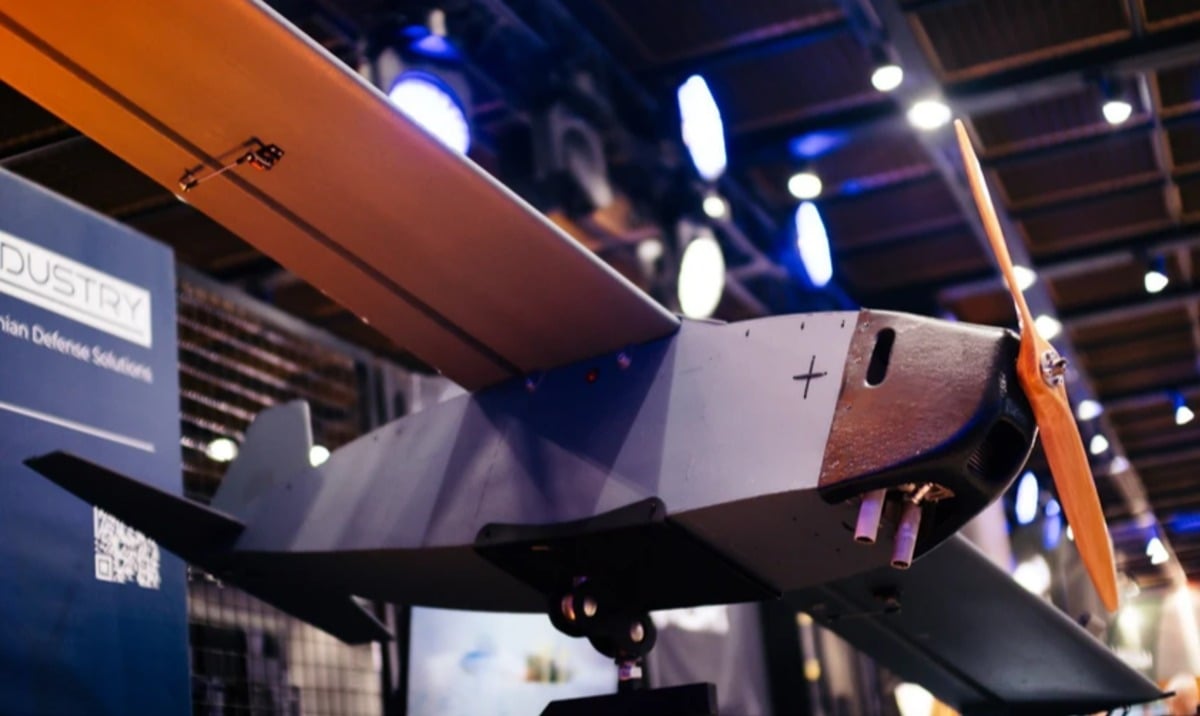
Spending millions of dollars on air defense missiles to shoot down a piece of cheap plywood and foam is a losing strategy. That's the exact asymmetric headache Ukraine handed Russia with the Shpatel decoy drone. But things just got worse for Moscow's air defense commanders. The same five-thousand-dollar drone that used to just draw enemy radar fire can now blow up those exact radar installations.
Ukrainian defense tech firm DG Industry recently confirmed that the Shpatel, which translates to "Spatula," has received a massive mid-tier strike upgrade. It's a classic case of battlefield evolution. Why waste a perfectly good, long-range airframe solely on distraction when you can pack it with explosives and hit a target 250 kilometers away?
The math behind this upgrade makes absolute sense, and it reveals how Kyiv plans to keep draining Russia's expensive air defense stock.
The Economic Asymmetry of the Shpatel Upgrade
Let's look at the numbers. The original Shpatel decoy cost about $5,000 to manufacture. It was designed with a simple mission: fly up to 420 kilometers, look like a massive threat on Russian radar screens, and force an air defense battery to fire a missile that costs anywhere from $500,000 to several million dollars. It carried roughly a single kilogram of explosives, just enough to destroy itself so Russia couldn't easily salvage the tech.
The new middle-strike version costs basically the same $5,000 but flips the script entirely.
- Warhead capacity: Up to 8 kilograms of high explosives.
- Operational range: 250 kilometers.
- Cruising speed: 130 km/h.
- Launch method: Pneumatic catapult.
This payload is more than enough to obliterate fuel trucks, command posts, or vulnerable radar arrays. DG Industry didn't need to reinvent the wheel to achieve this. They reused the existing low-cost aerodynamic frame and instead focused on swapping out internal components. By sacrificing some of the decoy's maximum flight range, they freed up weight capacity for a highly destructive punch.
Smart Comms Over Premium Materials
You don't need carbon fiber or radar-absorbing paint to make an effective weapon in modern warfare. You just need a stable signal. The real breakthrough in the strike-capable Shpatel isn't the explosive payload; it's the upgraded control and communication system.
DG Industry integrated a modernized, highly jam-resistant communication suite that maintains a stable control channel over massive distances. Russian electronic warfare is notorious for dropping a digital blanket over the frontline, rendering standard commercial drones useless. The Shpatel bypasses this by operating on dynamic frequencies.
This communication upgrade makes the drone incredibly flexible. An operator doesn't just have to point it at a coordinate and hope for the best. The aircraft can act as a flying signal relay, circling at an altitude of over one kilometer to extend the control range of smaller, short-range FPV drones operating in the area. If a high-value target appears, that same relay drone can dive out of the sky to act as the strike weapon itself.
Tricking the Air Defense Grid
The deployment of the Shpatel strike drone fits into a broader, highly coordinated strategy. Ukrainian intelligence units often launch massive mixed swarms of drones during deep-strike operations.
Picture a wave of 50 drones heading toward an oil refinery deep inside Russian territory. Historically, Russian radar operators had to guess which blips on their screens were dangerous weapons and which were harmless Shpatel decoys. Now, they don't have the luxury of guessing. Every single Shpatel on the radar could be carrying an 8-kilogram warhead.
If Russia chooses to ignore the Shpatel to save their air defense missiles for more expensive targets, the Shpatel will blow up their equipment anyway. If they choose to shoot it down, they're trading a million-dollar missile for a $5,000 piece of Ukrainian ingenuity. It's a checkmate scenario for localized air defense.
Next Steps for Defense Analysts and Observers
If you're tracking the rapid shifts in modern drone warfare, watch how DG Industry scales production of the Shpatel variant alongside their other projects, like the Vyriivniuvach guided aerial bomb. The trend is clear: successful defense tech relies on modular, dual-use platforms that keep manufacturing costs at rock bottom. Watch for upcoming frontline footage demonstrating the Shpatel's performance as a signal relay to see how it alters local electronic warfare dynamics.