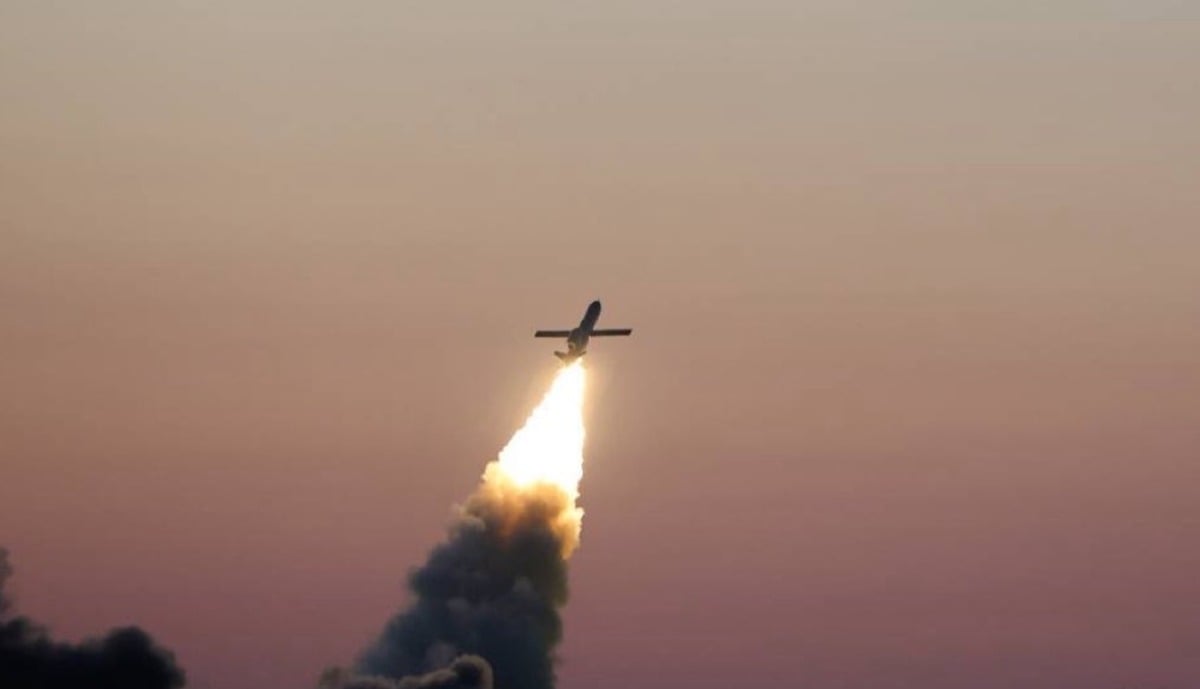
Imagine a six-ton cruise missile packing a 2,500-pound warhead, designed to fly 3,000 kilometers deep into enemy territory. Now imagine the brain guiding this terrifying weapon isn't a billion-dollar, top-secret military operating system. It's code you can download for free on GitHub.
That's the reality of Ukraine's new FP-5 Flamingo cruise missile. Developed by the domestic defense firm Fire Point, this massive weapon runs on ArduPilot, an open-source autopilot platform originally built by hobbyists to fly DIY quadcopters.
When the tech world realized a strategic long-range missile was running on free software, critics and traditionalists lost their minds. They called it cheap, amateurish, and a massive security risk. But Fire Point's leadership isn't backing down. They're defending the choice, and frankly, they're rewriting the rules of modern military engineering in the process.
The Six Ton Hobbyist Drone
The FP-5 Flamingo isn't a small loitering munition. It's roughly 12 meters long with a seven-meter wingspan. It tears through the sky at speeds up to 950 km/h, powered by a modified jet engine and kicked into the air by a solid-fuel booster.
Using ArduPilot for a weapon this size sounds insane to anyone used to Western defense procurement. Traditional defense giants spend a decade and hundreds of millions of dollars coding proprietary, heavily locked-down guidance systems. Ukraine didn't have a decade. They didn't have billions to throw at legacy contractors. They needed something that worked immediately.
ArduPilot offered a mature, battle-tested codebase for zero dollars. It handles automatic flight control, complex route planning, waypoint navigation, and sensor integration out of the box.
The Electronic Warfare Blindspot
The biggest criticism leveled against using open-source software on a cruise missile is vulnerability. If the code is public, can't the enemy just reverse-engineer it and find a backdoor to hijack the missile?
Fire Point argues that the open architecture is actually a defensive advantage. Because the code is completely transparent, Ukrainian engineers can modify algorithms on the fly. When Russian electronic warfare units deploy a new jamming technique on the front lines, Fire Point's software team can rewrite the Flamingo's flight logic in hours, not months. Try doing that with a proprietary system locked behind corporate intellectual property walls.
More importantly, the software has evolved to beat severe signal jamming. The Flamingo doesn't just stare at a GPS signal and hope for the best. When Russian jamming drops the satellite connection, ArduPilot switches the missile over to dead reckoning.
By continuously calculating position based on speed, acceleration, time, and heading, the missile keeps barreling toward its target in total radio silence. It doesn't need to talk to a satellite. It just does the math.
Striking Cheaply and Speeding Up Production
Military strategy in 2026 is entirely about the math of attrition. If you shoot a three-million-dollar air defense missile to down a fifty-thousand-dollar drone, you're losing the economic war even if you hit the target.
By utilizing open-source software and repurposing existing hardware—like civilian-grade electronics and older jet engines—Ukraine is driving the cost of long-range strike capabilities down to a fraction of Western alternatives. This cost efficiency allows for rapid scaling. Fire Point isn't building a handful of boutique weapons; they're aiming for mass production to consistently threaten logistics lines and fuel hubs deep behind the lines.
What This Means For Future Weapons
The Flamingo isn't an isolated experiment. It's the logical conclusion of a trend that started when hobbyist tech first hit the battlefield. We've seen consumer FPV drones alter tactical engagements; now we're seeing hobbyist software scale all the way up to strategic weapons systems.
This democratization of military tech terrifies traditional defense establishments because it strips away their monopoly on precision guidance. When the barrier to entry for long-range missile guidance drops to an internet connection and a laptop, the global balance of military tech shifts permanently.
If you want to understand where defense tech is heading, stop looking at high-end aerospace labs. Look at what developers are pushing to open-source repositories. The software driving the future of conflict is already public. It's just waiting for someone to build a bigger engine around it.
If you're tracking how decentralized software is shifting modern defense, keep your eyes on open-source autopilot repositories like ArduPilot and PX4 on GitHub. Watch how quickly community-driven patches are integrated compared to traditional aerospace updates. The speed of the code update is becoming just as critical as the speed of the missile itself.