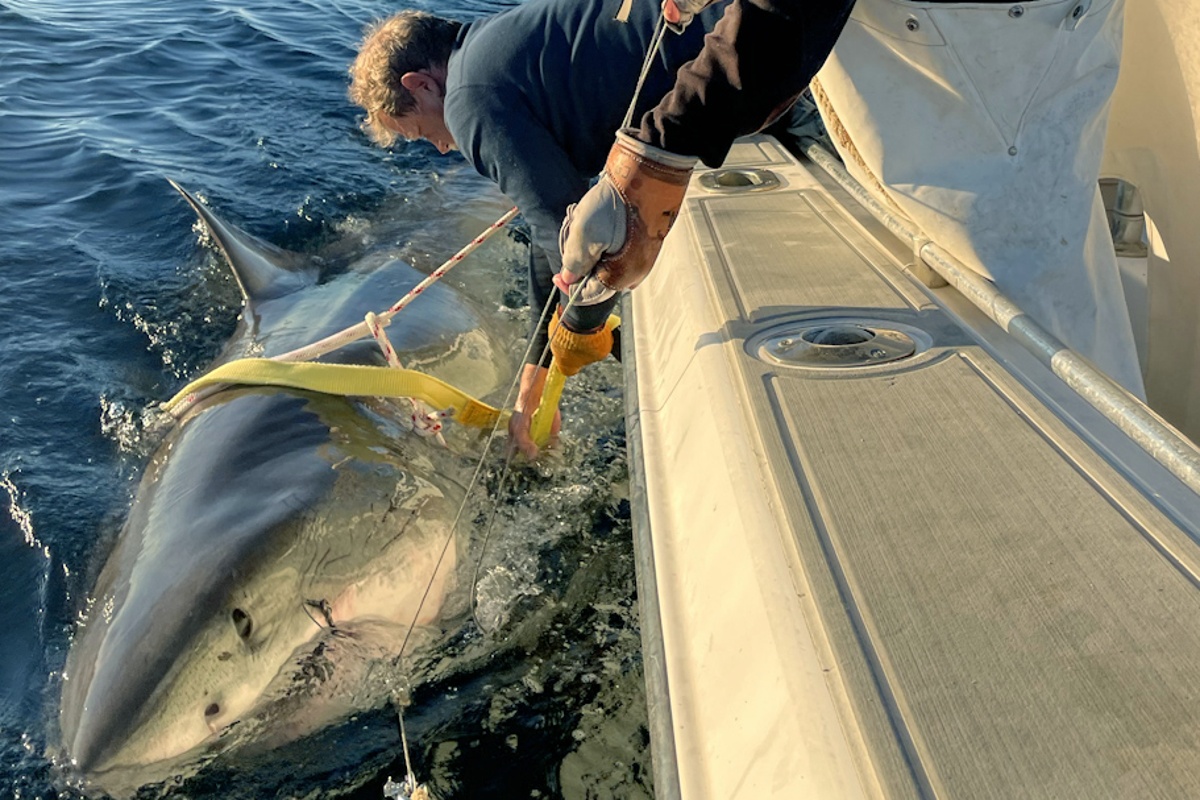
Every summer, the tabloids run the exact same play. A massive shark shows up on a tracking map, and suddenly every headline screams that a bloodthirsty monster is heading straight for your favorite holiday beach. The latest target of this media frenzy is Contender. He is the largest male great white shark ever detected on the Atlantic coast, an absolute beast of an animal weighing 1,653 pounds and stretching 13 feet, 9 inches long. When his satellite tag flared back to life in July 2026 after months of complete radio silence, the internet did what it always does. It panicked. But if you are planning a trip to Cape Cod or the Jersey Shore, you can take a deep breath. The real story behind this apex predator isn't a horror movie plot. It's a fascinating look at ocean recovery, and honestly, he has no interest in ruining your vacation.
The panic started when researchers from the non-profit organization OCEARCH noticed a brief signal from Contender's tracking device. He had vanished from the grid after an April 2026 ping near the Outer Banks of North Carolina. For months, scientists heard nothing. Then, a partial transmission known as a Z-ping registered on July 10, 2026, followed by clearer signals confirming he is moving north right on schedule. He is currently tracing the Eastern seaboard, heading toward the seal-heavy waters of New England and Atlantic Canada.
Sensational headlines make it sound like an anomaly. They make it seem like a rogue monster is stalking tourists. That is total nonsense. Contender is doing exactly what healthy great white sharks have done for thousands of years. Understanding his journey tells us a lot about the health of our oceans and how we can safely share the water with them.
Breaking Down the Mind Blowing Size of Contender
To understand why scientists are losing their minds over this shark, you have to look at how great white sharks grow. In the shark world, females are the true giants. Female white sharks routinely reach 15 to 16 feet in length, with famous specimens like Deep Blue pushing past 20 feet. Males are significantly smaller. On average, a mature male great white only grows to between 11 and 13 feet.
That is what makes Contender a statistical outlier. At 13 feet, 9 inches and well over 1,600 pounds, he is pushing the absolute absolute physical limits for a male of his species. He is essentially the heavy-weight champion of the Atlantic male shark population.
When the OCEARCH team first captured, sampled, and tagged him on January 17, 2025, off the coast of Jacksonville near the Florida-Georgia border, they knew they had caught something legendary. Chief Scientist and Veterinarian Harley Newton noted that adult males of this size are incredibly elusive. Based on his size and development, experts estimate Contender is in his early 30s. Great whites can live for over 70 years, meaning this guy is a mature adult right in the prime of his reproductive life. He represents the future of his species in the Western Atlantic.
The Secret World of Satellite Tracking and Z Pings
A lot of the public fear comes from a basic misunderstanding of how shark tracking technology works. People look at the tracking apps, see a shark icon disappear for three months, and assume the animal was hiding in the shallows waiting to strike. That is not how this works at all.
Contender is fitted with a Smart Position or Temperature tag, commonly called a SPOT tag, attached to his dorsal fin. This tag does not constantly transmit a GPS location like your smartphone does. It only works when the shark's dorsal fin breaks the surface of the water for several consecutive seconds while an Argos satellite happens to be passing overhead in orbit.
If a shark stays submerged, you get zero data. When Contender went dark between April and July, he wasn't missing. He was just doing normal shark things. He was swimming in deep waters, hunting pelagic fish, and traveling miles away from the coast where humans never go.
The signal that caused the recent media uproar was a Z-ping. A Z-ping occurs when the fin breaks the surface just long enough to send a faint pulse to the satellite, but not long enough to calculate an exact, highly accurate geographic coordinate. It is basically the shark waving its hand out of the water to say, "Hey, I'm still alive." It gives scientists a general location and confirms the tag is functioning, but it doesn't mean the shark is swimming parallel to the boardwalk.
Mapping the Real Atlantic Shark Highway
If you look at the historical data of the largest male great white shark ever detected on the Atlantic coast, you notice a highly predictable pattern. These animals operate on an annual loop that acts like a massive underwater highway.
During the winter months, from roughly December through March, Contender and his peers hang out in the warmer waters off the coast of Florida, Georgia, and the Carolinas. The food source there consists mostly of large fish, tuna, and small cetaceans.
As the calendar turns to spring, the water warms up, and the sharks begin a massive migration northward. They travel thousands of miles up the East Coast. By the time July and August hit, they arrive at their summer feeding grounds around Cape Cod, Massachusetts, and further north into Nova Scotia, Newfoundland, and the Gulf of St. Lawrence in Canada.
Why do they travel so far? It comes down to a change in their diet. Adult great whites love fat. They need energy-dense food, and nothing beats a gray seal or a harbor seal. Cape Cod has seen a massive explosion in its seal population over the last few decades thanks to federal protections. For a 1,600-pound shark like Contender, Cape Cod in the summer is an all-you-can-eat buffet of high-calorie blubber. He isn't traveling north to look for swimmers; he is traveling north because the seals are there.
Simple Reality Checks for Summer Beachgoers
It is easy to get spooked when you hear that a 14-foot apex predator is in the same state where you are building sandcastles. But a little context changes everything. You need to understand how these animals behave if you want to stay safe without letting fear ruin your summer.
First, realize that sharks like Contender generally stay pretty far offshore. When he pinged off the Outer Banks earlier this year, he was more than 20 miles out at sea. Even when they come closer to Cape Cod, they are tracking the deep channels where seals move, not the shallow sandbars where toddlers are splashing.
Second, shark attacks are incredibly rare. Your chances of getting bitten by a great white shark are roughly 1 in 11.5 million. You are vastly more likely to get injured driving to the beach, struck by lightning on the sand, or crushed by a collapsing sand hole than you are to have an encounter with Contender.
Sharks do not view humans as food. We are too bony, we don't have enough fat, and we don't taste like seals. Almost every single shark bite in history is a case of mistaken identity. In murky water, a human swimming with dark fins or splashing around can look and sound exactly like a struggling seal from below. Once the shark realizes its mistake, it almost always lets go and moves on. The problem is that when an animal the size of Contender makes a mistake, even a single test bite can be catastrophic. That is why smart beach habits matter.
Your Practical Action Plan for Ocean Safety
You don't need to stay out of the ocean. You just need to be smart about how you enter it. If you are swimming in areas known for seasonal great white activity, like the beaches of Massachusetts or the Northeast coast, follow these non-negotiable rules.
- Avoid swimming at dawn and dusk. This is prime hunting time for white sharks. The low light conditions make it harder for them to distinguish between a human and a seal, drastically increasing the risk of an accidental bite.
- Stay away from seal colonies. If you see seals hanging out on a beach or swimming nearby, get out of the water immediately. You are swimming in a dining room. Don't be surprised if the dinner guest shows up.
- Do not swim alone. Sharks are ambush predators. They look for isolated targets. Swimming in groups significantly lowers your profile and ensures someone can help if something goes wrong.
- Keep close to the shore. Do not swim past the breakers or out into deep drop-offs. If you stay in waist-deep water, you are well out of the zone where large sharks can easily maneuver and hunt.
- Leave the shiny jewelry at home. Bright, reflective metal jewelry flashes in the water like the scales of a distressed fish. To a predatory fish, that looks like an easy meal.
- Avoid splashing excessively. Erratic splashing creates acoustic vibrations that travel long distances underwater. It sounds exactly like a wounded animal, which acts like a dinner bell for predators.
Why the Recovery of These Giants is Great News
It sounds counterintuitive to celebrate the return of giant predators to our coastlines, but it is actually a massive victory for environmental conservation. For decades, humans waged a war on sharks. Overfishing, finning, and simple hatred decimated global shark populations.
When you remove the top predator from an ecosystem, the whole system collapses. Without sharks to keep them in check, mid-level predators and prey species like seals multiply uncontrollably, destroying fish stocks and throwing the marine food web completely out of balance.
The fact that an animal as old, large, and healthy as Contender is thriving along the Atlantic coast means our conservation laws are working. Great whites have been protected in U.S. waters since 1997. Contender's presence proves that the Western Atlantic white shark population is slowly rebuilding its numbers. A healthy shark population means a healthy, resilient ocean ecosystem that can support fish, whales, and birds for generations to come.
Instead of tracking Contender on your phone with a sense of dread, view him as a symbol of wild nature successfully reclaiming its space. Respect his domain, use basic common sense when you step into the surf, and marvel at the fact that we get to share a planet with creatures this magnificent.
Download a public shark tracking app if you want to stay informed about local sightings. Check the local beach safety flags before you jump into the waves. Pay attention to lifeguards, stay clear of the seals, and enjoy your summer on the coast without letting sensational media panic dictate your life.
This video details the seasonal travel patterns of Atlantic white sharks and why they return north every summer.