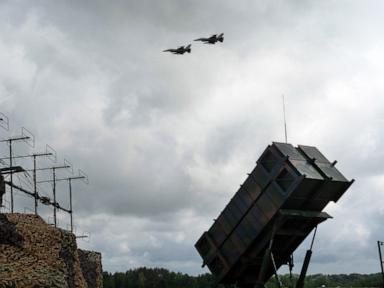
Donald Trump just dropped a massive defense policy surprise at the NATO summit in Ankara. Sitting next to Ukrainian President Volodymyr Zelenskyy, Trump announced that the U.S. will grant Ukraine a production license to build its own Patriot missile interceptors. "That's pretty cool," Trump said. "This way, you can't complain that we're not giving 'em enough."
It sounds like a masterful shortcut to solve Ukraine's desperate air defense shortage. By bypassing the years-long international waiting lists and letting Kyiv press the start button on its own assembly lines, the war-torn nation could theoretically secure its own skies. Trump even claimed that production could kick off in just two to three months.
But if you look at how military manufacturing actually operates, that timeline is a fantasy.
Let's be direct. You can't just hand over a stack of blueprints to a country under constant bombardment and expect advanced, radar-guided interceptors to roll off the line ninety days later. Building a Patriot missile isn't like spinning up a cheap drone factory. It's one of the most complex industrial processes on earth, and pulling it off inside Ukraine will take years, not months.
The Massive Gap Between a License and a Missile
Trump's announcement glossed over a glaring omission. When he made the statement, he hadn't actually informed RTX Corporation or Lockheed Martin—the defense giants that hold the proprietary technology for the Patriot system. You don't just bypass the prime contractors who spend decades perfecting solid-fuel rocket motors and guidance systems.
A production license is just a piece of paper. It authorizes a country to build something legally, but it doesn't instantly construct factories, train technicians, or secure specialized tooling.
Look at Germany's experience. Berlin signed a deal in 2022 to establish a localized European production line for PAC-2 GEM-T interceptors through MBDA, with RTX providing the technical data. Ground broke on the facility in 2024. The factory isn't slated to open until late 2026, and the first finished missiles won't be delivered until 2027. That's a five-year runway from pen-to-paper to an actual functioning weapon system, achieved in a peaceful, highly industrialized nation with no missiles raining down on its power grid.
To think Ukraine can replicate that in a matter of weeks is fundamentally unrealistic.
What Part of the Patriot Are We Talking About
We need to understand exactly what Ukraine would be allowed to build. The Patriot system isn't a single weapon. It's an entire ecosystem composed of:
- Phased-array radar sets that track incoming targets.
- Engagement control stations acting as the brain of the battery.
- Mobile launching stations.
- The interceptor missiles themselves (like the PAC-2 and PAC-3 MSE).
Anatolii Khrapchynskyi, a defense executive at Fly Group Ukraine, pointed out that Trump's language was incredibly vague. He said "Patriots," but manufacturing the radar systems or the command hubs requires highly classified, military-grade semiconductor fabrication facilities that Ukraine simply does not possess.
Even if the license is strictly limited to the interceptor missiles, the supply chain is a nightmare. A single PAC-3 missile relies on a vast web of hundreds of suppliers scattered across the globe. They provide everything from precision control surfaces to explosive warheads and highly sensitive guidance seeker heads. If one sub-component vendor faces a backlog, the whole line stops.
The Reality of Wartime Manufacturing
Ukraine has proven to be an absolute powerhouse at scaling up defense production under fire. Look at what they've done with tactical drones and the naval strike systems that cleared the Black Sea. They're fast, innovative, and highly adaptable.
But there's a world of difference between assembling a thousand-dollar FPV drone out of commercial off-the-shelf electronics and manufacturing a multi-million-dollar Patriot interceptor.
Drones are expendable and forgiving. A Patriot missile requires absolute precision. It flies at hypersonic speeds to smack a ballistic missile out of the sky using hit-to-kill technology. If a single solder joint is off by a millimeter, the missile misses, and a Russian Iskander strikes a residential block. The quality control and cleanroom environments needed for this type of aerospace engineering are incredibly difficult to maintain in a country where the electricity goes out regularly due to infrastructure strikes.
Then there's the target on Ukraine's back. The moment construction begins on a high-tech facility known to be producing America's premier air defense weapon, it becomes Russia's number one targeting priority. Keeping a massive industrial footprint hidden from satellite imagery and long-range cruise missiles is nearly impossible.
The Long Road Ahead
Don't expect Ukrainian-made Patriots to defend Kyiv anytime soon. If this initiative moves forward, the immediate next steps will look nothing like a factory floor.
First, U.S. and Ukrainian defense officials have to hash out government-to-government technology transfer frameworks. Then come the grueling commercial negotiations with RTX and Lockheed Martin over proprietary intellectual property. Following that, Western experts will have to ship knocked-down component kits to Ukraine so local engineers can practice basic final assembly before they even think about manufacturing parts from scratch.
This plan is a massive win for Ukraine's long-term security posture in the 2030s, but it's completely useless for the current phase of the war.