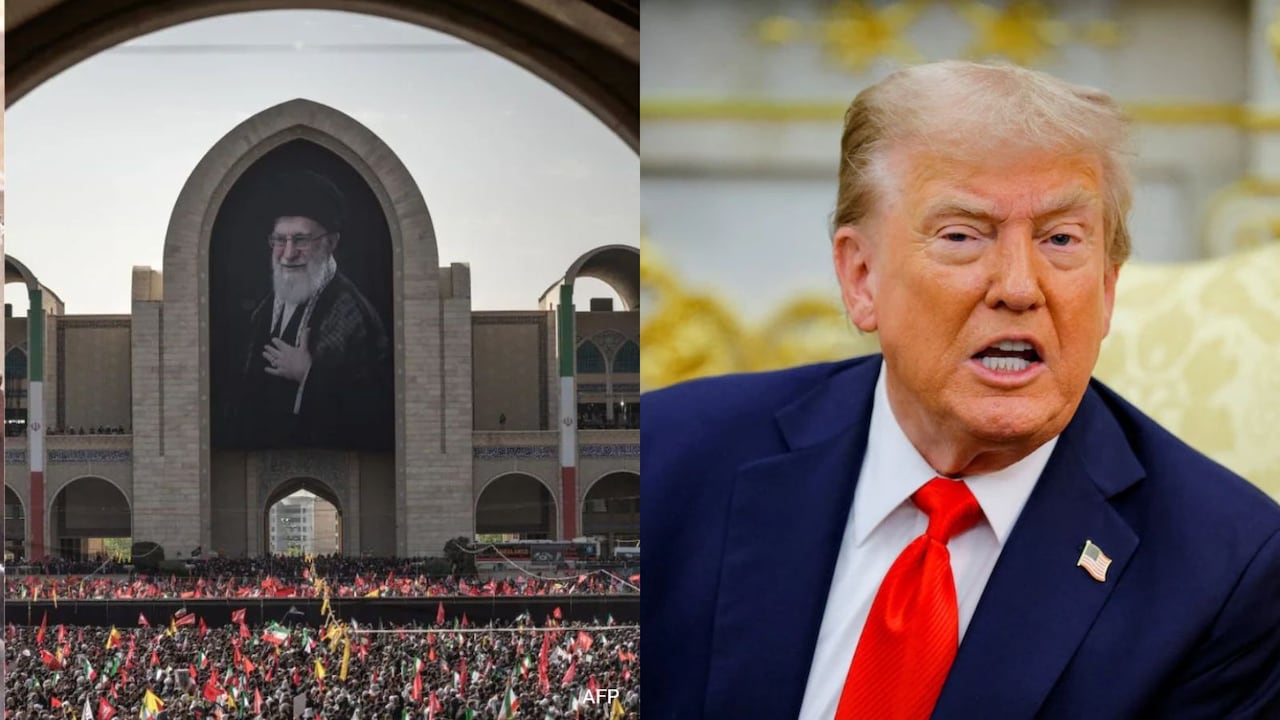
Donald Trump thought he was displaying ultimate strength when he told Axios that the United States could wipe out Iran's entire remaining leadership in one shot. He looked at the massive crowds gathering in Tehran for the state funeral of Ayatollah Ali Khamenei and dismissed their grief as fake tears. He bragged that Washington was being nice by giving the regime a week off from airstrikes to bury their leader.
Instead of backing down, Tehran fired back with a remarkably venomous diplomatic response that cuts straight to the core of this multi-generational conflict. Iran's embassy in Armenia issued a scathing public statement on X that mocked America's young history. The diplomats argued that a nation celebrating its 250th Independence Day simply lacks the civilisation, history, or honour to understand what is happening on the streets of Tehran. They compared Khamenei to a perfume bottle that, when broken by an enemy strike, only spreads its scent further across the world.
This latest rhetorical blowup shows how deeply both sides misjudge each other. Trump treats international diplomacy like a high-stakes real estate negotiation driven by raw intimidation. Iran views the crisis through the lens of ancient history, religious martyrdom, and long-term geopolitical endurance. When these two opposing worldviews collide during a massive public funeral, the risk of catastrophic miscalculation skyrockets.
The Interview That Sparked the Firestorm
Trump's comments to Axios were classic Trump. Speaking about the geopolitical pause in conflict, he claimed that Iran's top officials were begging to make a deal. He noted that because the entire political and military elite of the Islamic Republic had gathered in one place for the funeral ceremonies, the US military had a unique opportunity. They are all there, Trump said. One shot and we can take them all out. He added that he chose not to pull the trigger only because Washington needs someone left alive to sit at the negotiating table.
He also couldn't hide his surprise at the sheer scale of the public mourning. Khamenei ruled Iran for thirty-six years before he was killed in a joint US-Israeli air strike on February 28. Trump openly doubted the sincerity of the millions of people filling the streets. I thought people hated Khamenei, Trump remarked, before suggesting the tears might be staged for the cameras.
That specific insult triggered the explosive response from Iranian officials. By mocking the public grief and threatening a decapitation strike during a holy ritual, Trump handed Iran's propaganda machine the exact fuel it needed to unite a fractured domestic population.
The Perfume Bottle Metaphor and the Clash of Civilisations
Iran's diplomatic response did not just defend Khamenei. It attacked the very foundational identity of the United States. By specifically referencing July 4 and America's 250th birthday, Iranian diplomats sought to paint the US as a shallow, historical newcomer that relies on raw military power because it lacks cultural depth.
Deconstructing the Iranian Retort
The statement from the embassy in Armenia focused on two distinct ideas. First, it asserted that military strikes cannot destroy political or religious movements. People can be killed, but ideals cannot, the embassy stated. They used the vivid imagery of a broken perfume bottle to argue that assassination only amplifies the reach of Khamenei's revolutionary ideology.
Second, the response leveled a direct cultural insult against American society. The claim that the US has neither civilization, nor history, nor honour is designed to appeal to a deep sense of national and regional pride across the Middle East. It reframes a brutal military conflict into a struggle between an ancient, honorable culture and a ruthless, uncultured superpower.
The Power of Martyrdom in Shifting Public Narratives
To understand why Trump's words backfired, you have to look at the role of martyrdom in Shiite history. Public mourning, ritual chest-beating, and massive funeral processions are not just religious obligations. They are powerful political tools used to signal collective resistance against outside pressure.
Before the assassination of Khamenei, the Iranian regime faced significant internal dissent, economic stagnation, and widespread dissatisfaction among its youth. By killing the Supreme Leader and then joking about wiping out the rest of the government at his funeral, the US has inadvertently helped the regime shift the conversation. Internal political debates have been pushed aside. The current state narrative focuses entirely on national unity against an existential foreign threat.
The Dangerous Reality Behind the Propaganda
Strip away the fiery rhetoric and the social media posts, and the situation on the ground remains incredibly volatile. This funeral is not just a symbolic event. It is a highly logistical operation happening in the middle of an active geopolitical war.
A Funeral Designed as a Geopolitical Statement
Iran intentionally chose July 4 to kick off the week-long funeral procession for Khamenei. This was a deliberate poke in the eye to Washington. The schedule itself reads like a tour of regional religious authority.
- The ceremonies began with massive processions through the capital city of Tehran.
- The bodies will be taken to Qom, the theological heart of Iranian clerical power.
- Processions are also planned for Najaf and Karbala in neighboring Iraq, reinforcing Iran's regional influence.
- The final burial will take place on July 9 in Mashhad, Khamenei's northeastern hometown.
Throughout these events, the state has carefully managed the imagery. The coffins rest on decorated platforms surrounded by national flags and black mourning banners. Every camera angle is calculated to project power, stability, and defiance.
The Invisible Successor
While Trump joked about the leadership being gathered in one place, the most important figure in Iran was noticeably absent. Mojtaba Khamenei, the late leader's son and the man widely expected to take over the supreme leadership, did not attend the public services in Tehran.
Reports from diplomatic representatives indicate that Mojtaba stayed away due to extreme security risks. Israeli Defence Minister Israel Katz had already publicly stated that Mojtaba is marked for death. With constant drone surveillance and the threat of fresh airstrikes, Iranian security teams decided that a public appearance by the incoming leader was simply too dangerous. This shows that despite their public bravado about perfume bottles and immortal ideals, Iran's leaders are fully aware of their physical vulnerability.
Why the One Shot Logic Fails in Real Geopolitics
Trump's assertion that a single strike could solve the Iranian challenge ignores how the Islamic Republic actually functions. Decapitation strikes rarely produce the clean, stable outcomes that Western policymakers hope for.
The Institutional Structure of the Islamic Republic
Iran is not a typical dictatorship where power rests entirely in the hands of one man. It is a highly bureaucratic system with overlapping centers of authority.
- The Islamic Revolutionary Guard Corps controls vast swathes of the economy and the military apparatus.
- The Assembly of Experts is legally tasked with choosing the next Supreme Leader.
- The traditional military, the parliament, and the clerical network in Qom all hold distinct levers of power.
If the US were to execute a strike that wiped out the officials attending the funeral, it would not cause the regime to collapse overnight. Instead, it would create a chaotic power vacuum. The most radical elements of the Revolutionary Guard would almost certainly seize total control, unbound by any remaining diplomatic or political constraints.
The Illusion of the Week Off
Trump's claim that he graciously gave Iran a week off for the funeral obscures the strategic reality. The current pause in fighting is not an act of charity. It is a tactical intermission that serves both sides.
Iran needs time to manage a massive internal transition of power and bury its longest-serving leader without facing immediate military collapse. The US and its regional allies need time to assess the new leadership structure and avoid dragging the entire Middle East into an unmanageable regional war. Calling this pause a gift from Washington misreads the cold calculations happening inside the Pentagon.
The Broken Window for Diplomacy
Trump mentioned that he avoided striking the funeral because he wanted to keep someone around to negotiate with. He claimed that Iran is dying to settle and make a deal. But his public taunts make any actual diplomatic breakthrough nearly impossible in the near term.
The Problem of Face in Middle Eastern Diplomacy
In international relations, saving face matters immensely. This is doubly true for an Iranian regime that bases its entire legitimacy on anti-imperialism and resistance to Western dictation. When an American president publicly claims that a regime is begging for a deal while threatening to blow them up at a funeral, he closes the door to negotiations.
No Iranian official can step forward to talk to Washington right now without looking like a coward to their own people. By publicly humiliating his adversary, Trump makes it politically impossible for Tehran to offer the very concessions he wants.
Voices from the Street
The anger on the ground is real, and it is growing. During the funeral processions in Tehran, observers noted a distinct shift in the crowd's focus. Emotional anti-American chants filled the air.
At one point, a prominent poet named Mohammad Rasouli took the microphone in front of hundreds of thousands of mourners and openly called for Trump's death. He asked the crowd why the American president was still alive and declared that the world was no longer a safe place for him. The crowd responded with loud cheers. This was the first time a state-sanctioned emcee at the funeral made a direct call for the assassination of a US president, showing how quickly the rhetoric is escalating beyond traditional diplomatic boundaries.
Where the US Iran Conflict Goes Next
The funeral will end on July 9, and with it, the informal week off will expire. Once Khamenei is buried in Mashhad, the underlying geopolitical realities will return with a vengeance. The current situation cannot hold indefinitely.
Immediate Practical Steps for Regional Stability
To prevent this war of words from turning into a direct military conflagration, several immediate steps need to happen behind the scenes.
- Establish Backchannel Communications: Direct talks are impossible right now, so Switzerland or Oman must act as intermediaries to clarify the red lines of both nations before July 9.
- Define the Parameters of the Pause: Both sides need to explicitly understand what constitutes a violation of the current ceasefire. A single stray rocket or unauthorized drone flight could reignite full-scale hostilities.
- Monitor the Succession Process: Western intelligence must focus on the internal shifts within the Assembly of Experts as they finalize the transition to the next Supreme Leader, whether it is Mojtaba Khamenei or a dark-horse clerical candidate.
The tragedy of the current US approach is the belief that total military dominance eliminates the need for sophisticated cultural understanding. Trump's one shot comment was meant to project strength, but it showed an astonishing ignorance of how religious nationalism operates. By reducing a complex, historical adversary to a simple target, the US risks walking blindly into a long, bloody conflict that no single shot can ever finish.