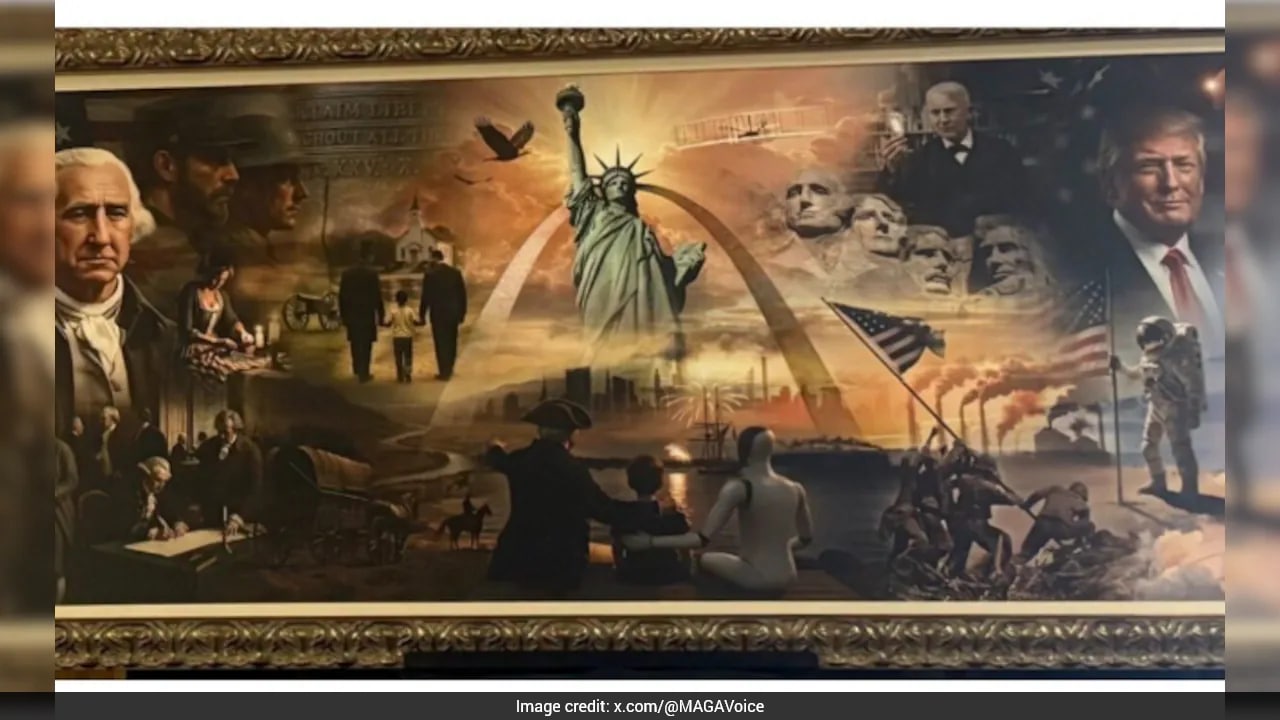
Donald Trump just dropped a piece of art that perfectly captures his approach to the upcoming 250th Independence Day. He posted a massive, chaotic collage on Truth Social featuring himself on one side and George Washington on the other. It's got everything you would expect from a hyper-patriotic meme. There's the Statue of Liberty, Mount Rushmore, the Moon landing, and a pioneer wagon. But if you look right at the center, things get weird. Sitting next to George Washington and a young boy watching fireworks is a humanoid robot.
Trump didn't give the name of the artist. He just captioned it with typical enthusiasm. "Great painting!! President DJT."
People online reacted exactly the way you'd guess. Fans called it epic and suggested hanging it in the Oval Office immediately. Critics compared it to state-sponsored propaganda. Some pranksters even edited the photo to swap Trump out for John F. Kennedy. This isn't just about a funny social media post, though. This is part of a deliberate, multi-year campaign by Trump to tie his own brand directly to America's semiquincentennial on July 4, 2026.
The Push for a MAGA Semiquincentennial
Trump has been hyping up this 250th anniversary for years. He has openly celebrated the fact that this historic milestone lands right in the middle of his second term. For him, the nation's birthday party is the ultimate stage. His administration has poured resources into turning the capital into a curated theater of patriotism.
Look at what else happened over the exact same weekend. Trump shared another image showing a giant golden bald eagle mounted right onto the Truman Balcony of the White House. He called it a golden gift for the building's 250th birthday year. CNN quickly pointed out the image was entirely AI-generated. The digital eagle had an architectural railing that didn't match the real White House, and the shield on its front only had 11 stars instead of 13. Metadata confirmed it came from Google AI tools. Freelance photographers checking the South Lawn later that night confirmed the balcony was completely empty.
Trump also revealed a completely redesigned, limited-edition US passport. This one features his own portrait right on the inside cover, leaning over the Resolute Desk with balled fists, staring intensely at the camera. The facing page displays John Trumbull's classic painting of the Founding Fathers signing the Declaration of Independence. On the back, there's a gold flag marking the Freedom 250 initiative.
Inside the Freedom 250 Infrastructure
The actual policy machine behind these visuals is extensive. The White House Task Force 250 is running a massive public-private partnership called Freedom 250. They've been setting up events since Memorial Day of last year, and they plan to keep going straight through the end of December.
The biggest ground-level push involves six custom mobile museums called Freedom Trucks. These massive vehicles are driving all over the country right now, from Washington state down to North Carolina. When you walk inside one, you get greeted by an AI-generated version of George Washington that literally talks to you. The digital Washington proclaims that your rights are a gift from God, right under a ceiling that reads "In God We Trust." Visitors can take a digital quiz to see if they're a loyalist or a patriot, sign a digital copy of the Declaration of Independence, and look at a wall of 50 American heroes ranging from Rosa Parks to the Wright Brothers.
The funding for these trucks has caused a major fight in Washington. The Institute of Museum and Library Services handed over a $14 million federal grant for the trucks, which was paired with $10 million in private money from Freedom 250. Senate Democrats have been demanding to know why federal cash went straight to a private entity without traditional oversight. They've raised concerns about whether private donations might be coming from foreign sources.
Turning History into a Cultural Battleground
The 250th anniversary should be something that unites people, but it has turned into a massive culture war instead. In places like Massachusetts, local pushback actually forced organizers to cancel scheduled visits from the Freedom Trucks. Critics argue that the administration's version of history is heavily sanitized. They say it pushes a deeply religious narrative while completely ignoring or glossing over America's foundational struggles with slavery and systemic racial injustice.
Meanwhile, the physical changes around Washington D.C. show exactly who is running the show. Giant banners featuring Trump's face have been hung outside multiple executive buildings. At the Department of the Interior, Trump's face sits side-by-side with George Washington on banners reading "America's First" and "America First." Over at the Department of Justice, another massive banner of Trump stares down at the street.
The main events on July 4 will turn the National Mall into an unprecedented spectacle. The administration is building custom pavilions for every single US state and territory. They are expecting over a million people to crowd the Mall for a full day of programming, a keynote speech from Trump, and a fireworks display designed to break the Guinness world record. Trump has even scheduled an IndyCar race, the Freedom 250 Grand Prix, to run right through the streets of the capital later this summer.
What Happens When a Milestone Gets Commercialized
This entire celebration highlights a massive shift in how we handle national history. Trump loves fan art and routinely shares flattering digital creations. He previously shared an AI image of himself as Atlas holding up the world, and another one where he was conducting a symphony orchestra made up of his own cabinet members.
Many historians are deeply uncomfortable with how the nation's 250th birthday is playing out. They argue that a major anniversary is supposed to be an opportunity for a country to reflect honestly on its progress, its mistakes, and its future. When the messaging is compressed into flashy AI images, golden eagles, and stylized portraits, that reflection disappears. It gets replaced by a highly polished, heavily branded corporate product.
Instead of a shared national moment, the birthday has become an endorsement of a specific political movement. People who don't support the administration feel completely locked out of their own country's milestone. On the flip side, supporters view the pushback as proof that their opponents simply lack patriotism. The middle ground has vanished.
Action Steps for Following the 250th Celebrations Safely and Critically
If you are planning to follow or attend any of these massive semiquincentennial events over the coming days, you need a practical strategy to cut through the noise.
First, verify what you are looking at online before sharing it. The golden eagle and the Atlas images prove that the current political media strategy relies heavily on synthetic media. Look closely at structural details, check the metadata if possible, and cross-reference social media posts with real-world journalists on the ground.
Second, if you visit the National Mall or interact with the mobile Freedom Trucks, separate the historical educational components from the political branding. Appreciate the focus on revolutionary battles and historical figures, but remain aware of how those narratives are curated. Seek out independent museum exhibits, like those at the Smithsonian or local historical societies, to get a balanced view of America's full history.
Third, prepare for intense logistics if you travel to the capital. The massive influx of over a million visitors, combined with ongoing National Guard deployments at major transit hubs like Union Station, means security lines and travel delays will be severe. Check local transit advisories daily and secure your viewing spots for the National Mall events early.