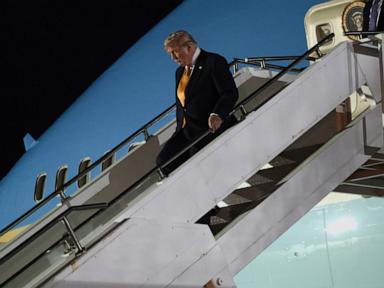
Donald Trump didn't fly back from Turkey the way he arrived. The sudden aviation shell game over Ankara caught everyone off guard. Flying into the NATO summit, he used the newly retrofitted Boeing 747-8, a luxury jet gifted by Qatar. Leaving Turkey, he was suddenly aboard the decades-old baby blue VC-25A.
Trump claimed it was for nostalgia. He claimed he wanted to show off the magnificent new aircraft to troops at RAF Mildenhall in Britain. That's the public story. The actual reason is far more chilling. The US Secret Service explicitly urged the president to switch planes out of an abundance of caution.
Hostilities with Iran are hitting a boiling point. Turkey shares a direct border with Iran. This geographical reality turned a standard presidential departure into a high-stakes security puzzle. The decision highlights the extreme measures required to keep a president safe when international tensions peak.
The Threat From Across the Border
Ankara sits in a complex geopolitical position. Flying a highly visible, newly customized presidential aircraft out of Turkish airspace right next to Iranian territory presented a unique risk vector. The Secret Service didn't have a concrete, active threat of an imminent strike. They had something just as concerning: a vulnerability window.
Iran has made no secret of its targets. Trump acknowledged this reality directly during his post-summit press conference in Ankara. He told reporters flatly that he knows he is at the top of Iran's target list. He added that he didn't care, but his security detail clearly cares a lot.
The Secret Service operates on risk minimization. When a threat environment elevates, you change the variables. You don't fly the shiny, new, predictable target. You mix up the playbook.
White House Communications Director Steven Cheung confirmed this line of thinking. He noted that the administration uses every tool available to counter threats. That includes distraction. It includes misdirection. Swapping planes mid-journey is classic misdirection.
The Qatari Jet Under the Microscope
The plane Trump flew into Turkey has been a lightning rod for controversy for months. Qatar gifted the Boeing 747-8 to the United States last year. The gift was meant to fill a gaping logistical hole. Boeing has faced severe, multi-year delays in delivering the official next-generation Air Force One fleet.
Defense contractor L3Harris Technologies took over the Qatari jet to fast-track a military-grade retrofit. They added defense systems, secure communications, and presidential quarters. They worked fast.
Too fast, according to some aviation security experts.
The breakneck speed of the upgrade raised eyebrows inside the intelligence community. A standard Air Force One overhaul takes years of painstaking testing. Every wire is checked. Every panel is swept for electronic bugs. The Qatari jet went through an accelerated version of this process.
When you fly into an airspace bordering an active adversary like Iran, "accelerated" isn't good enough. The Secret Service preferred the old reliable workhorse. The legacy VC-25A has been flying presidents since 1990. It features heavily shielded electronics, missile deflection systems, and decades of proven operational security. It's a flying fortress. The new jet is still earning its stripes.
How Presidential Decoys Actually Work
The logistics of a presidential plane swap are incredibly intense. The Air Force never flies the president anywhere without a backup. Usually, a second identical C-32 or a sister VC-25 follows the primary aircraft to an adjacent base.
In this case, both massive Boeing 747s were in theater. This allowed the Secret Service to execute a physical shell game.
One plane leaves empty or carrying support staff. The other carries the commander-in-chief. To an outside observer tracking transponders or watching the runway with binoculars, it's impossible to tell which plane holds the asset.
This tactic complicates an adversary's planning. If an actor wants to attempt an intercept or a surface-to-air strike, they have a fifty-fifty chance of hitting an empty plane. In the world of high-level protection, forcing an enemy to guess is a massive win.
The Secret Service used the new Qatari jet as the ultimate decoy. It flew out of Turkey with its bright new red, white, and dark blue livery, drawing all the attention. Trump slipped away in the older, less conspicuous aircraft.
The Journey Through Britain
The swap wasn't permanent. Trump used the legacy Air Force One to travel from Ankara to RAF Mildenhall in Suffolk, England. The new Qatari jet met him there after making its own stop.
Once on the ground in the United Kingdom, the security profile changed. The immediate proximity to Iranian airspace evaporated. The UK offers a much more controlled, friendly airspace compared to the eastern edge of NATO's borders.
At RAF Mildenhall, Trump switched back. He boarded the new luxury jet for the final leg across the Atlantic back to Washington.
This multi-stage flight plan proves the decision wasn't about a mechanical failure on the new plane. It wasn't about performance issues. It was purely about the specific airspace surrounding Turkey. The moment the geographic danger passed, Trump went right back to his preferred new ride.
What This Means for Future Presidential Travel
This incident reveals a massive vulnerability in how the US handles presidential transport right now. We are relying on stopgap measures. The primary Air Force One aircraft are old. They require constant maintenance.
The Qatari gift was supposed to ease the burden on the aging fleet. Instead, it created a new set of security headaches. It forced the Secret Service to make a highly public, embarrassing pivot during a major international summit.
Security must always trump optics. The Secret Service made the right call by forcing the swap, even if it made the administration look overly defensive.
Expect to see more of these erratic travel arrangements in the future. Until the official, fully certified Boeing replacement planes enter service, the White House will keep using misdirection to keep the president safe.
If you want to track how these security protocols evolve, keep a close eye on flight trackers during the next international summit. Watch the backup planes. The real story is usually hiding in the aircraft the public isn't looking at.