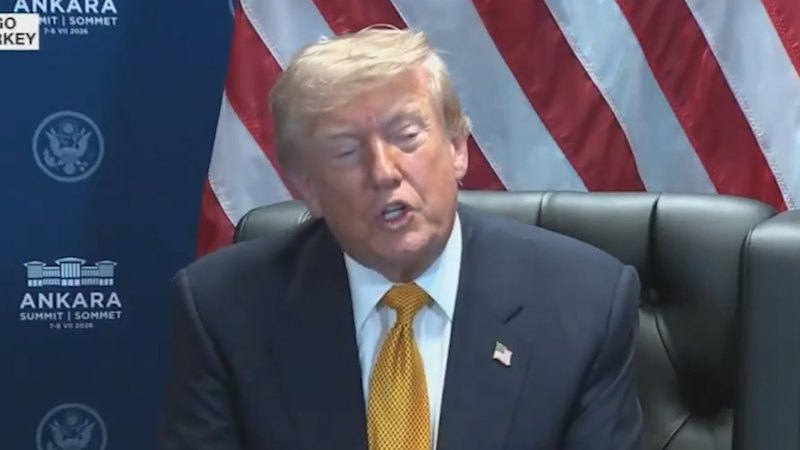
The internet is currently having a collective meltdown over Donald Trump’s latest verbal slip, and honestly, it’s easy to see why. During a high-stakes NATO summit in Ankara, Turkey, Trump was trying to describe a serious escalation in the Middle East. Instead, he dropped a phrase that immediately went viral.
He announced that a U.S. aircraft carrier had been targeted by the "Islamic Republic of Japan."
Social media erupted. Late-night hosts are already salivating. But if you look past the initial laugh-out-loud absurdity of combining a Middle Eastern standard-bearer of Shia Islam with an East Asian archipelago, there is a much darker, much more complicated reality beneath the surface. This isn't just another funny clip for your feed. It’s a window into an incredibly chaotic moment in global politics.
The Gaffe That Shook Ankara
Let’s look at what actually happened on the ground. Trump was in the middle of a meeting with Ukrainian President Volodymyr Zelenskyy when he started addressing reporters about the deteriorating situation with Iran. The U.S. had just launched overnight strikes against Iranian targets following a series of maritime disputes in the Strait of Hormuz. Iran retaliated, firing back at U.S. military facilities in Bahrain and Kuwait.
Trump wanted to project strength. He wanted to detail the sheer scale of the Iranian retaliation to justify his next moves.
"We have 111 missiles shot by the Islamic Republic of Japan," Trump said. He kept right on rolling, detailing how the missiles targeted an American aircraft carrier over the span of an hour. He also managed to bumble the name of the Joint Comprehensive Plan of Action, calling the historic 2015 nuclear deal the "JCPOC."
The immediate political fallout was predictable. Critics dusted off the old playbook, immediately shouting about the 25th Amendment on social media. Pundits started hyper-analyzing the cognitive health of a president who celebrated his 80th birthday just last month.
A Pattern of Pacific Confusion
If this were an isolated incident, you could chalk it up to jet lag or the exhausting schedule of a NATO summit. But this is part of a weird, hyper-specific pattern where Trump’s brain seems to cross wires whenever Iran and Japan share a news cycle.
Think back to March 2026. Trump was sitting right next to Japanese Prime Minister Sanae Takaichi in the Oval Office. A Japanese reporter asked a completely fair, standard diplomatic question: Why didn't the U.S. give its allies in Europe and Asia a heads-up before launching an earlier round of military strikes against Iran?
Trump’s response was peak Trump. He leaned in and said they wanted the element of surprise, adding, "Who knows better about surprise than Japan? Why didn't you tell me about Pearl Harbor?"
Takaichi’s eyes widened in real-time. The room went silent. It was deeply awkward, but it showed how Trump views these two nations through a highly personal, deeply transactional lens of history and conflict. Add in the fact that he recently referred to Japanese Prime Minister Shigeru Ishiba simply as "Mr. Japan" because he seemingly blanked on the man's name, and you realize these verbal shortcuts happen a lot when the pressure mounts.
The Real Crisis Trump Was Trying to Talk About
The comedy of the "Islamic Republic of Japan" is completely overshadowing some terrifying geopolitical news. During that exact same press availability, Trump casually dropped a massive bombshell: the interim U.S.-Iran ceasefire is officially dead.
"For me, I think it’s over," Trump told reporters.
That single sentence matters infinitely more than his geographical confusion. The fragile diplomatic process—which many hoped would stabilize after the recent funeral ceremonies for Iran’s late Supreme Leader Ayatollah Ali Khamenei—is completely falling apart.
When a president says a ceasefire is over while standing in Turkey, global energy markets notice. Oil prices are already spiking because everyone knows what happens when the Strait of Hormuz becomes a shooting gallery. Commercial shipping lanes are vulnerable, insurance rates for tankers are skyrocketing, and the threat of a full-scale regional war is higher than it has been in years.
What to Watch for Next
Don't get bogged down in the meme wars. If you want to know where this situation is actually heading, keep your eyes on three specific pressure points over the next few days.
First, watch the global energy indexes. If oil prices sustain their current upward trajectory, it’s going to trigger a ripple effect through inflation metrics worldwide. Second, look at how Prime Minister Takaichi handles the fallout back in Tokyo. Japan relies heavily on Middle Eastern oil, and being dragged into Trump’s rhetorical blender while trying to navigate their own strict constitutional limits on military action puts them in a brutal diplomatic bind. Finally, watch the Pentagon. Trump explicitly warned that the U.S. is preparing another round of strikes targeting Iran's strategic infrastructure if the missile attacks don't stop.
The internet will keep laughing at the geography lesson gone wrong. Just make sure you're paying attention to the actual missiles.