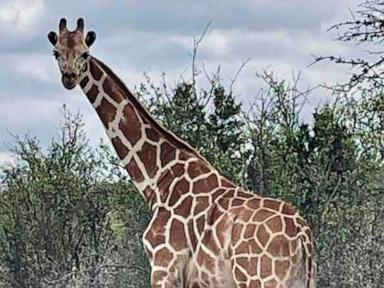
You expect to lose your car keys. Maybe your wallet. You don't expect to lose an 11-foot-tall, 1,200-pound mammal with a neck that rivals a small tree. But early this summer, that's exactly what happened in the rugged heart of the Texas Hill Country.
Gracie, a three-year-old giraffe, managed to pull off a vanishing act that captivated the internet and sent wildlife teams scrambling across thousands of acres of dense brush. She spent nearly two weeks living her best life on the lam before an aerial search team finally spotted her. The story ended well, but the mechanics of how a massive African animal went missing in rural Texas reveals a lot about the reality of private exotic ranching.
The Day Gracie Took the Wrong Turn
It didn't take a complex escape plan or broken locks for Gracie to break out. Honestly, it was just a matter of basic physics and a hill she wasn't supposed to climb. Gracie arrived at Cedar Hollow Ranch in Real County, Texas back in May. The remote property sits roughly 100 miles west of San Antonio, surrounded by limestone cliffs, steep ravines, and thick pockets of oak and juniper.
According to ranch owner Vick Jones, Gracie decided to explore an area none of the ranch's other giraffes had ever bothered with. She climbed a steep, rocky hillside to feed on the tender tree leaves growing along the limestone ledges.
When she finally decided to head back down, she got turned around. She descended on the wrong side of a gate. Because the terrain is entirely solid rock, the ranch hadn't jackhammered posts into the ground to build a fence in that specific area. Nobody thought they needed to. Once Gracie cleared that unfenced boundary, she just kept walking.
Real County is home to only about 2,700 people, but it spans hundreds of square miles of deeply isolated land. The local sheriff, Nathan Johnson, quickly put the community on high alert. Local police departments even started posting tongue-in-cheek, AI-generated images of Gracie "helping" with drone training to keep the public engaged, but the actual search was incredibly grueling.
Jones put up a $5,000 reward for information, but early tips led to dead ends. Teams would rush to a suspected sighting location only to realize they were two or three days late. In a landscape that massive, a giraffe can disappear into the brush in seconds.
Found Fat and Happy
The breakthrough happened on Friday morning, June 26, when Jones teamed up with Jeff Hill of Concho Aviation for a targeted aerial search. Flying over a rugged, roadless stretch of private property about four miles south of the ranch, they finally caught a glimpse of her.
Despite spending 13 days out in the elements, Gracie didn't look worse for wear. In fact, she looked entirely unbothered. She was hanging out within a half-mile of a natural pond and creek, surrounded by a buffet of native Texas vegetation. Jones noted she was just standing there, swishing her tail and looking "fat and happy."
The local ecosystem turned out to be a surprisingly perfect temporary home. The semi-arid climate and dense tree canopy of the Hill Country mimic the dry savannahs and grasslands where giraffes thrive in Africa. Predators weren't a threat to a 1,200-pound animal, and Gracie had all the water and leaves she could ask for.
The Logistics of Moving a Sedated Giant
Spotting a missing giraffe from a helicopter is one thing. Getting her back home without anyone getting hurt is a completely different logistical puzzle. You can't just put a halter on a giraffe and lead it down a rocky cliffside, especially when there are no drivable roads anywhere near the recovery site.
The recovery process requires precision teamwork and heavy sedation. Jones immediately contacted his veterinarian to assemble a specialized capture team. To do this safely, the vet must carefully dose a tranquilizer to slow the animal down without causing it to crash hard on the rocky ground, which could easily break its long legs.
Once the sedative takes effect, handlers place a specialized hood over the giraffe's eyes to keep it calm and reduce external stimuli. From there, the team must guide the animal onto an open-pasture trailer to navigate the rough, roadless terrain. Once they hit an actual road, Gracie must be transferred into a custom, extra-tall enclosed trailer built specifically to accommodate her height during the drive back to Cedar Hollow.
The Wild World of Texas Exotic Ranches
While a missing giraffe sounds like a bizarre, once-in-a-lifetime event, local law enforcement is surprisingly used to weird animal calls. The Texas Hill Country has one of the highest concentrations of private exotic animal ranches in the United States.
Sheriff Johnson noted that while this was his very first missing giraffe case, his office frequently tracks down other escapees. Over the years, local floods and damaged fences have loosed wildebeests, water buffalo, zebras, and monkeys into the Texas brush. Some are caught quickly, while others adapt to the landscape and are never seen again.
For Gracie, the taste of freedom is officially over. Jones stated that she's going to remain safely inside the ranch's primary, fully reinforced giraffe enclosure for the foreseeable future. The immediate plan moving forward is to bring out the heavy machinery, jackhammer through the limestone hills, and build a permanent fence across the gap she used to escape.
If you want to see exactly how the search played out and take a look at the rugged Hill Country terrain Gracie was hiding in, check out this local news broadcast tracking the recovery efforts. This video provides a clear breakdown of the aerial search and features the direct updates from the Real County Sheriff's Office right after she was spotted.