Plant crops in a shifting sandbox and they usually die. Do it in China’s notorious "Sea of Death" and everyone expects an absolute disaster. Yet, a heavily managed patch of wasteland just defied every rule of traditional farming. The latest data on the Taklamakan Desert wheat yield just shattered expectations, pulling off a stunt that most agronomists thought was a decade away. A trial plot deep inside the desert didn't just survive. It brought in a harvest that nearly doubled the entire national average of traditional farmlands.
This isn't a minor fluke. It’s a massive wake-up call for global food security. Meanwhile, you can find related events here: Why Europe Is Moving Toward A Phased Social Media Ban For Kids.
The Reality Behind the Surprising Taklamakan Desert Wheat Yield
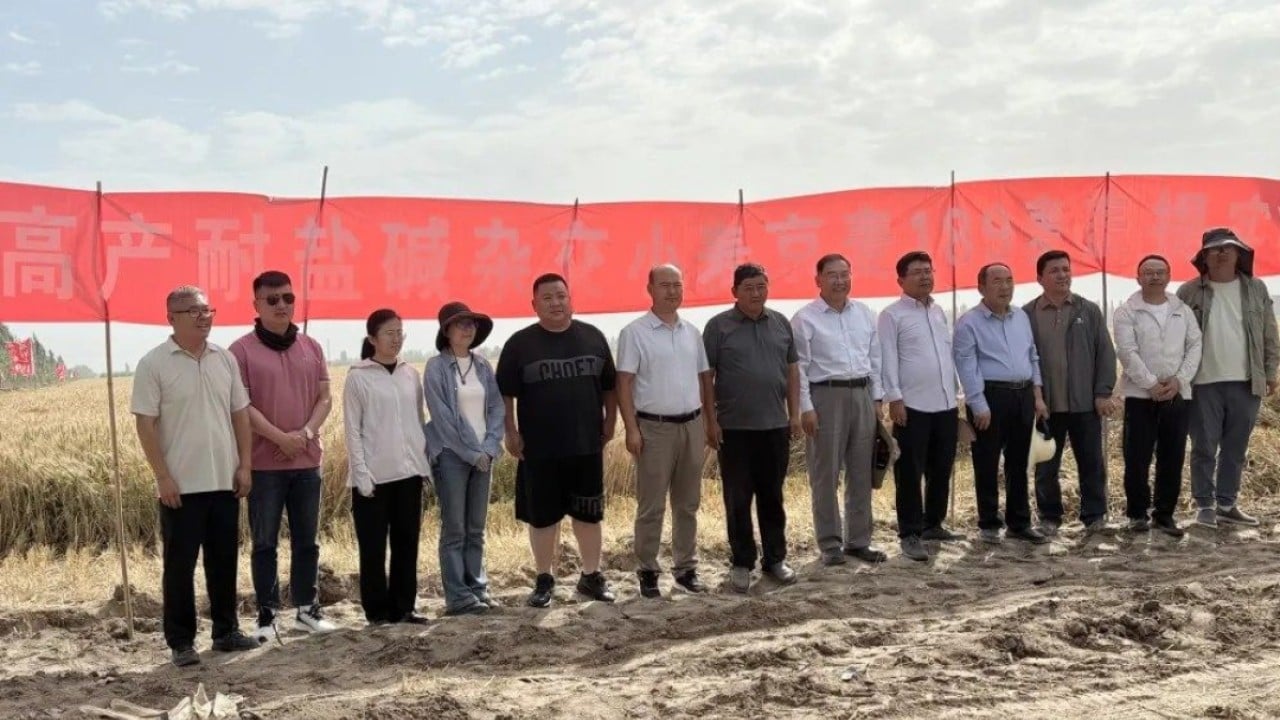
We aren't talking about a few sad stalks of grain clinging to a dune. The Institute of Hybrid Wheat Research, a branch of the Beijing Academy of Agriculture and Forestry Sciences, dropped the official numbers on June 23, 2026. The trial plot yielded a staggering 768 kilograms per mu. To put that in perspective for anyone outside the farming world, that translates to roughly 11.5 tonnes per hectare.
Compare that to China's normal output. The national average wheat yield sat at 399.2 kilograms per mu in 2025. To explore the complete picture, check out the excellent report by TechCrunch.
The trial took place in Makit county. It’s an unforgiving place. The county is bordered by sand dunes on three sides, making it the only administrative region in China literally embedded inside a massive, moving desert. Most of the land there is choked with severe soil salinity. Nothing is supposed to grow there. The fact that researchers pulled off these numbers on a heavily saline, nutrient-poor plot is wild. It caught even the project organizers off guard, with spokespersons admitting the results went way beyond what they anticipated.
Breaking Down the Tech That Beat the Sand
You can't just throw seeds into a dune and hope for rain. The crop variety used here is called Jingmai 189. Scientists bred this specific strain to stare down drought, withstand salt-heavy soils, and survive in dirt that contains almost zero organic nutrients.
But genetics only get you halfway. The real magic happens in how they managed the environment.
The biggest threat in the Taklamakan Desert is the shifting sand. If you don't anchor the ground immediately after leveling a dune, a single windstorm will bury your work under feet of hot sand. The team used a system of precise, high-frequency quantitative irrigation. Instead of flooding fields like traditional farms do, automated systems feed tiny, measured amounts of water mixed with targeted nutrients directly to the root zones at high frequencies. This keeps the water from evaporating into the dry air or sinking straight through the loose sand before the plant can drink it.
They also deployed automated sprinkler lines and drone patrols to manage the fields with minimal human labor. It’s a highly calculated factory system built on top of sand dunes.
Scaling Beyond the Desert Borders
This success has immediate geopolitical weight. Arable land is shrinking globally, climate change is making weather patterns completely unpredictable, and desertification threatens millions of livelihoods. If deserts can become productive food zones, the agricultural balance changes.
The technology behind Jingmai 189 is already moving into international trials. Countries involved in the Belt and Road Initiative, specifically Pakistan and Uzbekistan, are starting to experiment with these methods. These regions share similar struggles with arid climates and degraded, salty soils.
Actionable Next Steps for Marginal Land Agriculture
If you’re managing dry or high-salinity acreage, you can't replicate a multi-million dollar state project overnight, but you can adopt the core philosophy immediately.
- Shift to high-frequency micro-irrigation: Stop relying on deep soaking. Arid soils can't hold it. Deliver water in small, frequent cycles directly to the roots.
- Prioritize salt-tolerant cultivars: Look into hybrid varieties specifically certified for high electrical conductivity (EC) in soil.
- Protect the surface first: Sand and dust movement will ruin young crops. Establish windbreaks or use surface stabilization techniques before investing heavily in planting.
The old boundaries of what qualifies as farmable land are officially dead. Expect to see more green patches in places where human feet used to sink into nothing but dust.