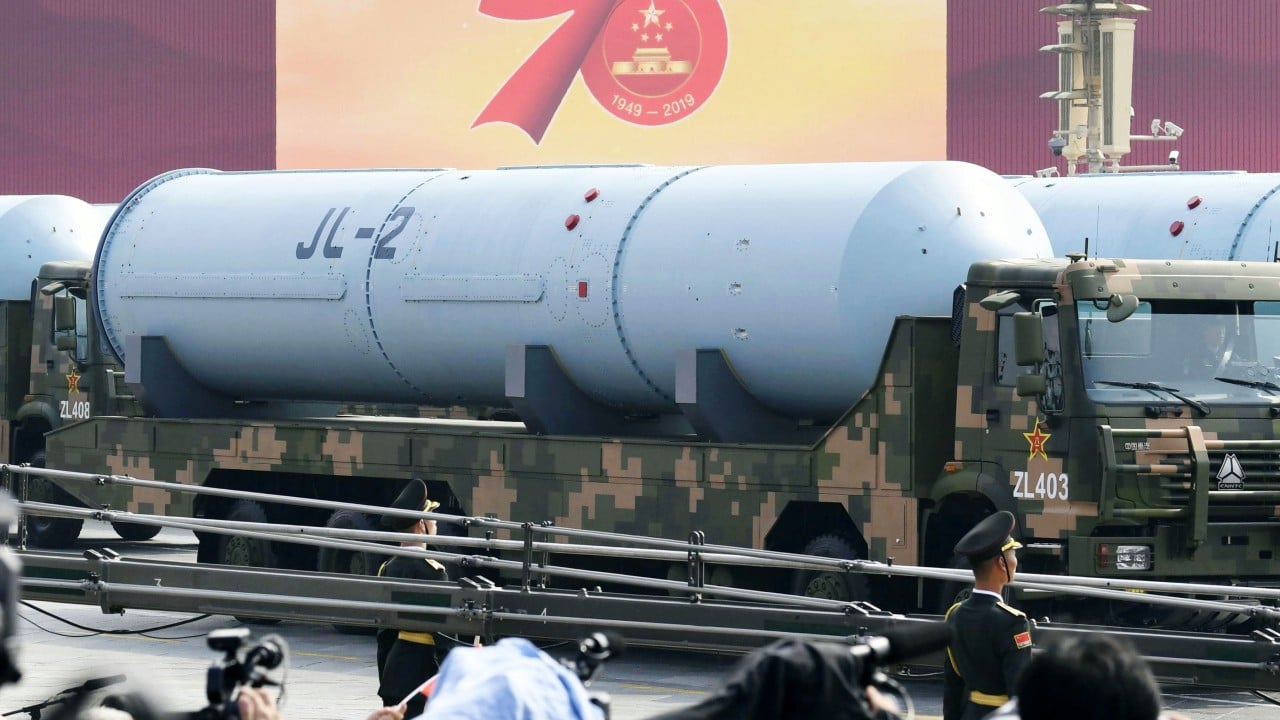
When the Chinese military fired a long-range ballistic missile from a nuclear-powered submarine in the South China Sea, Beijing expected the world to take notice. They didn't expect Taiwan to trace the entire opening sequence in real time.
On Monday, July 6, 2026, the People’s Liberation Army (PLA) navy launched an intercontinental-range JL-2 ballistic missile. The dummy warhead rocketed over the northern Philippines and splashed down thousands of kilometers away in the South Pacific, landing right between Nauru and Tonga. China calls these routine annual exercises. Regional neighbors call them destabilizing escalations.
But the biggest story isn't the missile itself. It's how quickly Taiwan saw it coming.
Sitting on a desolate mountain peak 2,600 meters above sea level in northern Taiwan, a massive, Cold War-style radar array caught the missile shortly after liftoff. The Leshan Radar Station didn't just spot the launch; it locked onto the trajectory, tracked it through the initial phase of flight, and fed the data directly to the United States military before the missile even exited local coverage.
This incident exposes the high-stakes electronic warfare quietly playing out across the Taiwan Strait. It proves that despite Beijing's efforts to isolate Taipei, the island's early-warning capabilities remain an indispensable asset for Western intelligence.
Inside the Leshan Radar Station
The physical manifestation of this tracking capability is the AN/FPS-115 PAVE PAWS, a massive phased-array radar system built by Raytheon. Taiwan poured roughly $1.4 billion into this facility, which became fully operational in 2013.
Most people assume radar is just a spinning dish on top of an airport tower. PAVE PAWS is a completely different beast. It is a fixed, multi-faced concrete monolith that uses thousands of small antenna elements to steer radar beams electronically in milliseconds. It doesn't move. It doesn't have to. It switches between scanning the horizon and tracking active targets faster than a human can blink.
Taiwan’s specific setup in Hsinchu County is uniquely customized. While original American versions were built during the Cold War to spot massive Soviet nuclear barrages coming over the poles, Taipeh’s variant was updated to handle low-altitude cruise missiles and tactical ballistic missiles.
With a range spanning up to 5,000 kilometers, Leshan looks deep into mainland China, monitors the entirety of the South China Sea, and peeks into the Korean Peninsula. When the PLA submarine broke stealth to launch that JL-2, it was effectively doing so inside a digital fishbowl.
The Real Time Data Pipeline to Washington
National Security Council Secretary-General Joseph Wu made waves by posting a map of the missile's precise flight path shortly after Beijing's announcement. It was a deliberate flex. The subtext was clear: We see everything you do.
But the radar's real value lies in what happened behind closed doors. Because the earth curves, the Leshan station can only track a projectile for so long before it dips below the horizon or exits the system's field of view. The moment the JL-2 headed eastward toward the Pacific, Taiwan handed off the tracking data to US defense networks. American satellites and long-range systems picked up the handoff flawlessly, tracking the dummy warhead to its final splashdown.
This level of real-time intelligence integration tells you everything you need to know about US-Taiwan defense relations. Beijing consistently demands that Washington cut military ties with Taipei. Yet, events like this prove the Pentagon relies heavily on Taiwan's geographic position and technical infrastructure to monitor China's nuclear modernization.
Why the PAVE PAWS is a Double Edged Sword
Having a billion-dollar radar system that can peer deep into Chinese territory is a massive strategic advantage. It also makes the Leshan station a primary target for the first minutes of any real-world conflict.
Military planners know this vulnerability all too well. A fixed, mountain-top facility cannot hide. In a hot war, the PLA would likely rain conventional ballistic missiles, cruise missiles, and swarm drones directly onto Hsinchu County to blind Taiwan's early warning network immediately.
Security analysts are increasingly worried about this vulnerability, especially after an upgraded early-warning radar facility in Qatar sustained real physical damage during an Iranian strike earlier in 2026. If a state-of-the-art facility in the Middle East can be compromised by incoming missile barrages, Taiwan’s prized asset faces a very real existential threat.
Taipei has spent years ring-fencing the Leshan site with its own layers of defense, including Patriot missile batteries and localized short-range air defense systems. But keeping the radar alive under a full-scale assault remains one of the toughest challenges for the island's defense forces.
What Happens Next
The July 6 launch shows that China is moving fast with its sea-based nuclear deterrent. The Pentagon estimates Beijing's nuclear stockpile will pass 1,000 warheads by 2030, and testing long-range submarine missiles is a core part of verifying that arsenal.
If you want to understand how the balance of power is shifting in the Pacific, watch how Taiwan upgrades its electronic warfare capabilities over the next 12 months. Tracking a single test launch is one thing; processing a complex, multi-axis saturated strike during a crisis is another.
For international observers and defense analysts, the next step is monitoring whether Taiwan secures funding for additional mobile radar units or secondary back-up networks to supplement the fixed Leshan station. Relying on a single giant facility is a gamble Taipei can't afford to lose.
Taiwan PAVE PAWS details
This broadcast covers the regional fallout of China's recent Pacific missile tests and the geopolitical friction building between the US, Taiwan, and Beijing over tracking capabilities.