The Taiwan Strait is one of the most volatile places on earth. For decades, the military math was simple. Taiwan bought big, expensive American weapons like fighter jets, tanks, and warships to keep Beijing at bay. China responded by building a massive, modern military that could overwhelm those traditional defenses by sheer numbers.
The math has changed.
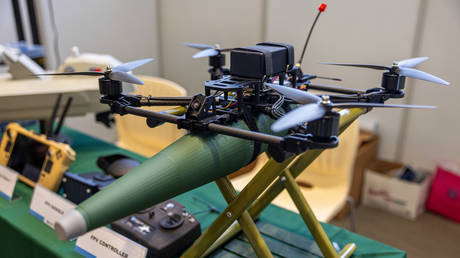
The top US diplomat in Taiwan, Raymond Greene, made that clear during a speech in Taichung on July 2, 2026. He did not talk about selling more stealth jets or heavy armor. Instead, he called for something far smaller, cheaper, and more terrifying. He told an audience of tech executives and officials that Taiwan must become a hornets nest of air, surface, and underwater drones.
It is a radical shift in strategy. It is also an admission of reality. If a conflict breaks out, conventional forces will not be enough. Taiwan needs thousands of cheap, expendable, and lethal unmanned systems to survive.
The Lessons of Modern Warfare
Look at Ukraine. The Black Sea fleet of Russia was supposed to dominate. Instead, cheap Ukrainian sea drones forced those massive warships to retreat. Improvised aerial drones have turned armored columns into scrap metal.
That is the blueprint for Taiwan.
Conventional Military Strategy vs. Asymmetric Drone Strategy
-------------------------------------------------------------
Conventional Approach:
- Expensive fighter jets, warships, and heavy tanks
- Years of production and training required
- High-value targets easily tracked by satellite
- Limited quantities that cannot be replaced quickly

Asymmetric Drone Approach:
- Thousands of cheap aerial, surface, and sea drones
- Rapid production using commercial supply chains
- Decentralized deployment making targeting difficult
- Highly expendable with immediate replacement potential
The US government sees this as the ultimate deterrent. Greene, who serves as the director of the American Institute in Taiwan, argues that nothing will stop an invasion attempt more effectively than a swarm of unmanned systems waiting in the skies and the waters around the island.
This is not a theoretical debate. It is a race against time. Taiwanese President Lai Ching-te stated that building these asymmetric combat capabilities is the country's most urgent national defense project.
The Multibillion Dollar Budget Battle
Everyone agrees that drones are necessary. The problem is paying for them. Taiwan is currently locked in a fierce political battle over how to fund this robotic army.
In May, the opposition-controlled parliament threw a wrench into the government's plans. President Lai asked for a massive NT$1.25 trillion special defense budget. The legislature only approved about two-thirds of that amount. They restricted the funds strictly to purchasing finished US weapons systems rather than investing in domestic development.
The administration is fighting back with a new proposal. They want a specialized NT$210 billion package. That translates to roughly $6.59 billion. This money would fund surveillance craft, coastal attack drones, and small uncrewed surface vessels through 2031.
The main opposition party, the Kuomintang, has its own counter-proposal. They want a spending cap of NT$240 billion spread over six years. The catch is that they want this funded out of the regular annual budget, not a special emergency fund.
This political infighting slows down procurement. In a security environment where months matter, bureaucratic delays are dangerous.
Taichung and the Domestic Supply Chain
The center of Taiwan's drone ambitions is Taichung. The city is a major industrial hub. It houses critical defense contractors like Thunder Tiger and the Aerospace Industrial Development Corporation.
Taiwan has a massive advantage here. It controls the global semiconductor market. It has an advanced precision manufacturing sector. The goal is to build an independent supply chain that does not rely on foreign components, especially from China.
Right now, many commercial drone parts come from Chinese factories. That is a security nightmare. If Taiwan relies on Chinese chips or motors, those systems could be bricked or tracked during a conflict. Building a clean supply chain is hard. It requires retooling factories and finding new suppliers for raw materials.
Three Elements of the Automated Defense
The hornets nest concept requires three distinct types of unmanned hardware. Each plays a specific role in keeping an invading force away from the coast.
Aerial Swarms
Small, exploding quadcopters and long-range reconnaissance drones form the first layer. They can spot incoming ships long before they reach the coast. They can target command vehicles and radar installations. They are too small for traditional air defense systems to hit effectively.
Surface Attack Boats
The Taiwan Strait is rough water. Small, fast, remote-controlled boats packed with explosives can target large troop transport ships. If an invasion fleet cannot cross the strait, the invasion fails. These surface vessels are cheap to build but can sink ships worth hundreds of millions of dollars.
Subsurface Hunters
Underwater drones are the most secretive part of the plan. They can map the seabed, monitor underwater cables, and lay mines. They can wait silently on the ocean floor until an enemy fleet passes overhead. Detecting them is incredibly difficult.
The View From Beijing
China is watching this development closely. They are not happy about it.
Following Greene's speech, Zhu Fenglian, a spokesperson for China's Taiwan Affairs Office, dismissed the comments. She accused the US of creating noise and meddling in internal affairs. Beijing views Taiwan as its own territory. They have never ruled out using force to take it.
The Chinese military is also building its own massive drone fleet. An eventual conflict in the Taiwan Strait might not look like traditional wars. It could be an automated war of attrition between two massive robotic networks.
Actionable Steps for Regional Security
To make the hornets nest a functional reality, Taiwan and its partners must take immediate steps.
- Resolve the Legislative Deadlock: The parliament must pass a unified funding bill for domestic drone production before the end of the year.
- Purge Chinese Components: Manufacturers must accelerate the transition to non-Chinese supply chains for software, chips, and communication modules.
- Standardize Systems: The military needs to ensure that different drone models can communicate on the same secure network.
- Expand Training: Regular soldiers must learn to operate commercial-style drones at scale, moving away from complex, specialized military hardware.
The era of relying solely on heavy warships and expensive fighter jets is over. Taiwan's survival depends on its ability to build a massive, automated deterrent. If the island can successfully build its hornets nest, the cost of an invasion will simply become too high for Beijing to pay.