Swiss glaciers just hit a terrifying milestone that wasn't supposed to happen until the dog days of late August. On June 29, 2026, the Swiss Alps officially marked Glacier Loss Day. It's only the second time in over two decades of intense monitoring that this tipping point has arrived in June. Basically, every flake of protective snow accumulated over the past winter has completely vanished. The glaciers are stripped bare. From now until October, every single ray of sunshine and warm breeze will chew directly into ancient ice that can't be replaced.
If you want to understand why this matters, you have to look at how a glacier actually survives the summer. Think of winter snow as a giant shield. It reflects the sun's harsh rays away from the vulnerable, dark ice beneath. When that shield disappears two months early, the glacier stands completely naked against extreme heatwaves. It's a brutal reality. We aren't just looking at gradual, predictable melting anymore. We're witnessing an accelerated collapse of the high alpine water reserves that sustain Europe. Also making waves recently: Why Moscow Cannot Stop Ukraines Cheap Drone Swarms.
The data coming out of Switzerland right now isn't a vague projection for the year 2100. It's happening today. Glaciologists checking tracking stations across the Swiss glacier monitoring network, known as GLAMOS, are stunned by the sheer speed of the ice destruction. The current rate of melting means the Alps are running roughly three months ahead of a normal, healthy cycle.
The Crushing Physics of Glacier Loss Day
To grasp the magnitude of this crisis, you need to understand the mechanism of glacial decay. Glaciologists track the health of these ice giants by calculating a simple balance sheet. Winter adds snow weight. Summer melts it away. The specific moment when the winter's accumulation drops to zero is what experts call Glacier Loss Day. Further insights into this topic are explored by The Washington Post.
When a glacier is healthy, this date arrives in mid-to-late August. That leaves only a few weeks of late-summer sun to scrape away at the permanent ice before autumn chills return to freeze the high peaks again. When it happens on June 29, the math changes completely. The ice is left exposed to high-altitude heat for July, August, and September.
The primary driver of this runaway melting is a feedback loop known as the albedo effect. Fresh winter snow is brilliant white. It acts like a giant mirror, bouncing up to 90 percent of solar radiation straight back into space. Glacier ice, however, is a different story. It's compacted, weathered, and deeply stained by dirt, rock dust, and atmospheric pollution.
Once the clean snow cover dissolves, this dark grey ice is exposed to the sun. Instead of reflecting light, dark ice acts like asphalt on a summer afternoon. It absorbs up to 80 percent of solar heat. The moment the white shield drops, the rate of melting multiplies exponentially. It's a self-reinforcing trap that scientists can't stop.
The Three Triggers That Ruined the Alpine Winter
This catastrophic summer didn't happen by accident. It's the result of a compounding series of weather failures that began early last winter. You can't blame this entirely on a single heatwave. The damage was done over months of bad luck and shifting weather patterns.
First, the winter snow accumulation was deeply disappointing. Across the Swiss Alps, total snowfall over the glaciers sat roughly 25 percent below the ten-year average. The glaciers started the spring season with a dangerously thin blanket of insulation. They were already highly vulnerable before the first warm day even arrived.
Second, an unusual meteorological event in March sealed their fate. Strong winds blew massive plumes of Saharan dust across the Mediterranean, dumping a layer of fine, orange-brown sand directly onto the alpine snowpack. You might have seen the photos of orange ski slopes. It looked surreal, but the ecological cost was devastating. That dark dust lowered the snow's reflectivity early in the spring. It caused the winter snowpack to start absorbing heat and melting weeks before it normally would.
Finally, an early heatwave slammed into Central Europe in May, followed by a truly punishing streak of weather in June. Lowland temperatures in Switzerland regularly crossed the 30-degree Celsius mark in late May. By June, major weather stations in Basel, Buchs, and Geneva registered all-time records, with Basel hitting an astonishing 38.8 degrees Celsius. The heat didn't just stay in the valleys. It pushed high into the mountain passes, turning the thin winter snow into rushing torrents of water.
Direct Evidence from the High Alps
The numbers are abstraction until you see what's happening on individual glaciers. Matthias Huss, the head of GLAMOS and a leading glaciologist at ETH Zurich, has been documenting the destruction firsthand. His recent field updates paint a dark picture of the alpine environment.
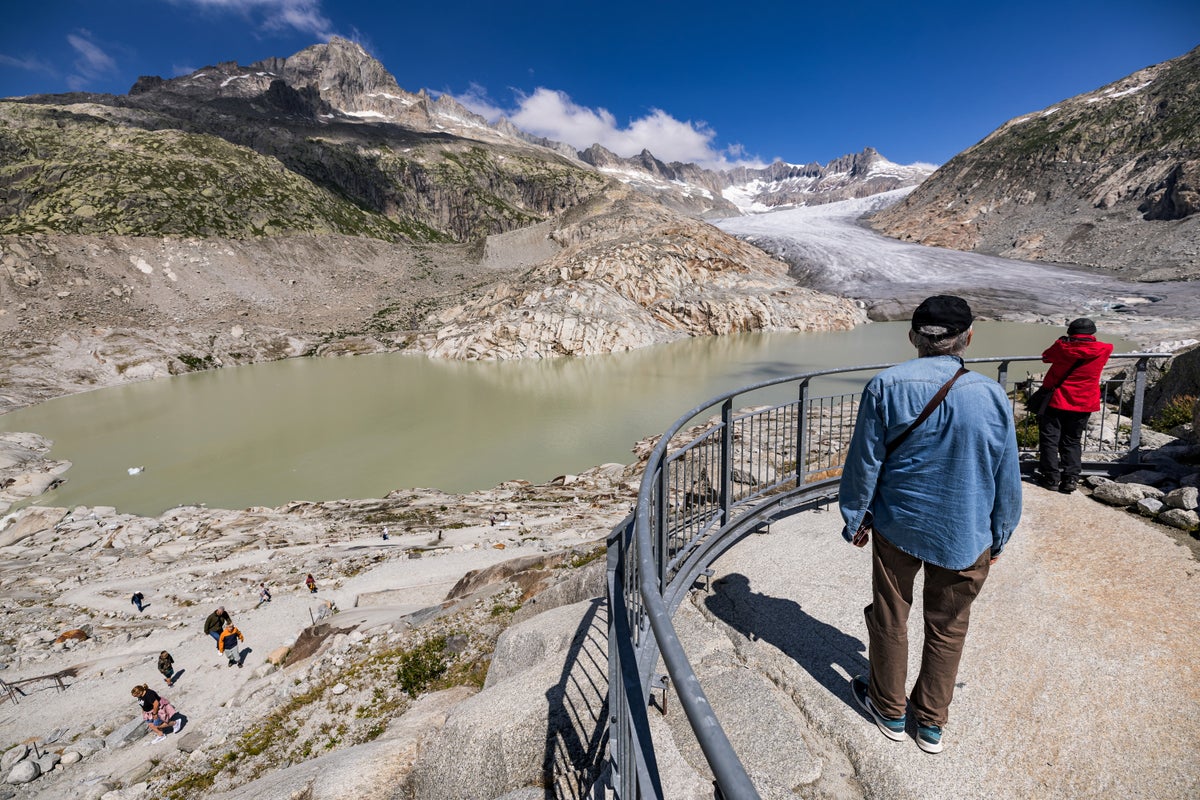
Huss recently inspected the famous Rhône Glacier in the western canton of Valais. The physical changes he measured in a microscopic timeframe are terrifying. The glacier lost a full meter of vertical ice thickness in just ten days. That is not a gradual shift. It is a rapid disintegration.
- The Great Aletsch Glacier: The largest glacier in the Alps is shedding its armor at record speed. At Konkordiaplatz, a massive junction where multiple ice streams meet, the surface went from solid white snow to completely bare, dark ice in less than two weeks.
- The Volumetric Loss: GLAMOS researchers calculate that the total volume of meltwater currently pouring off Swiss peaks is vast enough to fill an Olympic-sized swimming pool every six seconds.
- Historical Context: Switzerland has already lost around 1,200 individual glaciers over the last 50 years. Only about 1,300 remain today, and they are shrinking faster than anyone predicted.
The only year in recorded history that witnessed an earlier Glacier Loss Day was 2022, when the milestone occurred on June 26. That year shattered all previous volume loss records. The fact that 2026 is matching that horrific pace proves that the extreme anomaly of a few years ago is fast becoming our baseline reality.
The Downstream Economic and Social Shock
It's easy to look at melting ice as a distant aesthetic tragedy for mountaineers and tourists. That's a massive mistake. The Swiss Alps are often called the water tower of Europe for a very practical reason. The meltwater from these high-altitude reserves feeds some of the continent's most important river systems, including the Rhine and the Rhône.
During a standard summer, glaciers act as a critical buffer. When lowlands suffer from drought, glaciers melt steadily, keeping river levels high enough for commercial shipping, agricultural irrigation, and nuclear power plant cooling systems. But this system only works if the glaciers survive.
When the snow reserves run out in June, the rivers see a massive surge of water early in the summer, followed by a severe drop later when the water is actually needed. If the glaciers shrink past a critical threshold, the late-summer flow of the Rhine and Rhône will dry up significantly. That impacts international trade, lowers agricultural yields across France and Germany, and threatens drinking water supplies for millions of people.
We saw a preview of this during recent European heatwaves. Power grids faced intense stress because rivers were too warm or too low to cool power stations effectively. Hospitals were overwhelmed by heat-related illnesses as temperatures topped 40 degrees Celsius in surrounding countries. The melting ice is simply the most visible symptom of a continent completely ill-prepared for extreme heat.
Realistic Steps to Manage the Melt
We can't magically lower global temperatures overnight to save these specific glaciers before October. But throwing your hands up in despair doesn't help either. Managing the collapse of alpine ice requires practical, immediate shifts in how we handle mountain ecosystems and water infrastructure.
First, we need stricter regional controls on black carbon and industrial soot. While global greenhouse gases drive long-term warming, localized air pollution and industrial soot settle directly on alpine snow. Just like Saharan dust, this dirt darkens the surface and accelerates local melting. Reducing soot emissions from nearby European shipping and trucking routes can provide a small but vital buffer for the remaining ice.
Second, European water management policies must adapt immediately to an altered seasonal flow. Governments can't rely on glaciers to act as natural summer reservoirs anymore. This means investing heavily in lowland water retention basins, restoring natural wetlands that hold water in the soil, and upgrading agricultural infrastructure to use drip irrigation rather than high-volume spraying.
Finally, alpine communities have to rethink their local economies. Relying on winter sports and year-round glacier tourism is becoming a financial dead end. Resorts must diversify into low-impact summer tourism, trail recreation, and ecological education. The focus needs to shift from trying to preserve an artificial status quo to managing a dynamic, rapidly changing environment.
If current warming patterns don't reverse, researchers estimate that by the turn of the century, the Alps will hold nothing but a few isolated chunks of dead ice. The protective snow shield is gone for the year. The core of Europe's water tower is melting under the summer sun, and the window to adapt is shrinking just as fast as the ice.
This video offers a ground-level look at the rapid pace of Alpine ice melt and explains how scientists track the sudden loss of winter snow reserves during extreme European summer conditions. Swiss Glaciers Melting Fast As Europe Heatwave Intensifies