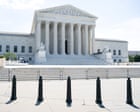
The concept of checks and balances in Washington just took a heavy hit.
In a massive decision, the Supreme Court handed the White House a major victory by ruling that the president has the authority to fire the leaders of several independent federal agencies at will. This upends nearly a century of legal precedent designed to protect these watchdogs from political interference. If you think this is just abstract legal inside baseball, you're missing the bigger picture. It directly alters how everyday federal rules—from labor laws to environmental protections—are enforced.
While the administration scored a massive win on agency control, it didn't get a total clean sweep. The high court drew a sharp line at the Federal Reserve, blocking an attempt to remove sitting Governor Lisa Cook in a tight 5-4 vote. But the broader expansion of executive control has sent shockwaves through Washington, leaving critics sounding the alarm over what this means for the future of independent oversight.
Dismantling a Ninety Year Shield
For generations, independent regulatory agencies operated with a layer of insulation from the Oval Office. A 1935 Supreme Court precedent established that a president couldn't simply sack the heads of these agencies without good cause, such as inefficiency or neglect of duty. The goal was simple: keep the enforcement of federal rules stable, fair, and free from partisan swings.
The recent ruling tears down that barrier. The conservative majority decided that the president's executive authority under Article II of the Constitution overrides those old statutory protections.
Advocacy groups are furious. Rachel Rossi, president of Alliance for Justice, pulled no punches, stating that the decision gives an authoritarian presidency the keys to expand its reach even further, predicting disastrous long-term consequences. Justice Sonia Sotomayor was equally blistering in her dissent, calling the ruling "egregiously wrong" and warning that chaos will inevitably follow.
We are already seeing what this looks like in practice. During this second term, the White House has aggressively targeted agency leaders who don't line up with its agenda. Take Gwynne Wilcox, the first Black woman to serve on the National Labor Relations Board. Her removal shows exactly how fast a change in executive mood can clear out independent officials.
The Defiance of the Federal Reserve
The White House hit a wall when it tried to apply this same scorched-earth firing power to the nation's central bank. The administration has repeatedly targeted Federal Reserve Governor Lisa Cook—the first Black woman to serve on the Fed's board—leveling unproven allegations of mortgage fraud against her.
The Supreme Court blinked. In a 5-4 split, the justices ruled that trying to fire Cook from her Federal Reserve post was flatly unconstitutional.
Why did the court back down here? Because the independence of the Federal Reserve is tied directly to global economic stability. If a president can fire a Fed governor over policy disagreements or personal grudges, Wall Street freaks out. Investors lose confidence, interest rates spike, and the markets tank. Even a deeply conservative court recognized that turning the Fed into a political playground is a recipe for economic disaster.
The Looming Fight Over the Fourteenth Amendment
As intense as the firing power battle is, an even bigger constitutional storm is hitting the court right now. The justices are poised to rule on the administration's controversial executive order attempting to end birthright citizenship.
On day one of the current presidential term, the administration issued an order declaring that children born on US soil to undocumented immigrants or temporary visitors shouldn't automatically receive citizenship. This directly challenges the 14th Amendment, which was ratified after the Civil War to guarantee citizenship to anyone born in the United States, explicitly protecting formerly enslaved people.
The administration argues that birthright citizenship is based on a fundamental historical misunderstanding of the amendment's text. Lower federal courts didn't buy that argument, quickly issuing injunctions to block the executive order from taking effect.
The administration has repeatedly complained on social media about the policy, claiming the US is the only country foolish enough to allow it. That claim is factually false. Data from the Pew Research Center confirms that around 30 countries globally grant automatic citizenship to anyone born within their borders, including Canada and Mexico.
What Happens Next
The era of the truly independent federal watchdog is effectively over. If you run an agency that regulates corporate behavior, labor conditions, or consumer safety, you now serve entirely at the pleasure of the president.
The immediate next steps will play out in federal workplaces and the federal court docket:
- Expect immediate leadership churn across independent commissions as federal officials who value their independence resign or get pushed out.
- Watch the imminent birthright citizenship ruling, which will decide if a president can unilaterally rewrite constitutional rights via executive fiat.
- Monitor the regulatory rollbacks that will accelerate now that agency heads know they can be fired on a whim for failing to compliance-test political directives.
The guardrails didn't just bend; they broke. The administrative state is being systematically dismantled, and the executive branch is consolidating power at a rate we haven't seen in modern history.
Supreme Court decision expected on Trump's call to end birthright citizenship
This broadcast provides immediate legal and historical context on the pending 14th Amendment challenge, outlining exactly what is at stake for millions of families ahead of the final ruling.