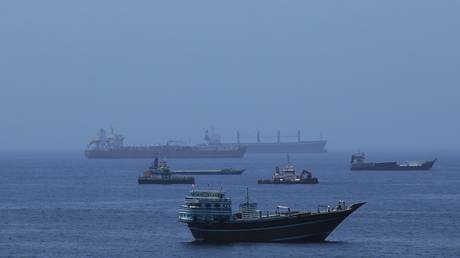
The fragile truce in the Middle East didn't even last a month. Over the weekend, US forces launched a massive third wave of airstrikes against military assets inside Iran. The heavy bombardment came directly after Iran's Islamic Revolutionary Guard Corps (IRGC) attacked the M/V GFS Galaxy, a Cyprus-flagged container ship making its way through the Strait of Hormuz.
If you think this is just another standard headline about regional friction, you're missing the bigger picture. The situation shifted from a localized skirmish into a high-stakes bottleneck for the global economy. Right after the container ship went up in flames, Tehran formally declared the Strait of Hormuz closed until further notice.
The immediate fallout is already spilling past Iran's borders. Retaliatory drone and missile salvos hit targets in Bahrain, Kuwait, the United Arab Emirates, and a major airbase in Jordan.
Here is what actually happened on the water, why the previous diplomatic frameworks collapsed so fast, and what this means for global trade routes moving forward.
The Escalation in the Strait
The official narrative out of Tehran claims the GFS Galaxy ignored warnings and took an unauthorized route with its transponder turned off. The Pentagon calls that absolute nonsense. According to US Central Command (CENTCOM), the strike on the commercial vessel was an unprovoked, blatant assault on a peaceful ship crewed by civilians in international waters.
The US response was swift and heavy. At 7:15 p.m. Eastern Time on Saturday, American fighter jets and naval assets pounded Iranian coastal bases, radar installations, and communications towers. Local reports out of southern Iran confirmed loud explosions shaking the energy-heavy hubs of Bushehr, Asaluyeh, and Dayyer. Defense Secretary Pete Hegseth summed up the administration's stance bluntly on social media: "Iran made a poor choice. Now they pay."
But Iran didn't back down. Within hours of the American strikes, the IRGC launched its own retaliatory barrage across the Persian Gulf. Air defense sirens wailed in Bahrain. The UAE military active-engaged incoming drones and missiles. More alarming still, Iranian ballistic missiles struck Jordan's Prince Hassan Air Base, reportedly destroying a command center and MQ-9 drone hangars.
The Total Collapse of the June Ceasefire
To understand how we got here, look back at the mid-June memorandum of understanding. Under that Omani-mediated deal, President Trump and the Iranian regime had agreed to a shaky ceasefire. The core of that agreement allowed Iran and Oman to jointly manage the navigation of the Strait of Hormuz, aiming to keep energy markets stable.
The deal was inherently flawed from day one. Iran interpreted the agreement as a green light to enforce strict, mandatory tolling and dictate exact routes to foreign ships. The US and its allies viewed it strictly as a framework to keep the peace while maintaining open transit under international maritime law.
When several ships tried to bypass Iran's forced routing protocols earlier this week, the IRGC viewed it as an American-backed violation of their sovereignty. The mid-June truce wasn't just tested; it completely disintegrated. Even as an Iranian delegation landed in Oman this weekend to scramble for a diplomatic lifeline, the missiles were already flying.
Real Shipping Fallout and Next Steps for Supply Chains
You can't easily reroute 20% of the world's petroleum and a massive chunk of its container traffic. Closing the Strait of Hormuz sends immediate shockwaves through global markets, and businesses need to adapt right now rather than hoping for a quick diplomatic fix.
If you manage logistics, supply chains, or energy assets, here are the immediate realities you have to account for:
- Expect Immediate War Risk Insurance Surges: Maritime insurers are rewriting risk premiums for the entire Persian Gulf overnight. Expect transit costs through adjacent waters to skyrocket immediately.
- Prepare for Extended Cape of Good Hope Detours: Container ships that typically connect European and Asian ports via the Gulf routes will now face the lengthy, costly trip around Africa. This adds roughly 10 to 14 days to standard transit times.
- Factor in Extreme Fuel Volatility: While domestic US energy production provides a buffer, global crude benchmarks are going to face intense upward pressure as long as the IRGC maintains its indefinite closure of the strait.
The rhetoric coming out of Washington signals that the US military intends to force the waterway open, one way or another. President Trump clarified the administration's stance, noting the US will either secure a definitive new deal or "finish the job." For the global shipping industry, the immediate path forward requires building long-term resilience into supply chains because the illusion of a stable Persian Gulf is gone.