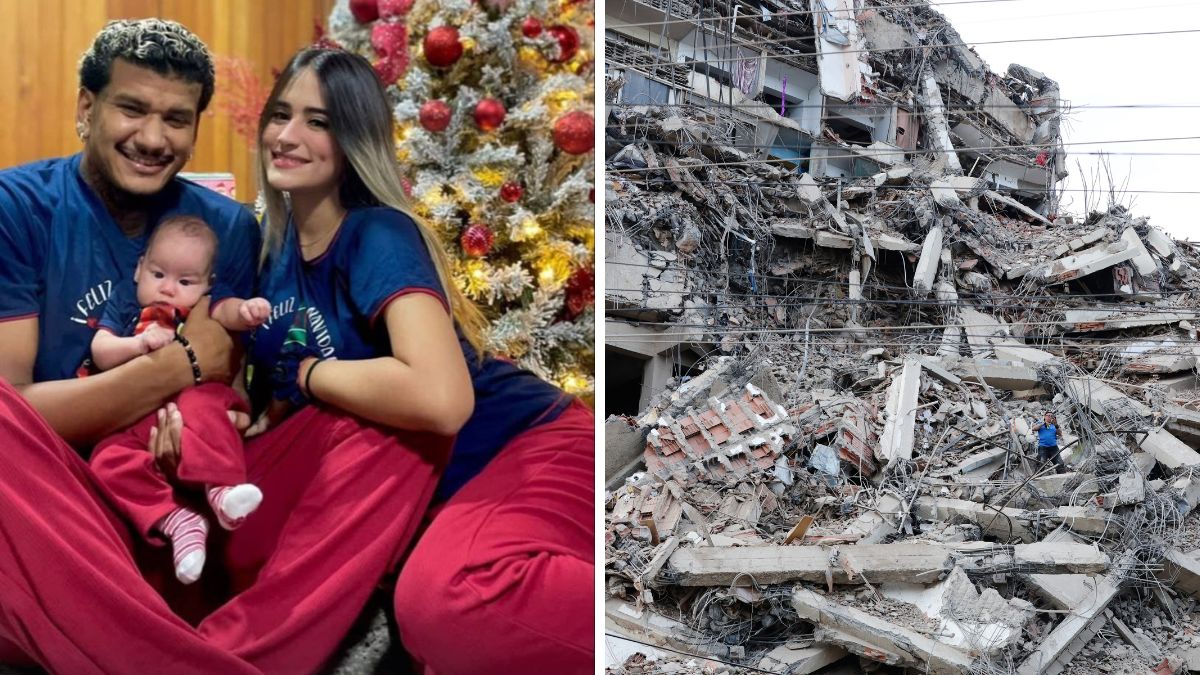
The headlines coming out of Venezuela right now focus on cold statistics. They list the rising death toll, the number of crumbled concrete slabs, and the estimated economic fallout of the worst seismic disaster the country has faced in over a century. But behind the cold data lies raw human agony. The tragedy of Andrea, the wife of professional footballer Héctor Bello, brings the true cost of this disaster into sharp focus. She lost her life in a collapsed building on June 24, 2026, using her own body as a shield to save their one-year-old daughter.
People searching for updates on this disaster want to understand how a regular Wednesday evening turned into a national nightmare. They want to know how a mother’s instinct managed to beat a falling concrete building, and why the infrastructure failed so dramatically. This article lays bare the human reality of the disaster, the professional backdrop of a grieving athlete, and the structural vulnerabilities that turned natural shifts in the earth into a mass tragedy.
The Sudden Loss That Shook Venezuelan Football
Héctor Bello, known affectionately to football fans across the country as "Kike," is a prominent figure in Venezuelan football. He serves as the central defender and team captain for Marítimo de La Guaira, a competitive club fighting for promotion in the Liga FUTVE 2. Bello has been a cornerstone of his team's defense, logging thousands of minutes on the pitch and guiding his squad with intense leadership.
He was away from home when the double earthquake struck. While he was preparing for the next match, his family was inside their residence enduring an unimaginable horror. The building collapsed during the violent shaking, trapping his wife and infant child under heavy debris.
When rescue teams finally reached the wreckage, they found a scene that was both heartbreaking and miraculous. Andrea had positioned herself directly over their one-year-old daughter. She absorbed the blunt force of the collapsing roof structure. Because of her positioning, her body created a pocket of space that protected the infant from being crushed. Emergency workers pulled the little girl out alive. She was rushed to emergency medical services and is currently receiving care. Andrea, however, suffered fatal injuries and could not be saved.
The football star shared his grief in raw, agonizing posts on his social media accounts. He expressed the crushing guilt of not being there to protect them. He asked how he could possibly explain to his daughter later in life that her mother died so she could live. The sports community has rallied behind Bello, with teams across South America offering statements of solidarity. But no amount of professional sympathy can heal the sudden void left by a catastrophe of this scale.
What Happened Inside the Collapse
To understand why this specific incident resonates so deeply, you have to picture the suddenness of the event. On the evening of June 24, families were resting or preparing dinner during a national holiday celebrating the Battle of Carabobo. Many businesses were closed. People were inside their homes.
When the earth began to move, it didn't just shake. It rolled violently. Witnesses in urban centers described structures swaying like trees in a storm. In multi-story residential buildings, the walls began to fracture immediately. Andrea had mere seconds to react. In an earthquake, finding a clear exit from an upper floor of an old building is almost impossible. The stairs are often the first things to fail.
Faced with a collapsing ceiling, she did what instinct dictated. She dropped to the floor, pulled her daughter underneath her chest, and braced for the impact. This act of shielding is a known survival phenomenon in extreme structural failures, but it requires a level of courage that is hard to comprehend until you face it. The debris came down instantly, trapping them in total darkness until emergency responders arrived hours later with heavy machinery and shovels.
Anatomy of the Double Earthquake That Caught a Nation Off Guard
The disaster that claimed Andrea's life was not a standard earthquake. Seismologists classify it as a doublet earthquake, which means two massive shocks occurred almost back-to-back with a very short window between them. This is part of what made the structural damage so severe.
The first event was a pre-shock that registered a massive magnitude of 7.2. It originated deep within the earth near Montalbán and Yumare. This initial shaking compromised the structural integrity of hundreds of older concrete buildings across northern Venezuela. Walls cracked, supports weakened, and foundations shifted.
Just 39 seconds later, before anyone could safely evacuate or assess the danger, the main shock hit. This second quake registered at a magnitude of 7.5. It struck at a shallow depth of only 10 kilometers.
While a jump from 7.2 to 7.5 might sound small on paper, the Richter and Moment Magnitude scales are logarithmic. In terms of actual energy released, that second earthquake was nearly three times more powerful than the first one. Buildings that had barely survived the 7.2 shock were entirely pulverized by the 7.5 monster. The shallow depth meant the surface energy was incredibly destructive, shaking cities like Caracas, Maracay, and Valencia with brutal force. The United States Geological Survey noted that this is the strongest seismic event to hit Venezuela in more than 125 years, drawing dark comparisons to the historic 1900 San Narciso quake and the devastating 1967 Caracas earthquake.
Understanding the Lack of Seismic Culture and Structural Risks
The scale of this tragedy points to a deeper issue that independent structural engineers have warned about for decades. Venezuela sits directly over a complex tectonic boundary. The Caribbean plate and the South American plate grind against each other along major fault lines like the Boconó fault, which stretches for 500 kilometers across the country. Yet, despite this high-risk geography, the nation lacks what experts call a widespread seismic culture.
Unlike residents of Chile or Japan, who undergo regular, rigorous earthquake drills from childhood, many citizens in Venezuela did not know whether to run outside or stay indoors when the ground shook. Video footage from the event showed chaos. People ran into narrow streets where falling glass and collapsing facades posed an even greater danger than staying inside.
Furthermore, economic challenges over the past two decades have severely impacted building safety. A vast number of residential structures in major cities were built without adhering to modern seismic codes. Informal housing settlements cover the hillsides of Caracas, while older high-rise apartments feature unreinforced masonry and weak concrete mixtures. When the doublet earthquake struck, these buildings stood no chance. The official death toll has climbed past 235 people, with thousands injured and tens of thousands displaced. Rescue workers are still digging through rubble in neighborhoods like El Paraíso and Los Palos Grandes, meaning the true casualty count will likely be much higher.
Moving Forward Through Chaos and How to Prepare for Seismic Realities
Grieving with the Bello family means acknowledging that these structural failures cannot be allowed to happen again without a fight. If you live in an area prone to seismic activity, relying on luck isn't an option. You need to know exactly how to protect yourself and your family before the ground starts moving.
First, memorize the golden rule of earthquake survival: Drop, Cover, and Hold On. Do not try to run outside while the shaking is actively happening. Most injuries occur when people try to move during the violent tremors, getting hit by falling objects, shattered window glass, or collapsing interior walls. Drop to your hands and knees immediately to prevent being thrown to the ground. Cover your head and neck with your arms. If a sturdy table or desk is nearby, crawl underneath it for shelter. If no shelter is available, crawl next to an interior wall, away from windows. Hold on to your shelter until the shaking stops completely.
Second, secure your living space ahead of time. Heavy furniture like bookshelves, wardrobes, and television sets should be anchored securely to wall studs. In a major tremor, these heavy items become lethal projectiles. Keep heavy objects on lower shelves, and ensure that beds are positioned away from large windows or heavy hanging mirrors.
Third, pack a dedicated emergency go-bag. It needs to be stored near your primary exit. This bag should hold at least three days of bottled water, non-perishable food items, a first-aid kit, a flashlight with extra batteries, a whistle to signal for help if you become trapped, and copies of essential identification documents.
Fourth, establish a family communication plan. In a severe disaster, local cellular networks usually crash due to damage or extreme traffic. Text messages often go through when voice calls fail. Designate an out-of-town relative as a central contact point. Every family member should know to send a text to that person to report their safety status if local lines are down.
The structural issues plaguing cities cannot be fixed overnight. It takes massive capital, government transparency, and years of engineering enforcement to retrofit vulnerable buildings. But personal preparedness is something you can control today. Andrea's final act was a testament to the fierce desire to protect life amid total structural failure. The best way to honor that sacrifice is to build a culture where families are educated, prepared, and structurally protected against the inevitable shifts of the earth.
Watch this raw news broadcast detailing the immediate aftermath and damage reports from Caracas
This video provides an essential visual record of the massive destruction in the capital city, helping viewers understand the sheer power of the double earthquake that destroyed families and buildings across the country.