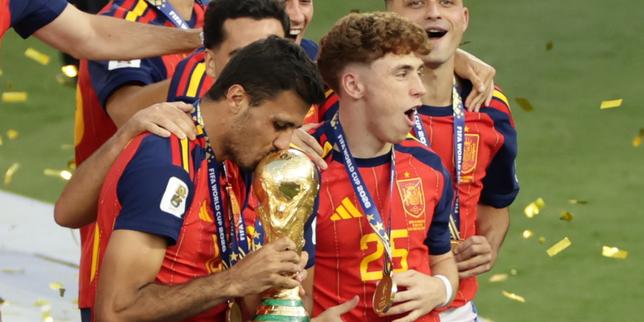
Sixteen years after Andrés Iniesta smashed a ball into the back of the net in Johannesburg, history repeated itself in New Jersey. Ferran Torres came off the bench and struck in the 106th minute to give Spain a 1-0 victory over Argentina in the 2026 World Cup final. If you watched the match at MetLife Stadium, you know the single-goal scoreline doesn't tell the whole story. Spain dominated possession, choked out Argentina's transitions, and pushed through against a wall of relentless defensive pressure.
Argentina fought hard. They took the match into extra time despite generating zero shots in regulation time. Enzo Fernández got sent off in stoppage time after picking up a second yellow card, leaving Lionel Scaloni's squad to survive with ten men. Emiliano Martínez turned into a wall, pulling off eleven saves to keep Argentina alive. Yet, Spain's relentless passing and press eventually wore them down. When Torres finally broke through early in the second period of extra time, it felt completely earned.
Here is an honest breakdown of how Spain earned their second star, what went wrong for Argentina, and why this tournament victory sets a new benchmark for international football.
How Spain Deserved the 2026 World Cup Title Through Absolute Control
Lots of teams talk about controlling matches. Luis de la Fuente’s squad actually does it. Throughout this whole tournament, Spain played with a clarity that no other nation could match. They didn't just win games. They controlled every square inch of the pitch.
Looking at the defensive record alone reveals something absurd. Spain conceded only one goal during the entire 2026 World Cup. Belgian forward Charles De Ketelaere scored against them in the quarterfinals, and that was it. Seven matches, six clean sheets, one goal conceded. That beats the previous defensive record held by France in 1998, Italy in 2006, and Spain themselves back in 2010.
People used to mock Spanish possession play as boring side-to-side passing without punch. That criticism doesn't apply to this team. With Lamine Yamal and Nico Williams stretching the wings, Spain combines tight midfield control with raw pace on the outside. Against Argentina, Spain racked up 20 shots while suffocating Lionel Messi and Julián Alvarez completely.
Rodri and the Art of Midfield Suffocation
If you want to understand why Spain won this tournament, look no further than Rodri. Winning the Golden Ball as the best player of the 2026 World Cup was completely deserved. He acts as the team's anchor. Every time Argentina tried to break forward, Rodri was right there to kill the counterattack before it started.
His positioning shuts down opponent options before they even materialize. Paired with Fabián Ruiz and later Pedri in the second half, Rodri gave Argentina zero room to breathe. Rodrigo De Paul and Alexis Mac Allister spent most of the evening chasing shadows.
The Moment Ferran Torres Settled the Debate
Mikel Oyarzabal started up front, but Scaloni's central defenders kept him isolated. De la Fuente made the critical call in the 61st minute by swapping Oyarzabal for Ferran Torres.
Torres brought immediate energy. He drifted out wide, ran into channels, and forced Cristian Romero and Lisandro Martínez out of position. By the time extra time rolled around, Argentina's defense was visibly gapped. When the ball broke to Torres in the 106th minute, he didn't overthink it. He drove a low, powerful shot past Emiliano Martínez to seal the championship.
Why Argentina Ran Out of Gas in the Final
Argentina entered this final trying to cap off a historic run. They wanted back-to-back World Cup trophies to go along with their 2021 and 2024 Copa América wins. It would have put them in the same breath as Pelé's Brazil from 1958 and 1962.
It just didn't happen.
Physical fatigue caught up with them. Argentina's path through the knockout stages was brutal, and their high-intensity style demands an immense physical toll. By the time they faced Spain, the legs simply weren't there.
The Breakdown of Argentina's Plan
Scaloni set up in a compact 4-4-2 shape designed to absorb pressure and feed Messi on the break. It sounds reasonable on paper. In practice, Spain's counter-press meant Messi barely touched the ball in dangerous areas.
- Zero shots in regulation time: Argentina went 90 full minutes without recording a single shot on or off target. That hasn't happened in a World Cup final in modern history.
- Early injuries: Lisandro Martínez went down with an injury right before halftime, forcing Scaloni to burned a crucial substitution on Nicolás Otamendi early.
- Midfield discipline issues: Leandro Paredes, Cristian Romero, and Enzo Fernández all picked up bookings trying to stop Spanish transitions.
When Enzo Fernández made a reckless challenge on Pau Cubarsí deep into second-half stoppage time, referee Slavko Vinčić showed him his second yellow card. Playing 30 minutes of extra time down a man against a team that hogged 68% of the ball was a death sentence.
Messi's Last World Cup Dance
At 39 years old, Lionel Messi still put on a masterclass across this tournament. He racked up eight goals and four assists leading into the final, battling Kylian Mbappé for the Golden Boot.
During the final match itself, Messi was starved of service. When he did drop deep to pick up the ball, two Spanish shirts immediately collapsed on him. He had brief moments of magic, like a silky turn away from Marc Cucurella in the first half, but he couldn't carry the attack on his own this time. Emiliano Martínez kept Argentina in the game with 11 heroics saves, but goalkeeper saves can only take a team so far if you never threaten the opposite net.
Key Tactics That Decided the 2026 World Cup Final
Matches between elite sides usually come down to small details. Here are the exact tactical decisions that flipped the game in Spain's favor:
- Fullback Overlaps vs. Compact Blocks: Marc Cucurella and Pedro Porro pushed high up the pitch, forcing Argentina's wingers to defend near their own penalty box. This completely cut off Argentina's out-outlets.
- Pedri's Insertion: Injecting Pedri at the hour mark refreshed Spain's creative spark. His quick one-touch passing inside the half-spaces pulled Argentina's central midfielders out of position.
- Pau Cubarsí's Composure: At just 19 years old, Cubarsí played like a veteran defender. He won his duels against Julián Alvarez and distributed the ball out from the back under intense pressure.
Misconceptions About Spain's Championship Run
A lot of casual fans and talking heads got Spain completely wrong heading into this tournament.
First, critics claimed Spain lacked a top-tier finisher and couldn't win tight games without a prime number nine. Spain proved you don't need a 30-goal striker when you have five different players capable of scoring off the bench. Ferran Torres, Dani Olmo, and Mikel Merino all delivered huge goals when called upon throughout the knockout rounds.
Second, analysts argued that Spain's young core—featuring Lamine Yamal and Pau Cubarsí—would crumble under the pressure of a World Cup final. Instead, those teenagers looked like the calmest players on the field. Yamal repeatedly drew double teams, creating space for Spain's central midfielders to operate.
Third, people assumed Argentina's tournament experience would give them an easy mental edge. Experience matters, but physical energy and tactical balance matter more. Spain simply outran and outplayed Argentina over 120 minutes.
What You Should Watch Next in World Football
The 2026 World Cup is over, but the international football calendar doesn't stop moving. Here is how to keep up with the fallout from this tournament:
- Track the UEFA Nations League Group Stages: Spain returns to international action soon, facing England and Croatia. Watch if De la Fuente integrates new young talent or sticks with this winning core.
- Follow Lionel Messi's Next Announcement: Keep an eye on Argentina's squad selection for upcoming qualifiers to see whether Messi officially retires from international duty or continues playing.
- Analyze Club Transfers: Expect players who stood out during this World Cup to draw massive transfer bids during the upcoming window. Watch where players like Pau Cubarsí and Nico Williams end up long-term.