South Korea is running out of people. It is not a distant threat or a worst-case scenario for the next century. It is an active emergency happening right now in 2026. The country's current population of 51.8 million is on track to collapse by nearly a third, plummeting to just 36.2 million by 2072. You cannot run a modern economy when your workforce evaporates. Walk into a neighborhood cafe in Seoul today, and you will see exactly how business owners are dealing with this demographic crisis. Humans are gone. Machines are in.
This is not just about fancy vending machines. It is a fundamental rewriting of retail economics. From unstaffed coffee shops to automated ramen bars, pet supply outlets, and clothing boutiques, automation is moving from heavy factory floors straight into daily public life. Business owners cannot find young workers because those young workers simply do not exist anymore.
The Death of the Twenty-Something Barista
The service sector is taking the hardest hit. For decades, restaurants and coffee shops relied on a steady stream of students and young adults to handle front-of-house operations. That supply has dried up.
Kim Dongjin runs Lounge X, a brand operating unstaffed coffee shops across South Korea. He points out a stark reality. The population of baristas in their early twenties is shrinking at a terrifying speed. Finding human staff who can show up consistently, manage orders, and maintain quality has become an expensive nightmare.
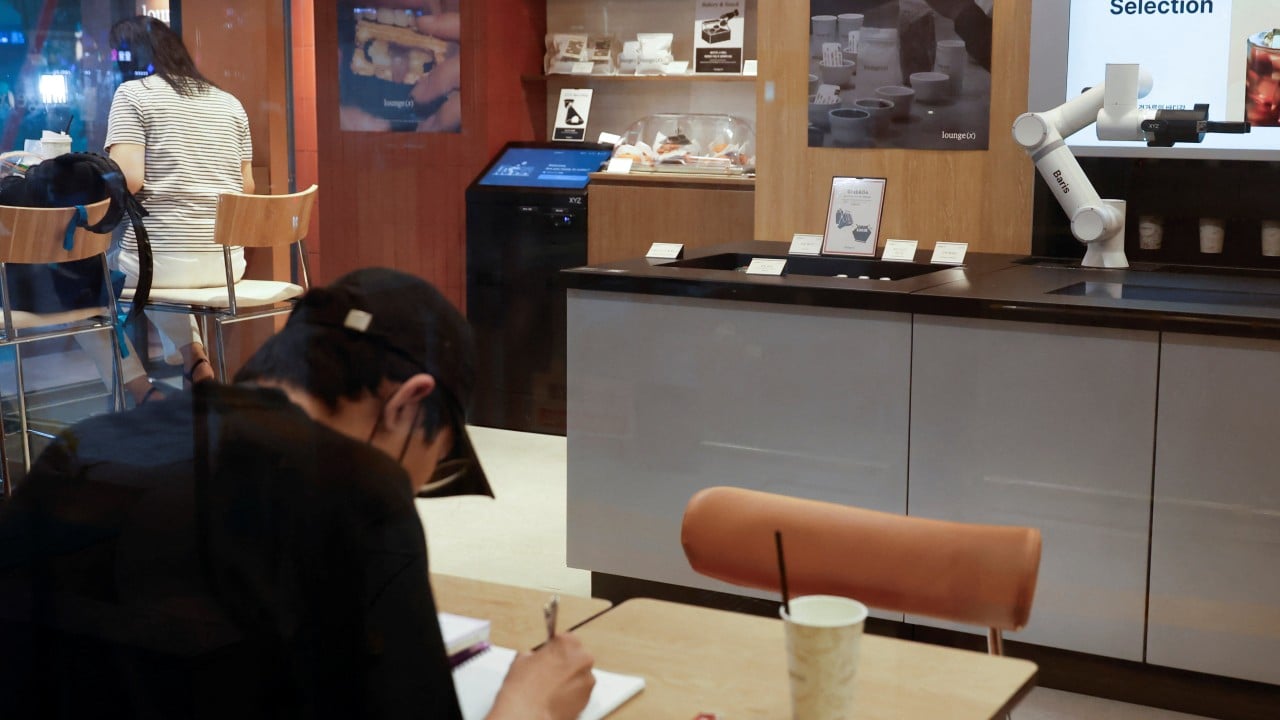
To solve this, Lounge X turned to a robotic arm named Baris. This mechanical limb stands behind an empty counter, picking up paper cups, executing precise pours of Americanos, and mixing matcha lattes. Customers place their orders at digital kiosks, pay with their phones, and watch the arm work. The shop requires no human supervision for most of the day.
The company started out testing a hybrid setup with one or two human baristas supporting the machines. That middle ground quickly proved unnecessary. Now, the fully automated stores need just a single one-hour visit from a human worker each morning. This person tops up the coffee beans, restocks pastry shelves, runs a quick cleaning cycle, and leaves. The machine handles the rest for the next 23 hours.
The Raw Math of Automated Retail
Let's look at the financial data. Running a business is about margins. When you strip human wages, payroll taxes, insurance, and management friction out of the equation, the numbers change completely.
In a traditional human-staffed coffee shop in Seoul, typical profit margins hover somewhere between 10% and 15%. High rent and rising labor costs eat the rest. When you transition to a robotic unstaffed model, those profit margins jump to more than 40%.
Sales volumes might be slightly lower because some customers still crave human interaction. The massive drop in overhead costs more than makes up for the difference. You do not need to worry about shift coverage, sick leave, or sudden resignations. The shop stays open 24 hours a day, generating revenue while the owner sleeps.
Consider the story of Hyun Sun-Joo. She took over an unstaffed ramen eatery to secure an independent income after spending years focused entirely on childcare. Her shop features walls lined with instant noodle packets. Customers pick their preferred flavor, use automated hot water dispensers, throw in their own toppings, and sit down to eat.
This model allows her to manage her household and keep up with her children's school schedules. She does not have to spend her evenings managing employee schedules or dealing with interpersonal workplace drama. The business runs itself while she focuses on her family.
Why the Honesty Economy Works in Seoul
If you tried to open a completely unstaffed, open-shelf ramen bar or boutique clothing store in New York, London, or Paris, the store would likely be emptied by thieves within a week. South Korea is different. The entire automated retail boom relies on a cultural phenomenon known locally as the honesty economy.
Unstaffed stores reached roughly 9,000 locations nationwide by the end of 2024. Data from major payments provider Samsung Card showed that the number of these automated businesses grew fourfold between 2020 and 2025. This expansion is only possible because petty crime rates in South Korean cities are incredibly low.
Citizens are deeply rule-abiding. Surveillance cameras are everywhere, and the social cost of getting caught stealing a three-dollar pack of noodles is massive. Store owners report that while isolated incidents of theft do happen, the vast majority of citizens use the automated checkouts honestly. They pay for their goods, clean up their tables, and discard their trash in the correct bins before leaving.
The psychology of the consumer has shifted too. Many younger patrons actively prefer the lack of human contact. They want to sit quietly, eat their food, look at their phones, and avoid forced polite conversations with service staff. For an anxious or tired worker, an empty, machine-operated cafe provides a level of psychological comfort that a traditional restaurant cannot match.
The Deep Structural Vulnerability Behind the Automation
On the surface, South Korea looks like the undisputed global champion of automation. The country holds the highest robot density in the world. According to data from the International Federation of Robotics, South Korea deploys 1,012 industrial robots per 10,000 manufacturing workers. That is roughly six times the global average.
But there is a massive catch. This rapid transition to a machine-dependent society is built on incredibly fragile foundations.
South Korea can build and deploy robotic arms, but it does not actually own the underlying technology supply chain. More than 71% of the robots built in South Korea stay inside the country to patch up the domestic labor shortage. Compare that to Japan, which ranks right behind South Korea in automation but exports more than 70% of its robotics manufacturing to the rest of the world.
South Korea has a severe component dependency problem:
- It imports 88.8% of its permanent magnets directly from China.
- It depends on Japanese manufacturers for 60% to 70% of its high-precision reducers and controllers.
- The domestic localization rate for core robotic parts is stuck at a meager 40%.
This creates a dangerous paradox. South Korea is using robots to escape its demographic collapse, but it relies entirely on its geopolitical neighbors to supply the parts that keep those robots moving. If trade tensions flare or supply chains choke, the automated cafes and factories will grind to a halt. The government knows this. The Ministry of Trade, Industry and Energy is pushing hard to train over 30,000 technical professionals to close the domestic engineering talent gap, but human talent takes years to cultivate. You cannot manufacture an experienced robotics engineer overnight.
The Hidden Costs of a Staffless Society
Automation solves the labor shortage on paper, but it introduces subtle social friction. While young consumers enjoy the isolation, older generations are being left behind. Navigating a complex kiosk interface, syncing mobile wallets, and troubleshooting a mechanical error without a human guide can be incredibly alienating for senior citizens.
Then there is the issue of technical reliability. When a machine breaks down, the convenience disappears instantly. If a milk dispenser clogs or a payment terminal freezes, a customer has to call a remote helpline and wait. In Lounge X's case, technicians can usually arrive and resolve an issue within three minutes in dense parts of Seoul. If you scale this model out to suburban or rural areas, that response time stretches, and the economic benefits begin to blur.
Actionable Steps for Navigating the Automated Shift
If you are a business owner watching these developments from abroad, you should not wait for your local population to collapse before planning your automation strategy. The transition requires deliberate preparation.
Audit Your Friction Points
Identify the repetitive, low-value tasks in your operation that trigger high staff turnover. In food service, it is often espresso pulling, dishwashing, and order taking. Target these specific areas for mechanical replacement first rather than attempting a total, immediate overhaul.
Test Hybrid Models First
Do not fire your staff tomorrow. Transition slowly by using a hybrid model. Let machines handle the predictable volume during peak hours so your human employees can focus on complex customer service, quality control, and maintenance.
Secure Your Local Infrastructure
Before deploying automated retail solutions, evaluate your local environment. Do you have the necessary internet speeds, responsive technical support contracts, and security frameworks to protect unstaffed assets? If your local culture lacks a baseline of public accountability, look toward locked-enclosure vending systems rather than open-shelf setups.
The reality is clear. Robots are no longer an optional upgrade for forward-thinking corporations. In countries facing demographic exhaustion, they are the only mechanism left to keep the lights on.