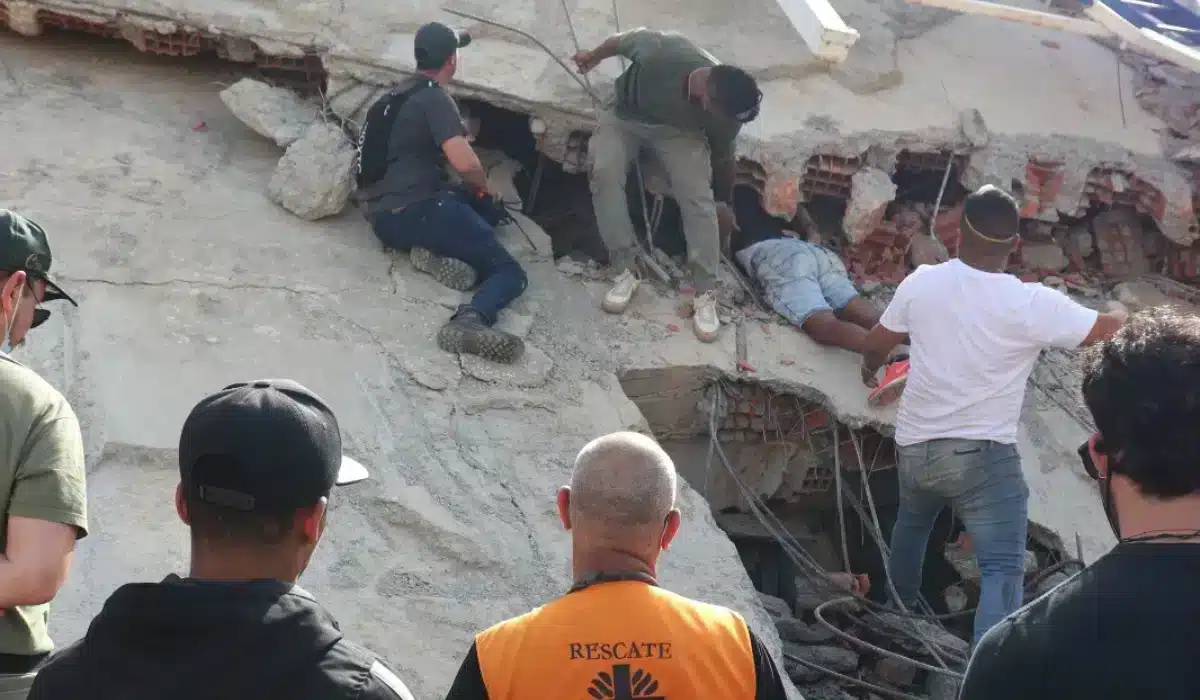
When the twin earthquakes hit northern Venezuela, the ground didn't just shake. It ripped away a decades-long political illusion.
The $M7.2$ and $M7.5$ quakes laid bare a disaster that had been brewing under the surface for over ten years. Look at the Ciudad Hugo Chávez Frías complex in La Guaira. Built as the crowning jewel of the socialist regime’s public housing push, it was meant to show the world what the Bolivarian Revolution could achieve. Today, it's a graveyard of concrete and broken promises.
Out of 192 residential blocks in the complex, 160 are completely destroyed or entirely uninhabitable. The death toll in this development alone makes up a massive chunk of the country's mounting casualties.
This isn't just bad luck. It's what happens when geopolitical favors matter more than structural engineering.
The Oil for Housing Deal That Skimped on Science
You have to go back to 2012 to understand how this trap was set. Hugo Chávez wanted to build fast, and he wanted to show that his international alliances paid off. Enter Turkey and a contractor called Summa, a major player heavily connected to Ankara.
The deal was simple: oil for housing. Turkey got energy; Venezuela got shiny new apartment complexes to house the poor and secure votes. Summa bragged about finishing the 1,488 apartments ahead of schedule.
Now we know why they were so fast.
They built on moving ground. Investigative reports from outlets like Climax show that as early as 2014, formal inspections flagged serious soil instability beneath the complex. The earth was shifting under the foundations before the concrete even fully cured.
Residents complained for years about massive cracks, shifting walls, and severe water leaks. What did the government do? They patched over the cracks, ignored the structural warnings, and kept using the complex for political rallies.
When Loyalty Replaces Regulation
The real tragedy of Venezuela's public housing program, the Gran Misión Vivienda, is how it bypassed every single safety standard in the book.
In a normal country, building a massive residential city in a high-risk seismic zone requires rigorous geotechnical testing. It requires independent inspectors who can shut down a site if the concrete mix is weak or the soil is soft.
That didn't happen here. Transparencia Venezuela has documented years of systemic corruption, hyper-inflated budgets, and zero independent oversight within the housing mission.
The regulatory bodies weren't looking at blueprints; they were looking at political party cards.
💡 You might also like: proesel park family aquatic
When you hand massive construction contracts to foreign firms based entirely on ideological alignment, you lose the ability to hold them accountable. When the ground shook, those shortcut building practices became fatal flaws. The buildings pancaked because they lacked the flexible steel reinforcement necessary to survive a major tectonic shift.
The Aftermath of a Pre-Collapsed State
It's tempting to blame the destruction entirely on the fault lines. But nature only finished what corruption started.
Venezuela was already in a state of chronic administrative collapse before the first tremor hit. Hospitals lacked basic medicine, fire departments didn't have functioning trucks, and inflation made simple recovery tools impossible to source locally.
Look at what's happening right now on the ground:
- The Military Bottleneck: Instead of coordinating smooth rescue operations, the Guardia Nacional has been caught stopping international rescue teams to demand paperwork and slow down supply drops.
- Refusing Help: Surviving residents in Catia La Mar are sleeping on mattresses in the middle of the street. They refuse to go to state-run shelters because they don't trust the government to ever let them out or provide actual housing.
- No Accountability: Summa has stayed completely silent, refusing to answer local journalists asking whether they ever even performed a real seismic study before pouring foundations.
Actionable Steps for Monitoring Global Infrastructure Risks
The collapse of the Hugo Chávez complex offers a brutal lesson for international observers, NGOs, and real estate watchdogs. Ideological infrastructure projects are highly volatile. Here is what you need to look for to spot similar high-risk developments globally.
- Audit the Geopolitical Supply Chain: If a major public work is funded through opaque "barter" agreements (like oil-for-infrastructure) rather than open, competitive international bidding, assume safety corners were cut.
- Cross-Reference Local Investigative Journalism: Long before a building falls, local independent media usually uncovers the defects. Track localized reports of structural shifting, water main breaks, and foundational cracks in state-built projects.
- Verify Sovereign Inspector Autonomy: Check if the building inspectors are independent civil servants or military-appointed political figures. If it's the latter, the building codes aren't worth the paper they're written on.


