Naval shipyards don't usually hand over major warships piece by piece, but that's exactly what just happened in Singapore.
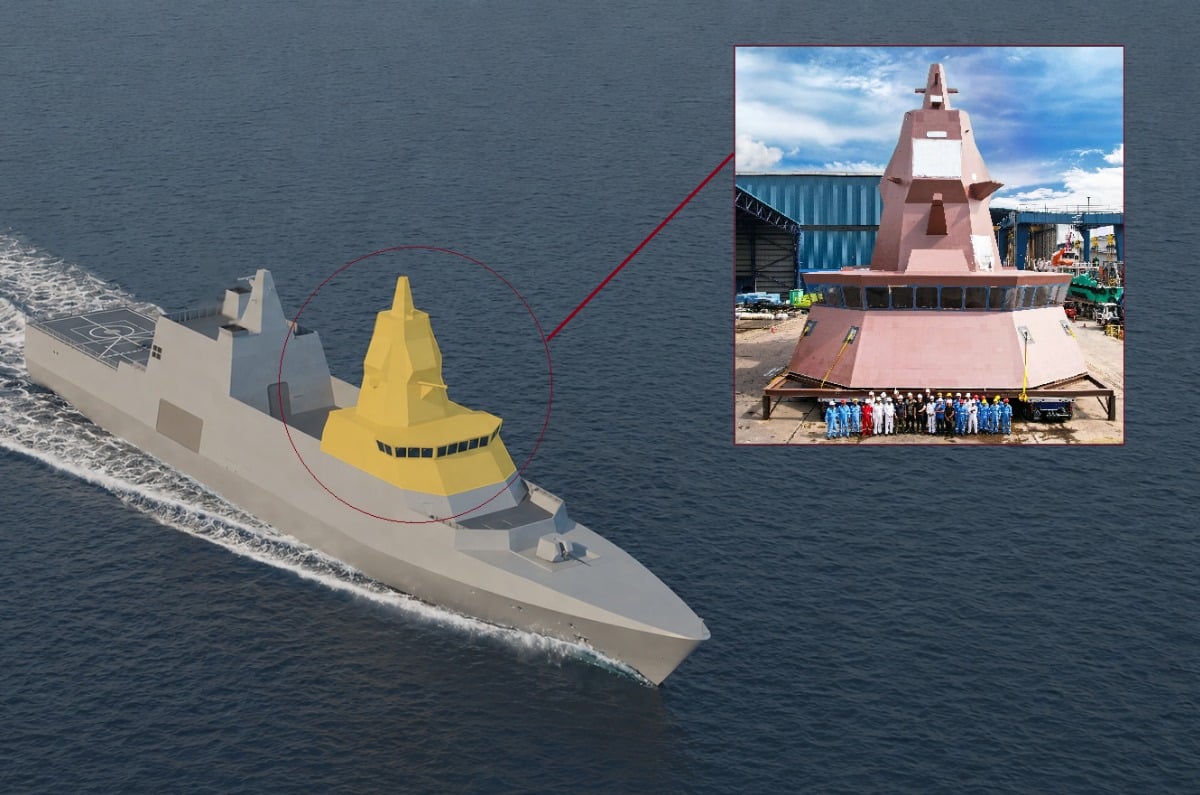
Penguin Shipyard International completed and delivered the first massive composite superstructure for the Republic of Singapore Navy's new Multi-Role Combat Vessel (MRCV). Built using specialized technology from Swedish defense giant Saab, this massive block of high-tech composite materials is the largest ever assembled for a vessel in Singapore, and one of the largest anywhere in Asia.
It's not just a big chunk of plastic and fiber. It represents a fundamental shift in how modern militaries build surface combatants. Traditional steel shipyards are running into structural limits, and Singapore's solution is to swap heavy metal for advanced composites where it matters most.
The Tech Behind the Switch From Steel to Composite
Building a warship hull out of steel makes sense for durability, but stacking tons of heavy steel high above the waterline creates a massive problem: it ruins the ship's stability. Top-heavy ships roll aggressively in rough seas.
By using Saab's unique composite technology, Penguin fabricated a bridge and mast superstructure that weighs a fraction of traditional steel alternatives. The composite sheets were produced by Saab in Sweden and shipped to Singapore, where local shipwrights handled the complex assembly into a single, cohesive macro block.
[Image of hydrogen fuel cell]
Reducing weight at the highest point of the ship gives naval architects incredible flexibility. They can pack more heavy sensors, radars, and vertical launch missile systems onto the upper decks without making the vessel unstable.
Weight reduction isn't even the biggest win here. The real magic lies in what this material does to physics:
- Shrinking the Radar Cross-Section: Smooth, precisely angled composite panels absorb and scatter radar waves far better than welded steel plates. It makes an 8,000-tonne warship look like a small fishing boat on enemy radar screens.
- Killing Rust Forever: Steel rusts when exposed to saltwater. Composites don't. This dramatically cuts down on long-term maintenance and slashes life-cycle costs for the navy.
- Zero Magnetic Signature: Magnetic mines track the massive iron signatures of steel ships. Composite structures don't trigger those sensors, adding an extra layer of stealth and survival.
Why the Multi-Role Combat Vessel is a Drone Mothership
The macro block superstructure won't stay at Penguin's yard for long. It's bound for ST Engineering, where workers will integrate it directly onto the heavy steel hull of the first MRCV, named Victory.
ST Engineering launched Victory at its Benoi Yard in October 2025 and immediately moved it to Gul Yard for outfitting. Construction on the second vessel is already moving fast, with its keel laid in early 2026, while steel cutting for the third and fourth ships began in April 2026.
Singapore isn't building a standard frigate. At 150 meters long and displacing 8,000 tonnes, these MRCVs are explicitly designed to act as "motherships" for an entire fleet of autonomous systems. They feature an operational range of over 7,000 nautical miles—double that of the older Formidable-class frigates—and can stay at sea for more than 21 days straight.
Instead of risking human crews in dangerous waters, a single MRCV can sit back and deploy a synchronized swarm of Unmanned Surface Vehicles (USVs), Unmanned Aerial Vehicles (UAVs), and Autonomous Underwater Vehicles (AUVs). The ship becomes a floating command hub, controlling everything from the air down to the seabed.
The Industrial Leap for Singaporean Shipyards
This project is a massive milestone for Penguin Shipyard International. Historically known for building high-speed commercial aluminum crewboats and ferries, this marks Penguin’s very first naval defense project and its first major foray into composite manufacturing.
Managing Director James Tham noted that the capabilities developed during this project will be integrated across their broader commercial shipbuilding operations. It proves that commercial yards can pivot to high-tech military contracts if they partner with the right international technology providers.
Saab is betting heavily on this local assembly model. Rather than building everything in Sweden and shipping finished, oversized products across the globe, they provide the material science and let local experts build the actual structures. It secures Singapore's domestic defense supply chain while giving Saab a highly capable manufacturing partner in Southeast Asia.
Next Steps for the Regional Fleet
Keep your eyes on the upcoming sea trials for the Victory. ST Engineering is on track to deliver the full fleet of six MRCVs progressively starting in 2028. Watch how the composite superstructure handles the harsh, humid tropical environments of the Malacca and Singapore Straits during initial system integration tests over the next 18 months.