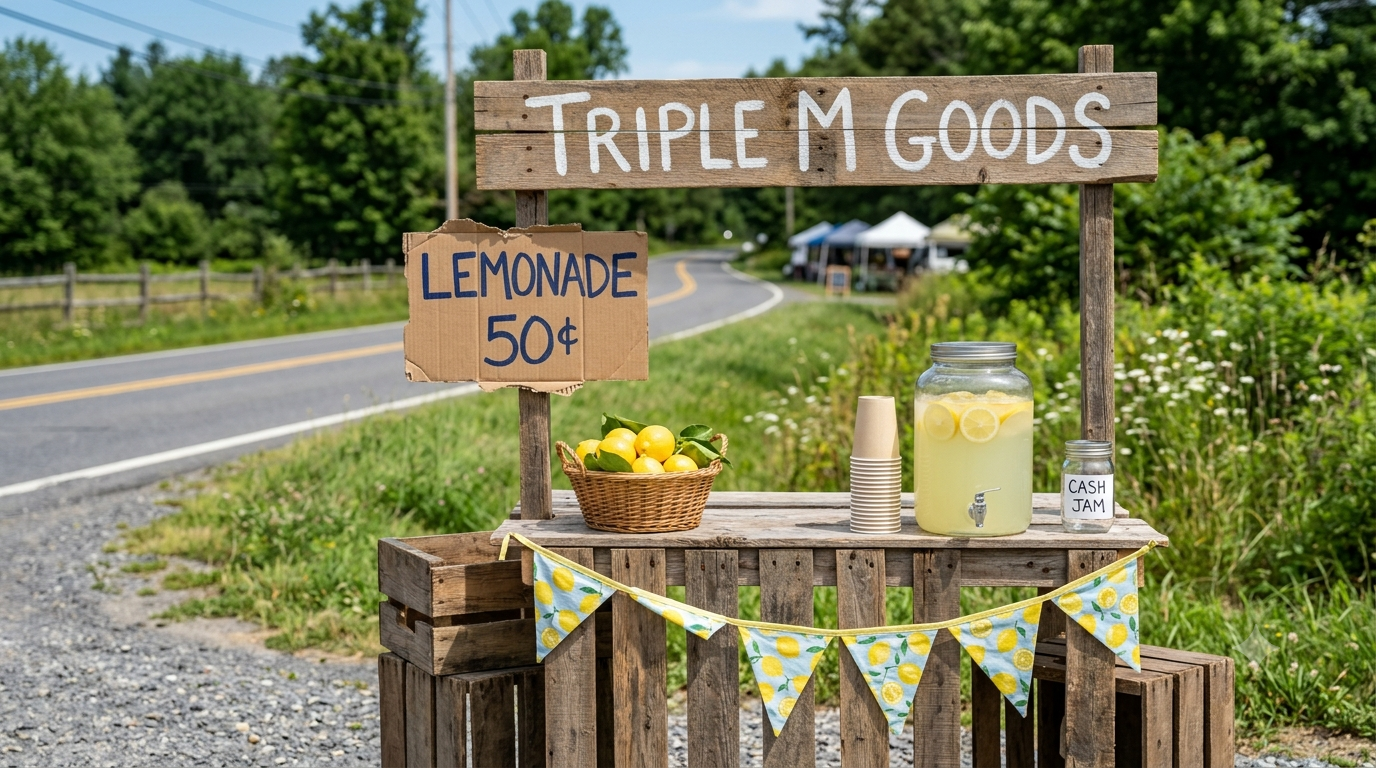
Imagine spending your summer vacation squeezing lemons, mixing sugar, and pouring 50-cent cups of joy for your neighbors, only to have a team of local officials hand you legal paperwork demanding nearly $400 in fees.
It sounds like a bad joke. It isn't.
That's exactly what happened to Ethan, Seth, and Jonathan Mielke in Rogers City, Michigan. The three brothers, ages 13, 11, and 8, ran a small summer business called Triple M Goods. For three years, they set up a table at their local farmers market, selling home-grown produce, hand-painted rocks, and fresh lemonade. Adults paid 50 cents. Kids paid a dime.
Then the rules changed. A new management team took over the market and told the boys they couldn't sell a single drop of lemonade without a permit from the district health department.
When their mother, Jessica Mielke, checked into the legalities, she discovered a bureaucratic nightmare. To legally sell their juice, the boys needed a temporary food license. The cost was $57 every two weeks. Over the course of a single summer season running from June through September, those fees would stack up to nearly $400.
Here is the problem. The brothers only pocketed about $100 to $200 each for the entire summer. The government was demanding more money in paperwork than the business could actually generate.
Instead of throwing their hands up and walking away, these kids decided to fight the system. What started as a local zoning dispute turned into a statewide political movement that resulted in a unanimous vote on the house floor.
The day local regulations came for the neighborhood lemonade stand
We have all seen the classic image of kids sitting behind a cardboard box with a hand-drawn sign. It's a rite of passage. It teaches children the basics of commerce, customer service, and cash flow.
Regulators often fail to see the difference between a multi-million-dollar restaurant chain and a kid selling juice on a Friday afternoon. Local health departments claim they're protecting public safety. They worry about foodborne illnesses, unregulated water sources, and cross-contamination. While those concerns make sense for a commercial kitchen handling raw meat, applying them to a child's beverage table is completely ridiculous.
The Mielke brothers faced a classic bureaucratic wall. The health department didn't have a special, low-cost category for minors. They just had a standard fee structure. Pay the $57 bi-weekly tax or shut down.
For a micro-business, that kind of upfront expense is a death sentence. The boys did the math and realized they'd be working for free just to fund the county health office. They stopped selling the drinks, but they didn't stop thinking about how to fix a broken system.
How three kids successfully lobbied their state government
Change doesn't happen by complaining on social media. It happens when you take the fight directly to the people who write the code.
During the winter offseason, Jessica Mielke suggested her sons take their grievance to their state representative. The boys sat down and wrote formal, handwritten letters explaining exactly how the local fees had priced them out of their summer project.
In January, the family drove to a local coffee hour event in the nearby town of Alpena to meet State Representative Cam Cavitt. They handed him the letters directly.
Cavitt listened. He realized the state's food safety laws were actively punishing young people for trying to work hard. He took the boys' story back to the state capital and introduced House Bill 6007.
The proposed legislation amends the Michigan food law to create a common-sense exemption. Under the new rules, minors can host a temporary, lemonade-style beverage stand on private or public property without paying a single dollar in licensing fees or filling out government permits.
The bill includes a few reasonable guardrails to keep things safe and fair:
- The business must be operated entirely by minors.
- The stand must bring in less than $5,000 in gross annual sales.
- The drinks must be nonalcoholic and require no temperature control for safety.
In June, the Mielke brothers traveled to Lansing to testify before the House Regulatory Reform Committee. They brought a picture of their stand and a tip jar. The testimony worked. On June 25, the Michigan House of Representatives voted 110 to 0 to pass the bill. Republicans and Democrats completely agreed that the state needed to get out of the way of childhood capitalism.
The wider war on childhood entrepreneurship
This isn't just a Michigan problem. Across the United States, young entrepreneurs regularly face fines, shutdowns, and police intervention for running simple stands.
A few years ago, a story went viral when police in Texas shut down a stand run by two young girls who were trying to raise money for a Father's Day gift. In New York, state park police shut down an 11-year-old child for selling water bottles without a commercial vending license.
These high-profile shutdowns forced several states to rethink their approaches. Texas, Georgia, and Utah passed sweeping laws to protect youth-run businesses from overzealous code enforcement officers.
The fundamental issue is that local municipal codes are often written with broad, sweeping language that fails to account for scale. A law meant to stop uninspected food trucks from parking outside a stadium shouldn't apply to an eight-year-old on a sidewalk. When cities enforce these laws without using common sense, they kill the exact type of community engagement and work ethic they should be celebrating.
How to protect your kids from code enforcement overreach
If your children want to start a summer business, you shouldn't let the fear of bureaucratic red tape stop them. You do need to be smart about how you set things up to avoid a surprise visit from a city inspector.
Check your specific state laws first
Do not assume your state automatically protects young entrepreneurs. Before putting out a table, look up your state's stance on youth businesses or cottage food exemptions. If you live in a state like Texas or Utah, your kids are completely protected by law. If you live in a state without explicit protections, you are at the mercy of your local county health board.
Keep the menu simple and shelf-stable
The moment you start selling items that require strict refrigeration, you invite intense regulatory scrutiny. Stick to simple items like classic lemonade, pre-packaged snacks, or whole, un-cut produce from your garden. Avoid dairy, cream-based drinks, or anything containing raw eggs.
Choose your location wisely
Setting up on your own front lawn or private property gives you the strongest legal footing. If your kids want to sell at a public park, a community beach, or a local farmers market, always ask the property owners or event coordinators for permission in writing before setting up the table.
Turn a shutdown into a civic lesson
If a code enforcement officer or market manager tells your children to pack up, don't get into an angry shouting match on the sidewalk. Take the paperwork, ask for the specific ordinance number they're enforcing, and go home. Use that moment to teach your kids how local government operates. Find your state representative or city council member, attend their public office hours, and present a clear, calm case for why the law needs to change.
The Mielke brothers proved that a bad law doesn't have to be permanent. By taking their letters to a local coffee hour, three young boys managed to shift the legal framework of an entire state. The bill now heads to the Michigan Senate, where it is expected to pass with widespread support, ensuring that future generations of kids can sell a cup of juice without funding a government office.