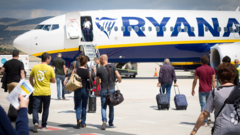
Low-cost flying was supposed to be immune to geopolitical shocks, or at least that's what budget carriers wanted us to believe. But when oil prices spike and consumers start freezing up, even the most aggressive price-cutters take a beating.
Ryanair just reported a 34% drop in quarterly profits after tax, falling to €538 million (£457 million) for the three months ending in June. On paper, carrying 61.3 million passengers sounds like a massive win. That's up 6% year-on-year. Yet, its bottom line shrank.
The main driver? A brutal combination of soaring jet fuel costs linked to conflict in the Middle East and deliberate fare slashes meant to keep seats filled.
If you fly budget, this isn't just corporate financial noise. It directly impacts how much you will pay for your holiday tickets over the coming months.
The Unhedged Fuel Trap
Airlines buy fuel in advance to protect themselves against price volatility, a practice known as hedging. Ryanair is famous for running a conservative hedging strategy, keeping 80% of its fuel requirements locked in at a predictable $67 a barrel.
That remaining 20%, however, was exposed to the spot market.
When fighting escalated in the Middle East and threatened supply through key shipping lanes, crude markets went wild. Unhedged jet fuel surged to $150 per barrel during the quarter. Because of that single unhedged chunk, Ryanair's overall operating costs jumped 11% to €3.42 billion.
That is the vulnerability of modern aviation economics. Even an 80% safety shield isn't enough when unhedged costs more than double overnight.
Discounting Fares to Fight Consumer Hesitancy
Fuel wasn't the only pressure point. Chief Executive Michael O'Leary admitted the airline actively lowered average fares by 6% across the quarter.
Why intentionally drop prices when input costs are skyrocketing?
"The Middle East conflict led to consumer hesitancy, concerns about EU jet-fuel shortages, economic uncertainty and later bookings," O'Leary stated.
People simply held off on planning trips. Rather than let planes fly half-empty, Ryanair chose to sacrifice profit margins to stimulate volume. Total revenue crept up by a meager 1% to €4.38 billion, despite carrying millions more passengers.
It reveals a critical shift in how holidaymakers behave during broader geopolitical tension:
- Close-in bookings: People are waiting until days before departure rather than months in advance.
- Price sensitivity: Travelers respond to price cuts, but revenue per seat declines overall.
- Reduced visibility: Airlines can no longer reliably forecast revenue for the second half of the year.
What This Means for Passengers Right Now
If you are planning to travel soon, don't expect these dirt-cheap ticket sales to last forever. Ryanair's strategy of discounting fares is a temporary patch to keep cash flowing through uncertainty.
Here is what you should expect next:
- Steep fare hikes for late 2026 and 2027: Hedging contracts expire eventually. Ryanair has already locked in 15% of its fuel for the 2028 fiscal year at $85 per barrel—significantly higher than its current $67 baseline. Higher locked-in base costs mean higher baseline fare prices down the road.
- Short-term deal windows: Second-quarter fares are still trending modestly lower year-on-year. If you are looking to travel in the near term, grab close-in deals while airlines are still panicking to fill unsold capacity.
- Pressure on rival carriers: Smaller European airlines without Ryanair’s massive cash reserves or aggressive hedging programs are in far worse shape. Expect frequency cuts or route cancellations across weaker regional competitors as fuel costs chew through their balance sheets.
How to Book Smart in a Volatile Market
Stop waiting six months to book欧洲 short-haul flights thinking prices will drop further. The era of predictable seasonal pricing is on pause while fuel markets recalibrate.
Set price alerts for your preferred routes 3 to 6 weeks before your intended departure date. When you see a discount driven by an airline's late-booking panic, lock it in immediately.